Aphasia
Historical document, translated for reference. It reflects medical knowledge of the 1920s–30s and is not medical advice.
Summary
This article provides a comprehensive overview of aphasia from the 1930s, detailing its definition, evolutionary and developmental theories, and clinical classification. It also explores the historical development of cerebral localization theories, including the contributions of Broca, Wernicke, and Jackson.
Encyclopedia article (1928–1936)
APHASIA (from Greek a - negative particle and phasis - speech), a speech disorder consisting of the loss of the ability to use phrases and words as a means of expressing thoughts. Aphasia must be distinguished from certain speech disorders in the mentally ill, who sometimes do not use the speech apparatus due to the absence of corresponding impulses. An aphasic, however, is unable to convert their speech impulse into speech. Aphasia must, furthermore, be distinguished from anarthria or dysarthria, caused by paralysis of the muscles and nerves of the peripheral speech apparatus. The latter does not suffer in aphasia: patients very often pronounce the words remaining in use correctly; furthermore, the individual muscles participating in the act of speech function correctly during all other acts not related to speech (if not hindered by apraxia, which sometimes accompanies it). Thus, aphasics are able to move their tongue, lick their lips, kiss, chew, swallow, make sounds, whistle, bite, etc. In aphasics, the higher function that usually sets the peripheral speech apparatus in motion to express thoughts is lost. The latter is carried out with the help of special conventional signs in the form of phrases or words, which are symbols of objects, actions, and concepts. So-called expressive movements (Darwin) of animals can be considered as the rudiments of speech-type reactions. Movements and postures assumed by animals under certain conditions (rising mane, baring of teeth, a series of threatening postures), being reactions to a specific situation, simultaneously serve as signals, conditioned stimuli for other creatures living in the "world of the given animal." In these expressive, or signal, movements, sound reactions play a large role (barking, roaring, meowing, neighing, bird song, hissing of snakes, etc.). Having great biological significance for the maintenance of life and the species, they are connected with affective states characteristic of instinctive actions. Attempts to discover articulate sounds in the signals of higher animals, e.g., monkeys, have not yet been crowned with success. The "speech" of a parrot is not speech in the sense of the definition given above. Likewise, child speech at a lower stage of development has the closest relation to vital stimuli. Mimic and vocal reactions to feeding, to changes in external temperature, and to visceral irritations are the same rudiments of speech with an emotional character. Only later does the "intellectualization" of speech occur. At first, everything is designated by words of one's own formation. Only gradually does this more "concrete speech" begin to give way to conventional symbols, the words and phrases of adults. Initially, this speech is simpler, without grammar and inflections, resembling the style of primitive peoples (for example, Negroes or Kaffirs). In pathological cases, we easily recognize phylogenetically and ontogenetically older forms of speech with a predominance of emotivity, with agrammatism, with fragments of syllables, with one's own word formation, etc. From the evolutionary point of view of Jackson, in pathological cases, during the reverse development of speech or during the decay of speech, its ontogenetically and phylogenetically younger functions are lost earlier, as a result of which older functions are revealed, distinguished by greater elementariness and automaticity, but, on the other hand, by more solid organization. In speech, as in any signaling, two elements can be distinguished: one with an effector, motor, centrifugal character (expressive speech), the other with a receptor, sensory, centripetal character (understanding of speech). Both these elements are closely connected with each other. But in pathological cases, they are often disturbed more or less in isolation. When the understanding of speech is disturbed (sensory aphasia, verbal, or, better, speech deafness), the patient, whose hearing apparatus has not suffered and who therefore perceives all sounds and noises, is unable to differentiate individual words or phrases. He perceives them as unfamiliar signals, as a foreign language. Sensory aphasia is therefore a special case of agnosia: acoustic speech agnosia. It is not always sharply expressed. Sometimes patients understand individual words, even simple phrases, but do not grasp long sentences. At the same time, the ability to read is almost always lost—so-called alexia, or optical speech agnosia. The disorder of expressive speech, which can be viewed as apraxia of the speech apparatus, is revealed in two forms: either the patient speaks a lot (logorrhea), "without a brake," but mangles phrases and words, taken as if from a foreign language (paraphasia, jargonaphasia), or, conversely, the patient finds words for expressing thoughts with difficulty, or does not find them at all, reaching almost to verbal muteness (aphemia). More often, however, individual fragments of phrases, words, sometimes individual syllables remain, stereotypically repeated with different intonation (so-called "speech remnants"). Sometimes those fragments of speech that the patient uttered at the moment of the disease remain. Sometimes it is difficult for the patient to set his speech apparatus in motion; he skips words, mangles them, at times stuttering. The latter phenomenon is especially frequent in the stage of speech recovery. Often aphasia is revealed in the form of agrammatism, sometimes in the form of amnestic aphasia. In addition to alexia and agraphia, amusia and acalculia are sometimes observed. In polyglots, the native language is sometimes better preserved. Usually, in aphasia, the emotional part of speech, its so-called musical elements: intonation, rhythm, tempo, suffers the least. With a preserved word or syllable, patients are able to express the whole gamut of feelings, their reaction to a given situation, etc. Sometimes aphasics correctly use words during singing or in a moment of strong affect. Sometimes aphasics represent a confirmation of Ribot's rule: functions acquired later suffer to a greater degree. Clinical forms of aphasia are most naturally divided into sensory and motor. In the former, speech deafness, logorrhea, paraphasia, and jargonaphasia, alexia, and agraphia are sharply expressed. In the latter, the understanding of speech is completely or almost not disturbed, but expressive speech becomes completely or almost completely impossible. Sometimes independent, voluntary speech, the designation of shown objects or their properties (color, size), the repetition of words, automatic speech ("knowledge of series" in the form of the alphabet, counting numbers, memorized phrases, poems, days of the week, etc.) suffer equally. Sometimes, conversely, one of the listed functions suffers more; agraphia and alexia are inconstant. The significant variety of clinical pictures of aphasia and the important questions of topical diagnosis of individual forms of aphasia have given rise to a huge literature, in which it is not easy to sort out without knowledge of the history of aphasia. The doctrine of cerebral localizations is generally connected with the name of Gall (1758–1828). The localization of aphasia, however, is connected with the name of the French anatomist and surgeon Broca, who in 1861 first demonstrated the brain of a patient suffering from "aphemia." In his left hemisphere, there were large changes. True, even before Broca, father and son Dax taught about the significance of the left hemisphere for the act of speech. But their theory was little known, and Broca has the honor of the first clear formulation of the picture of aphasia and its localization in the third frontal gyrus (F3) on the left. Of Broca's contemporaries, Jackson described the clinical picture of aphasia particularly vividly and originally. However, his influence on the development of the doctrine of aphasia begins only from 1914–1915, thanks to the works of Pick and Head, who republished the old works of Jackson. In 1874, Wernicke discovered the significance of lesions in the first temporal gyrus (T1) on the left for the loss of speech understanding. Through the works of Kussmaul, Bastian, and others, two forms of aphasia were distinguished: sensory and motor. However, the further development of the doctrine of aphasia took on a chaotic (Head) character, thanks to an extreme fascination with schemes. Of these, the Lichtheim-Wernicke schemes became especially famous. Both speech centers were connected by lines ("paths") with each other, with centers of reading and writing, with centers of projection, motor, and sensory paths, and, finally, with a "higher intellectual center." According to the geometric figure obtained in this way, different clinical forms of aphasia were constructed, depending on the place of the interruption of the connecting paths or the damage to the centers themselves. Thus arose the doctrine of cortical (lesion of the centers F3 or T1 themselves), transcortical, and subcortical aphasias, which has not fully died out even to this day. In cortical motor aphasia (Broca's aphasia), the understanding of speech is preserved, expressive speech is uniformly difficult in all its manifestations; writing and reading suffer more or less. In cortical sensory aphasia (Wernicke's aphasia), poor understanding of speech, logorrhea, jargonaphasia, and disorder of reading and writing are noted. In subcortical motor aphasia, there is a violation of the paths from Broca's center to the motor centers of the speech musculature in the central gyrus: only oral speech is disturbed, sometimes to the point of "verbal muteness," reading and writing are preserved ("pure" motor aphasia, or aphemia). In subcortical sensory aphasia—an interruption of the paths from the hearing center to Wernicke's center: only the understanding of speech, the repetition of words, and writing from dictation suffer ("pure" sensory aphasia).
Transcortical motor aphasia is an interruption of the pathways from the 'concept center' to Broca's center: spontaneous speech and writing are impaired, while repetition of words, copying, and writing from dictation are preserved. Transcortical sensory aphasia is a lack of understanding of speech, a disorder of reading and writing, and paraphasia, with preserved repetition of words, etc. Conduction aphasia is also distinguished, resulting from an interruption of the pathways between F3 and T1. In this condition, the repetition of words is most impaired. The limited suitability of these schemes for every case of aphasia and the theoretical nature of the construction gave rise to a number of critical works (Freud, Monakow, Goldstein). Monakow objected to any localization of aphasia, viewing it as the result of diaschisis, a functional shutdown of speech due to any cerebral lesion. Pierre Marie (1906) denies the classical motor aphasia of Broca: 'F3 plays no role in aphasia.' There is only one aphasia—due to a lesion of the Wernicke area. Only the absence of internal speech (forme intrinsèque) characterizes aphasia, which is nothing other than a disorder of intellect. Often, a disorder of expressive speech is added to it. But the latter is not aphasia, but anarthria, and is caused by a lesion of the 'lenticular zone,' i.e., the quadrilateral, which is bounded on the outside by the cerebral cortex, on the inside by the internal capsule, and in front and behind by the boundaries of the insula. Consequently, Broca's aphasia = Wernicke's aphasia + anarthria. An exclusive lesion of F3 causes anarthria (forme extrinsèque), close to subcortical motor aphasia, to the so-called 'pure' aphasia. For all its apparent coherence, the 'revision' of Pierre Marie met with strong objections (Dejerine, Liepmann), especially against the position on word deafness in Broca's aphasia and on the characterization of aphasia as a disorder of intellect. Some authors went even further regarding localization. Jendrassik believed that the 'memory images of words' (auditory, visual, kinesthetic) lost in aphasia have their material substrate for each word in a separate nerve cell. Henschen, through painstaking analysis of many hundreds of cases of aphasia that underwent autopsy, confirmed the significance of Broca's center, the writing center in F2, the visual speech center in the gyrus angularis, the auditory one in T1, and finally, the centers for musical and mathematical abilities (see Acalculia). The modern doctrine of myelo- and cytoarchitectonics of the brain speaks in favor of the doctrine
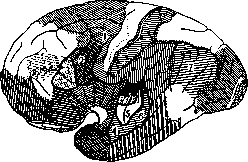
Centers of aphasic disorders: 1-agraphia; 2-Broca's center; 3-vocal amusia; 4-musical hearing; 5-'understanding' of words; 6-'comprehension' of words (5 and 6-Wernicke's center); 7-alexia, agraphia, acalculia (architectonic drawing according to Economo).
on the localization of aphasia. Crude localization by gyri must now give way to localization by cytoarchitectonic fields. Broca's center corresponds to field 44 according to Brodmann and FCBm according to Economo, Wernicke's center to fields 41 and 42 according to Brodmann. Economo, with major reservations, localizes the perception of sounds in general in TC, the understanding of words in TB, the comprehension of words in TA1, and musical hearing in TA2. Vocal amusia is caused by a lesion in FDr according to Economo, while alexia, agraphia, and acalculia are caused by a lesion in the gyrus angularis, corresponding to field 39 according to Brodmann or PG according to Economo. Not possessing material on the function of these areas in the normal state, we can for now view them only as centers of aphasia and only hypothetically as centers of speech. Recently, Head has defended the viewpoint of aphasia as a disorder of a unified act of formulation and use of symbols (symbolic formulation and expression), which cannot be broken down into motor and sensory forms, nor into individual elements in the form of oral speech, writing, or reading. Each case represents a unified reaction of the organism as a whole to an abnormal situation caused by a disease that disrupts the sequence of the flow of complex processes of speech ('symbolic') formulation (see Agrammatism). Proceeding from the most essential signs of the clinical picture, Head proposed his purely descriptive division of aphasic disorders into verbal, syntactic, nominal, and semantic aphasia. Verbal defects, which come closest to the Broca's aphasia of the classics, are caused by a lesion in the lower part of the central gyri and deeper parts. Syntactic aphasia, jargonaphasia: an inability to use one's vocabulary; understanding of speech is slightly impaired, it is difficult to follow a conversation; writing is better preserved; it corresponds to mild forms of sensory aphasia of the classics and is caused by a lesion in the temporal gyrus. Nominal aphasia: ignorance of words, inability to grasp their meaning, to name and point to required objects. Both 'knowledge of series' and understanding of what is read are impaired. Repetition of words is preserved. A card game, which requires greater 'symbolic formulation,' is impaired, but a game of checkers or dominoes is possible. It is caused by a lesion near the gyrus angularis. Semantic aphasia is characterized by the loss of the ability to understand the meaning of words, despite the fact that the patient is able to speak; he gets stuck on trifles; he knows how to count, recognize numbers and coins, but he is unable to perform arithmetic operations or play any games. The lesion is in the gyrus supramarginalis. The question of the classification of aphasia cannot be considered resolved. For practical purposes, the division into motor aphasia (Broca type) with a lesion in F3 and sensory aphasia (Wernicke type) with a lesion in T1 and the adjacent parietal region should be recognized as the simplest. Amnestic aphasia and special forms of agraphia are also practically important. Diagnostic assessment of individual combinations of symptoms is complicated due to the lack of precise methods for investigating aphasia. Head proposes the following methods: 1. Recognition and 'designation' of six common objects (pencil, key, coin, Aphasia
A box of matches, scissors, and a knife). The patient must a) point to the one of them which was casually shown to him beforehand, b) name the object, c) point to it upon an oral command, d) upon a written command, e) upon tactile perception of a duplicate placed in his hands, f) repeat, g) write, h) copy the name of the object. 2. His speech 'behavior' in relation to colors is investigated in approximately the same way. 3. The 'man, cat, and dog' test: images of a man, a cat, and a dog are shown in different combinations of two, and the patient must a) read aloud, b) write from dictation the designation of the pictures, c) write and d) name aloud what is being shown to him, e) repeat, and f) copy the designation of the pictures. 4. The 'clock' test: the patient is shown two clock faces with hands; on one of them, the hands are set to a specific position. The patient must a) set the same time on the other clock face, b) name the time, c) set the hands to any time upon an oral or written command. 5. The patient must place one of 4 coins into one of 4 cups. 6. Touch one or the other eye or ear with one or the other hand, a) by imitating the movements of the investigator, or b) an image in a mirror, or c) a drawing, or d) a mirror reflection of a drawing, e) upon an oral, f) written command, g) write down the movements of the investigator, h) and those which he sees in the mirror. 7. Copy the alphabet, arrange the letters in alphabetical order, the same with the days of the week and the months. 8. Describe the shown picture orally and in writing. 9. Count to 100, write and read numbers, perform arithmetic operations. 10. Draw a simple picture a) from a model, b) from memory. 11. Games of dominoes, checkers, chess, cards, and billiards. With the help of these tests, not only speech, but also, in a broader sense, 'symbolic' behavior is investigated. Therefore, an incorrect reaction can also be explained by agnosia or apraxia. But careful recording of the results allows one to sort them out. In the vast majority of cases in right-handed people, aphasia depends on a disease of the left hemisphere, and in left-handed people (who are generally considered to be 5%)—on a disease of the right hemisphere. In a third group—ambidexters (two-right-handed)—the differentiation of both hands and hemispheres is less pronounced. In any case, even in a right-handed person, the right hemisphere takes a greater part in the act of speech than is usually thought. According to Mingazzini, the speech function in the first years of life is performed by F3 of both hemispheres and only gradually concentrates in the left. Individual characteristics play a large role in this. Only recently have they begun to find some difference in the cytoarchitectonics of the corresponding regions of both halves of the brain. Most often, aphasia is caused by diseases of the vessels supplying the speech centers, namely the 1st, 4th, or 5th branches of the middle cerebral artery or this artery itself, sometimes also the posterior cerebral artery (thrombi, embolisms, ruptures). Sometimes hemorrhage in the short branches of the middle cerebral artery also leads to the destruction of speech centers. Long before the final shutdown of the area supplied by the damaged vessel, changes in the vascular walls sometimes lead to short-lived attacks of aphasia. In cases of hypertension, especially those accompanied by polyglobulia, such precursors to persistent aphasia are not uncommon. An increase in blood viscosity, the number of formed elements, a change in their sedimentation rate, and other physical-chemical properties of the blood can produce similar symptoms. Aphasia is often encountered in nephritis and diabetes. Temporary vascular spasms, 'intermittent claudication', migraine—can be accompanied by attacks of aphasia. Sometimes an epileptic seizure begins with aphasia; often, also, after it ends, aphasic disorders remain for some time. Aphasia in combination with apraxia and agnosia is encountered in so-called Alzheimer's disease. Tumors of the speech centers or in their vicinity can also produce symptoms of aphasia, not only due to the destruction of the speech center but also due to the influence on its blood supply. Aphasia acquires important diagnostic significance in brain abscesses, especially left-sided ones of aural origin, which often develop in the third temporal gyrus. Amnestic aphasia is also not uncommon in such cases. Aphasia can also develop as a result of traumatic or rhinogenic abscesses in the frontal lobes. Skull injuries, hemorrhages into the meninges, and brain wounds cause a picture of aphasia either due to direct damage to the brain or a vessel, or due to an associated encephalitis. Encephalitis developing after infectious diseases, especially after typhus or typhoid fever, after meningitis, when localized in the speech centers, often causes aphasia. Aphasic disorders are also encountered in syphilis of the brain, in particular in progressive paralysis; much more rarely, as an exception—in multiple sclerosis and epidemic encephalitis. The prognosis of aphasia depends on the underlying disease, individual characteristics, the extent of the process, and age. In the case of a developing tumor, a progressive vascular process, or general arteriosclerosis, the prognosis for aphasia is poor, especially in an old person; in a young person, however, the prognosis is far from hopeless. Aphasia after war wounds often had a good course. Understanding of speech is restored best of all, as is the ability to repeat words. Somewhat earlier than spontaneous speech, the ability to name objects usually improves. If speech has been restored in an aphasic, then after a secondary stroke due to a lesion of the right hemisphere, aphasia sometimes develops again, and this time with a poor prognosis. For the prevention of aphasia, perhaps, the 'culture of left-handedness or ambidexterity', which is quite popular among educators in some countries (America, Germany), will acquire significance. Children are taught to use the left hand on an equal footing with the right. In this way, the right hemisphere is involved to a greater degree in the act of speech. The prevention of aphasia of vascular origin coincides with the general prevention of vascular diseases of the brain. The treatment of aphasia primarily coincides with the treatment of the underlying disease. In cases of abscesses and some tumors—radical or palliative trepanation; in cases of syphilis, arteriosclerosis, etc.—appropriate treatment. Persistent aphasia is subject to persistent treatment with systematic, but not tiring, exercises according to the rules of speech therapy (see). By means of imitation, demonstration, and exercises in front of a mirror, the patient is trained to give his speech musculature the positions necessary for pronouncing a letter or a word. It is easiest to start with the letters A, O, M, P, F, V. They quickly move on to syllables, to naming objects, to pictures, to the alphabet, to the first reading book with illustrations. It is useful to simultaneously act on a maximum of receptors, eliciting speech impulses with the help of auditory, visual, and tactile stimuli and linking them with the use, purpose of the object, etc. Exercises in writing with the left hand are very useful if the right is paralyzed. One must start with copying dashes, then letters, etc. Exercises in games are useful. Avoid fatigue, move forward slowly, starting from what is familiar, using speech remnants, constantly encouraging, maintaining interest, confidence, optimism, exercising the will, concentrating attention, strengthening memory. One should not neglect exercises even in severe cases of persistent (non-progressive) aphasia. Both a slight improvement in speech and the exercises themselves alleviate the joyless life of the patient.
Related articles
Mentioned in
Cite this page
“Aphasia.” Soviet Medical Encyclopedia. English translation of Bolshaya Meditsinskaya Entsiklopediya, 1st ed. (Moscow, 1928–1936), ed. N. A. Semashko. https://sovietmedicalencyclopedia.pages.dev/article/aphasia/