Speech
Historical document, translated for reference. It reflects medical knowledge of the 1920s–30s and is not medical advice.
Summary
Speech is described as the highest form of symbolic-expressive functions, acquired through individual life as a cortical-associative function. The article explores the relationship between speech, thinking, and anthropogenesis, examining how speech evolved from expressive movements and became a significant factor in human evolution.
Encyclopedia article (1928–1936)
SPEECH. Vocal speech represents the highest form of symbolic-expressive functions; more elementary manifestations of these expressive functions serve as affective exclamations, facial expressions, and gestures. In contrast to the latter, which have the character of automatic reactions, vocal or verbal speech represents a cortical-associative function, acquired during individual life. Like all other manifestations of nervous system activity, the speech act can be identified with a reflex process, in which the receptor (afferent) function is represented by the process of hearing (understanding) words, and the effector (efferent) function is represented by the process of pronouncing words. In terms of its physiological mechanism, the process of perception of verbal symbols represents one form of gnosis, while the process of pronouncing words represents one form of praxis. The close connection of speech function with the process of thinking, the specificity of this function for humans—all this served as a reason for attributing to speech function an essential role in the process of anthropogenesis. The view of the dependence of thinking on speech function and even of the complete identity of thinking and speech was repeatedly expressed. This idea found its most radical expression in Max Müller's teaching that 'Reason and language are identical.' 'Language represents our Rubicon, and no animal dares to cross it.' Such statements led M. Müller and some other thinkers to the erroneous view that the presence of speech in humans can serve as evidence against the origin of humans from anthropomorphic primates: 'the transition from animal to human is incomprehensible; in humans there is something that could not have been inherited from monkeys.' In contrast to this, the correct view was expressed that verbal speech is a product of the evolution of expressive movements and that its presence in humans not only does not contradict the teaching of evolution but is a confirmation of this teaching: speech represents not only a product of evolution but is itself an essential factor in anthropogenetic evolution. Three moments are usually cited as the most essential factors of anthropogenesis: 1) the vertical position of the body with the complete liberation of the anterior (upper) extremities from supporting the body and their adaptation to work; 2) speech function and 3) the strong development of associative areas of the cerebral cortex. Each of these factors was attributed by various research as more or less essential importance for the process of anthropogenesis. Attempts to attribute to any one of these factors an exclusive role in anthropogenesis and in particular attempts to make the latter dependent exclusively on speech function can hardly be considered correct. The factors of anthropogenesis are very complex and diverse, but the strong development of the cortex in anthropomorphic ancestors of humans, the liberation of hands with their adaptation for fine movements, and speech occupy the main place among these factors. The question of the interrelationship of these factors and the question of the development of speech in the process of anthropogenesis have very important significance for clarifying the entire mechanism of speech function. As has already been indicated above, speech in terms of its genesis can be considered as one of the forms of expressive movements; the most elementary form of the latter are affective exclamations, which are characteristic of very low stages of phylogenetic development. With the development of mobile facial musculature, expressive facial movements appear. The latter have the character of reflexive and accompanying movements and do not bear the traits of conventionality or symbolism. Only secondarily can they take on the character of relative conventionality; thus, facial movements of the mouth muscles for expressing pleasure and displeasure represent nothing more than the voluntary reproduction of those movements that arise reflexively during pleasant and unpleasant taste sensations. Although thanks to such a 'transfer' of facial movements the sphere expressed by these movements somewhat expands, however it still remains very limited compared to other expressive movements. The content of expressive facial movements consists exclusively of the quality and intensity of sensory experiences. Non-sensory manifestations of the psyche, 'expression of thoughts' in the broad sense, are inaccessible to facial expressions. Everything said about facial expressions applies also to expressive body movements (threatening postures, etc.). The next degree of evolution of expressive movements consists of gestures. Although gestural movements, like facial expressions, have a close genetic connection with emotions, however the sphere expressible by means of gestures is much broader: by means of gestures not only emotive experiences can be expressed, but with the perfection of development of gestural speech, as is observed for example in the deaf-mute, gestural movements, 'drawing in the air' certain images, can express corresponding representations. Gestural movements could naturally appear in the human ancestor only after its adoption of the vertical position. This period of 'gestural speech' is interesting not only as one of the specific forms of human movements but also as a factor that determined certain anat.-physiol. features of the later developed vocal speech. As is known, speech belongs to the number of asymmetrical cortical functions: cortical innervation of speech appears to be one-sided, and indeed in all right-handed people, who constitute 95% of people, cortical speech centers are localized in the left hemisphere. The origin of the asymmetry of brain functions in general and of speech function in particular should be explained as follows. In that period when humans adopted a fully vertical position and their hands, freed from supporting the body, began to be adapted for work, there arose a need for predominant use of one hand. In fine movements, which humans began to perform with their hands, it was expedient to perfect one hand and to use the other as a support for the object being worked on. The predominant use of the right hand for fine or requiring great muscular tension movements is explained by the fact that the left hand is connected in the spinal cord with the nerves innervating the left heart; muscular tension of the left hand is reflected to a greater extent in the activity of the heart. The predominant use of the right hand served as the beginning of functional asymmetry of the brain, as it led to greater development of the left hemisphere of the brain compared to the right. In this same period, parallel with the development of human intellect, the 'spirit of community' began to develop rapidly. The need for communication of humans with those around them and the necessity of developing methods for this communication increasingly grew. The first of these methods were gestural movements, which together with affective exclamations could have been the only means of communication of people in this period. Since by this period right-handedness had already been developed, humans in gestural movements used predominantly the right hand. Thus the left hemisphere of the brain became the area regulating expressive movements in the form of gestures and the accompanying affective exclamations. As the spiritual world of humans expanded and enriched, exclamations and gestures proved insufficient for expressing his representations, and when humans began to use conditional sound symbols for expressing his thoughts, the innervation corresponding to the production of these sounds was localized in the left hemisphere, already prepared for this by the previous stage of evolution of expressive movements. The use of the right hand for drawing and writing further contributed to the connection of speech function with the left hemisphere of the brain. As for the process of development of verbal-symbolic speech, both anthropologists and linguists consider onomatopoeia to be its beginning: to express the representation of a known object, a sound characteristic of this object is reproduced. Such onomatopoeic word formation is undoubtedly a very important source of vocal speech. Due to the transformations that words underwent over thousands of years, due to the conditional symbolic transfer of them from one object to another, the primary source of onomatopoeic origin of words in many cases can be discovered only with great difficulty. If it is not difficult to discover the onomatopoeic origin of such words as 'noise,' 'thunder,' 'whistle,' 'groan,' etc., then at first glance it may seem strange the assertion that words such as 'cockade' or 'coquetry' have onomatopoeic origin. Meanwhile, according to the statement of lexicologists, both these words have a connection with the French word 'coq'—rooster; this word is produced onomatopoeically from the cry of the rooster (in French pronunciation 'coquerie'). Further, this root 'coq' (coq) was transferred to the variegated decoration of the headgear ('cockade') and to the desire to decorate oneself variegatedly ('coquetry').
However, in modern speech, along with secondary sound symbols that have a greater or lesser connection with onomatopoeia, there is undoubtedly a very large number of primary symbols, i.e., such sound signs that are entirely conventional, artificially connected with certain representations, and have no connection with the corresponding images of these representations. Thus, the successive evolution of speech in the path of anthropogenesis can be characterized by the following stages: 1) affective exclamations and gestures, 2) onomatopoeic word formation, and 3) primary symbols. The analysis of speech development in the path of ontogenetic development is of particular importance for mastering the mechanism of the speech function. The human individual is born with elementary affective exclamations in the form of crying. Infant crying is attributed to certain significance for the subsequent development of speech: during crying, the child makes short inhalations and long exhalations, i.e., becomes accustomed to the disruptions of respiratory rhythm that are necessary for the speech act. In the next period of infancy, when in a cheerful mood, the child, along with other motor acts, occasionally tries to activate its vocal musculature. These sounds cannot, of course, be fully classified as expressive movements; they rather belong to the category of reflexive or accompanying movements. The character of expressive movements can be attributed to them only in the sense that they are an expression of satisfaction, as opposed to crying, which is an expression of a negative sensory tone. According to the nature of the sounds produced by the child, this so-called babbling consists of the vowels a and e, and among the consonants, labial b, p, m, labio-dental v, f, and front alveolar d, l, t predominate; the sound r in babbling is represented in the form of a guttural (rolling) r. The predominance of these sounds is explained by the fact that vowels a and e are the easiest to pronounce, requiring only the opening of the mouth and vibration of the vocal cords without special changes and contractions of the musculature. As for the consonants, the consonants pronounced in babbling (labial, linguo-dental, and front alveolar) require for their execution the action of muscles that appear to be fully formed in the infant, since precisely these muscles participate in the act of sucking during breastfeeding. Forming syllables from these sounds, the child repeats these syllables during babbling; thus, the most typical sounds of babbling turn out to be: 'pa-pa-pa', 'ma-ma-ma', 'ba-ba-ba', 'te-te-te', etc. This repetitiveness is explained by the fact that it represents the simplest and easiest form of innervation of the vocal musculature and does not require for its execution the coordinatory sounds that are necessary for pronouncing sounds consisting of different vowels and consonants. The aforementioned predominance of certain sounds in infant babbling is the reason why in all peoples the designations for the closest surroundings of the infant are denoted by words mama, papa, baba, deda, tetya, etc. The surroundings of the infant use the existing ability of sounds in babbling and artificially make words from them, connecting them with representations of the child's closest surroundings. The phenomena observed in infant babbling are not without certain significance for pathology. Thus, the repetition of syllables in babbling is related to the development of stuttering, and the insufficient transformation of the babbling (guttural) r into an alveolar r is the basis for a rolling r. Thus, by artificially connecting certain images with the sounds pronounced in babbling, the child's first words are formed. Thus, representing essentially reflexive, automatic phenomena, the sounds of babbling are transformed into the first conditional-symbolic signs. Thus, constantly hearing the word 'mama' when seeing the mother, the child connects this auditory impression with other impressions originating from the sight of the mother, her embraces, feeding, etc.; thus, a connection is established between a certain auditory impression and the corresponding image according to the general law of conditioned reflexes or consolidated associative connections. Upon establishing this connection, when the image of the mother arises in the child's representation under the influence of some external stimulus, the child activates its motor vocal apparatus according to the principle of consolidated associative connection, producing the sound corresponding to this image. Thus, the beginning of the sensory function of speech (the process of understanding sound signs) is laid, and simultaneously with this, the rudiments of the motor (spontaneous, voluntary) speech arise. Later, the child 'learns' speech. In the sensory sphere, this learning is based on establishing a connection between audible sound impressions and their corresponding images according to the general principle: 'the more often a known object is presented together with its corresponding sign, the more firmly they are connected' (mechanisms of conditioned reflex formation). In mastering the motor speech function, imitation plays a very essential role: the child strives to repeat audible words; this striving for imitation, based on a process analogous to a reflex act (motor reaction to auditory stimulation), is of great importance as a factor for exercising the speech musculature and as a factor for consolidating the connection between the auditory and motor innervations corresponding to the sound symbols of words. It should be noted that in the process of speech development in children, there is a tendency toward onomatopoeic word formation (cow-'mumu', dog-'au-au', etc.). At the same time, the invention of primary symbols is also often observed, i.e., the arbitrary designation of various objects with words invented by the child himself. Thus, ontogenetic speech development as it were repeats the stages of phylogenetic evolution: affective exclamations, onomatopoeic word formation, and the invention of primary word symbols. But the main role in the process of the child learning speech is, of course, the mastery of word symbols from the surroundings. The anatomophysiological basis for mastering and forming the speech function consists of the following moments. The process of learning speech begins with hearing words as sounds that have no meaning as symbols of certain representations. The cortical area for perceiving these sounds is the superior temporal gyri. As this word-sound impression is connected with other impressions originating from the corresponding object, a connection is established between different areas of the cortex and the auditory area. In view of the aforementioned fact of asymmetry of cortical innervation of Speech in the sense of predominance of the left hemisphere, the connection of the auditory area with other parts of the cortex occurs through the left superior temporal gyrus. The posterior part of the left superior temporal gyrus is the area through which the connection between the auditory sphere and other parts of the cortex is established: this connection is necessary so that when a word sound is heard, the word is understood, i.e., the traces of impressions that acted in the past experience of the individual simultaneously with hearing this word sound are activated. This area—the posterior part of the left superior temporal gyrus—is designated by the term 'auditory center' of Speech or 'Wernicke's center', also 'sensory speech area' (see figure 4). The preservation of this area is necessary for the process of understanding words. Damage to this area leads to the phenomena of so-called sensory aphasia, or Wernicke's aphasia, the essence of which consists in the loss of the ability to understand Speech while the perception of words as sounds is preserved. Since the sensory center is formed first in the process of speech development, it forever remains dominant over other speech functions. Therefore, when this center is damaged, i.e., in sensory aphasia, there are always more or less severe disorders of other speech functions (motor function of Speech, writing, reading). The important role of the sensory speech area for the entire speech process is manifested, among other things, in the syndrome of so-called 'temporal speech akinesia', consisting in the loss of the motor function of Speech when the posterior parts of the superior temporal gyrus are damaged at its border with the occipital lobe.
Parallel to the formation of the auditory center of speech, the cortical-associative center of the motor speech function also forms. The cortical area of elementary movements of the speech musculature is the lower part of the anterior central gyrus. The connection of this area with the rest of the cerebral cortex is carried out through the frontal associative area, specifically through the posterior part of the third frontal gyrus (see figure, 5). The preservation of this area, designated by the term 'motor speech center' or 'Broca's area', is necessary for the pronunciation of words as symbols, i.e., for the execution of those vocal movements that as sound symbols correspond to a certain image or representation. When Broca's area is affected due to the disconnection that occurs at this time between the lower part of the anterior central gyrus and other areas of the cortex, the subject, while retaining the ability to pronounce elementary vocal sounds, is unable to pronounce words. Such a disorder of speech—the inability to pronounce words while preserving the elementary movements of the speech musculature—is called 'Broca's aphasia' or 'motor aphasia'.
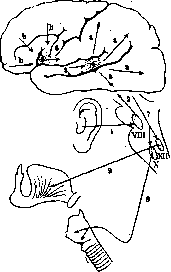
The associative apparatus of Speech represents the highest regulatory mechanism of the speech function. The initiative for speech expressive movements arises in various parts of the cerebral cortex under the influence of external irritations. The corresponding impulse through Broca's area spreads to the lower parts of both anterior central gyri. From here begins the second part of the speech 'paths' or conductors of speech motor innervation; this part can be designated as the projection or cortico-bulbar pathway; its initial stage consists of the cells of the cortex of the lower parts of the anterior central gyri and its terminal stage is the nuclei of the medulla oblongata (nuclei of V, VII, X, XI nerves). With lesions of this pathway (tr. cortico-bulbaris), the associative function of Speech is not impaired; the process of evocation of word symbols, i.e., the process of the emergence of word images under the influence of corresponding irritations, remains intact; what is impaired is the innervation of contractions of speech muscles in the form of their central paralysis or paresis (see Pseudobulbar paralysis). Finally, the third, last part of the speech pathways are the peripheral conductors of speech musculature, i.e., the V, VII, X and XII pairs of cranial nerves from their nuclei to their terminations in the corresponding muscles. Lesion of this third part of the speech pathways leads to a flaccid peripheral paralysis of the speech musculature, or so-called bulbar paralysis (see). In contrast to aphasias, which represent non-paralytic associative disorders, disorders of Speech depending on central or peripheral paralysis of speech musculature are designated by the term dysarthrias or -articulatory disorders of Speech. The essence of these disorders consists in the incorrectness or impossibility of the realization of the word sound as a complex of simpler sound elements, consisting of syllables, which in turn are articulated from vowel and consonant elements (letters). The extreme degree of dysarthric disorders is represented by inarticulate Speech, consisting in the complete loss of the ability to realize letter sounds and articulate them into syllables and words. An example of this is anarthria (see), in which patients emit only moaning sounds in which it is impossible to distinguish not only words, but also syllables or letters. The area of dysarthric or articulatory disorders of Speech is extremely extensive and diverse. It includes defects in the pronunciation of individual letter sounds, their combinations in syllables and words. In general, it can be recognized that articulatory disorders more often affect consonants. This fact is explained by the fact that vowels, which are tones produced by vibrations of the vocal cords, require less complex innervation than consonants, for the production of which more complex coordinating innervations, strictly calculated forms of constrictions in various parts of the epiglottic tube are required (consonants are noises produced by friction of air in constricted spaces of the pharyngeal, nasopharyngeal and oral areas - the so-called 'articulatory constrictions'). In their nature, articulatory disorders can be subdivided into organic and functional. It goes without saying that the classification of these disorders into the functional group appears artificial and conditional, since in most cases of this kind, the denial of structural deviations from the norm, i.e., the denial of the presence of organic changes, is conditioned only by the impossibility of detecting them by modern research methods. To the area of organic disorders, in addition to the already mentioned bulbar and pseudobulbar Speech disorders, belong Speech disorders in cerebellar lesions; the ataxia developing in this case also affects speech movements; the 'atactic' Speech in cerebellar diseases is characterized by the following features: slowness, trembling of the voice, scanning, i.e., the distinct articulation of individual syllables, a nasal timbre to the voice due to hypotonia of the soft palate musculature, incorrect modulation of the voice; explosiveness, i.e., periodic sudden intensifications of sound as a result of dysmetria. Especially marked degrees of slowing of Speech - bradylalia or bradyarthria - are observed in states of parkinsonism as a manifestation in the speech musculature of general stiffness and slowness of movements. From other organic diseases, bradylalia is usually observed not in very marked forms in athetosis, chorea, brain tumors, meningitis; in states of general weakness, bradylalia is also often present. The terms bradylalia and bradyarthria are used by some as symptoms of bradylalia and bradyarthria. Others apply the terms bradylalia and bradyarthria to such cases of slowness of Speech, which do not depend on a disorder of innervation of speech musculature, but on the state of the psyche, i.e., to cases where the slowness of Speech depends on a depressed mood or difficulty in thinking processes. - A typical disorder of articulation is observed in paralytic dementia (progressive paralysis); this disorder is designated by the term paralytic Speech and is characterized by a trembling timbre of the voice, omission of letters and syllables, as well as stumbling on syllables, i.e., difficulty in transition from one syllable to another, which is expressed in indistinctness, 'smudging' of a certain sound; earlier and most markedly stumbling is observed in the pronunciation of the sound r. In far-advanced forms of progressive paralysis, a complete loss of Speech develops - the so-called 'alalia', in the development of which both paretic weakness of the articulatory musculature and the absence of speech initiative due to the profound disintegration of intellect play a role. To this can be added disorders of an aphasic character. Sometimes in deep stages of progressive paralysis, the symptom of 'monophasia' is observed - the restriction of Speech to a single word or one phrase. In addition to the organic dysarthrias mentioned above, there exists a whole series of defects of articulation, classified as functional. As already indicated above, most of these disorders are in reality organic and are classified as functional only because the underlying structural changes have not yet been precisely established. For the designation of these forms of articulatory disorders, various terms have been proposed, used as synonyms. The most common general term for various articulatory disorders is the term 'dysarthria'. A large group of functional dysarthrias, characterized by the inability to correctly pronounce certain speech sounds, in the absence of clear signs of organic disease, can be subdivided into two main forms: syllabic dysarthria (dysarthria syllabaris), a typical representative of which is stuttering (see), and letter dysarthria, concerning individual elementary sounds (letters) - so-called letter dysarthria (dysarthria litteralis). As synonyms for the latter term, the following designations are also used: 'dyslalia', 'amelia of letter coordination', or 'amelarthria', 'habitual dysarthrogenesis', 'lallation', 'idiotoglossia'. Regarding the pathogenesis of these disorders, the most significant role is attributed to the underdevelopment of the speech apparatus (speech infantilism); this assumption is all the more probable that certain forms of these disorders are observed as physiological phenomena in childhood; insufficient attention from those around who do not correct these defects, as well as from the patients themselves, can contribute to the fixation of such physiological defects. A certain role must also be attributed to neuropathic organization. Sometimes the speech defects in question are inherited (by imitation). Cases of combination of various forms of idiotoglossia with other functional defects (left-handedness, hidden or obvious) are not uncommon. From the large number of forms of idiotoglossia, we note the main ones. The most marked form of idiotoglossia is Hottentotism (see), in which patients use only one consonant. In contrast to the rarity of this form, dyslalias concerning a single letter are very frequent. For the designation of corresponding disorders of Speech, Greek names are used for those letters whose pronunciation appears incorrect or completely impossible. Such are the terms lambdacism - incorrect pronunciation or complete inability to pronounce the letter l; sigmatism - the same with respect to the letter s; gammacism - of the letter z; mytacism - of the letter m; under the term rotacism is meant lisping, i.e., the inability to pronounce the correct (linguo-palatal) r and its replacement by a guttural r; it should be noted that lisping in some dialects is physiological. By pararthrias or paralogias are meant such articulatory disorders in which patients replace a sound inaccessible to their pronunciation with another, quite definite sound. In the group of paralogias, the following varieties are distinguished: paragammacism (instead of g and k); paralamdacism (instead of l-zh, t, r, e, v); pararotacism (instead of r-l), observed very frequently in children; parapsittacism (instead of s-f).
Under barigl or bariphrazia is meant unclear, 'clumsy' speech, characterized by slowness and insufficient clarity of pronunciation. Treatment of articulation disorders consists of systematic exercises. The area of dislalies also includes nasal speech (rhinolalia). As is known, when pronouncing all vowels and consonants except m, the posterior nasal openings must be closed. Violation of this function of regulating communication between the vocal tube and the nasal cavity leads to disorders of pronunciation of vocal sounds, which manifest in two forms. Open rhinolalia (rhinolalia aperta), caused by the inability to close the nasal openings due to paralysis of the palatal curtain, manifests in that all sounds acquire a nasal tone—'nasalness'. The most severe forms of this disorder are observed in paralysis of the palatal curtain (diphtheritic paralysis; bulbar paralysis); this disorder manifests with particular clarity when attempting to pronounce the labial sounds b and p, which turn out to be completely impossible for patients and are replaced by the sound m: the sounds b, p, m are identical in terms of articulation, and the difference in their pronunciation consists only in the fact that b and p are pronounced with closed choanae, while m with open ones; when it is impossible to close the choanae, an attempt to pronounce the sound b or p leads to the formation of the sound m. Sometimes such patients are able to pronounce b and p while in a horizontal position if they throw their head back, because in this case the choanae are passively closed by the hanging palatal curtain. Under closed rhinolalia (rhinolalia clausa) is meant the state opposite to the one just described: due to the closure of the choanae by inflamed swollen mucous membrane or other processes, the penetration of air from the vocal tube into the nasal cavity becomes impossible, and patients lose the ability to pronounce nasal sounds; when attempting to pronounce m, they get the sound b or p. In the act of word production, an essential role belongs to phonation, i.e., the formation of vocal sounds. Disorders of this function, denoted by the term dysphonia, can be observed independently of the function of articulation. Complete loss of voice, known under the name aphonia, is observed besides paralyses of the recurrent nerve (bulbar paralysis, postdiphtheritic paralysis) as a manifestation of hysteria. Dysphonias, i.e., partial violations of vocal production, can manifest in various forms and have different origins. Here primarily belong the so-called 'mutational' disorders, depending on deficiencies in physiological transformations of the voice; an example of this can be the falsetto voice in men due to delay of the high voice, which is subject to transformation into a low one during the period of sexual maturation. An abnormal timbre of voice for a given sex can also depend on endocrine disorders (high voice in men, low in women with hypogenitalism). Among various causes of loss and difficulties of speech, a certain role belongs to functional weakness of the voice, denoted by the terms mogiphonia or phonasthenia. The essence of the disorder consists in rapid fatigue of the voice, expressed in weakening of its intensity, pains in the area of the speech apparatus, feeling of fear, palpitations. This disorder represents one of the varieties of professional neurosis and is observed in representatives of professions requiring voice strain; accordingly, the following forms of phonasthenia are distinguished: resoastenia of orators, lecturers, klezeastenia—command phonasthenia, and diaodia—singer's phonasthenia. Usually in phonasthenia it is only a matter of weakening of the voice; for extreme degrees of it in the form of complete loss of voice, the term phonocollapse was proposed. Phonatory and articulatory anomalies can also be a manifestation of tic. Speech tic is most often expressed in the pronunciation between words or syllables of any sounds in the form of individual vowels or syllables. A more severe form is represented by the so-called exclamatory tic—an obsessive urge to shout out individual words, entire phrases or sounds that reproduce cries of various animals. To the area of tic can also be angophrazia (see) and embolalia or embolophrazia—the insertion at the end or beginning of phrases of various words or certain sounds. In some people, the habit of excessive use of words 'that is', 'you see', 'so to speak' etc. takes on the character of embolalia. One of the features of normal phrase construction is a certain accentuation of individual words, the so-called intonation, on which depends the expressiveness, and sometimes the meaning of the pronounced phrase. Among disorders of intonation should be mentioned the monotonous speech, observed in parkinsonism, disseminated sclerosis. Besides the above-mentioned disorders of speech in the form of violations of the structure of word sounds, should be mentioned disorders of speech in regard to the content of speech utterances. Quantitative changes of speech in the sense of decrease of speech manifestations can reach various degrees. The phenomenon of monophasia, mentioned above as one of the manifestations of paralytic speech, can also be observed in other diseases; among other things, in motor aphasia patients sometimes retain the ability to pronounce one particular phrase or one word. Monophasia can also be a manifestation of speech stereotypy in schizophrenia. Among the disorders characterized by limitation of speech manifestations belongs also oligophasia—reduction of speech initiative. Oligophasia is observed in some organic diseases of the brain (motor aphasia in the stage of recovery, parkinsonism), as well as as a consequence of psychic anomalies (depressive state, weakening of intellect). Complete cessation of speech of psychogenic origin, mutism (see), is most often a symptom of hysteria; mutism can also be caused by delusional ideas (depressive states, paraphrenia). Increase of speech initiative, speech excitement is observed in manic states; rapid abundant speech of manic patients is denoted by the term logorrhea. Extreme degrees of acceleration and increase of speech manifestations, accompanied by rapid change of the content of speech ('flight of ideas'), are denoted by the term 'confused speech' (tumultus sermonis); a severe degree of speech confusion, taking the form of an incoherent jumble of words, is denoted by the term 'word salad'. Anomalies of speech in regard to its content are denoted by the term dyslogia (incorrect judgment); one of its varieties is paralogia—the appearance in speech of words or phrases that have no relation to the meaning of what is being said; however the terms paralogia and dyslogia are also used as synonyms. The degree of perfection of speech ability is, as is known, subject to significant fluctuations and within physiological limits; speech or linguistic giftedness is determined by the following signs: perfection of phrasing (the process of transforming ideas into word symbols), speed of assimilation of speech symbols, correctness of articulation and phonation, imagery of speech, i.e., perfection of selection and combination of word symbols for expressed thoughts. Development of these features of speech giftedness does not always go in parallel: good phrasing can be combined with defects of articulation and vice versa. To the number of linguistically gifted can be partly included polyglots—subjects possessing a large number of languages; polyglots can be deprived of other features of speech giftedness, for example not possessing highly developed diction or imagery of speech. The anat.-physiol. basis of speech giftedness constitutes the functional plasticity of the cerebral cortex, ease and speed of establishment of associative connections and ease of flow of the associative process, sufficient development of the apparatus of coordination of movements. All these properties can be to a certain extent cultivated by exercise. Culture of speech from the neurological point of view should consist in establishing and spreading data on the ways of occurrence of speech defects and methods of their elimination. In general it should be borne in mind that defects of speech arise in the period of its development, i.e., in childhood; having become fixed, they can later be eliminated only with great difficulty; therefore elimination of speech defects should occur in childhood, before these defects have become fixed. In upbringing of correct speech and elimination of speech defects should be borne in mind not only the elementary mechanisms of speech function but also that role which belongs in the process of speech to psychic moments, especially to the influence on the speech process of emotional factors. As one of the questions of speech culture should be mentioned the development of bilateral cortical speech centers. As was indicated above, the formation of speech centers depends on the function of the hand: normal localization of speech centers in the left hemisphere is connected with right-handedness. Symmetrical departments of the cortex of the right hemisphere appear however also as potentially speech centers; in them speech functions can be developed on condition of functional predominance of the left hand.
In connection with this, the view was expressed that it would be expedient to create speech centers in both hemispheres through the uniform exercise of both hands (so-called ambidexterity, i.e., 'bilateral right-handedness'). The possibility of artificially creating functional symmetry of speech centers cannot be doubted, but as for its expediency, there are certain disagreements in this regard. In general, it should be recognized that the expediency of this proposal has not been proven; there is even a view not without foundation about the harm of developing 'bilateral right-handedness' due to its inconsistency with the innate predisposition of the cerebral cortex to certain functions.
Related articles
Mentioned in
Cite this page
“Speech.” Soviet Medical Encyclopedia. English translation of Bolshaya Meditsinskaya Entsiklopediya, 1st ed. (Moscow, 1928–1936), ed. N. A. Semashko. https://sovietmedicalencyclopedia.pages.dev/article/speech/