Monkeys
Historical document, translated for reference. It reflects medical knowledge of the 1920s–30s and is not medical advice.
Summary
This article provides a comprehensive overview of monkeys, their classification, anatomy, diseases, and their use in medical research. It also details the Sukhumi Monkey Nursery, a Soviet research facility established in 1927 for acclimatizing and breeding monkeys for scientific purposes.
Encyclopedia article (1928–1936)
MONKEYS and humans belong to the order of primates (Primates), class of mammals, subphylum of vertebrates, and phylum of chordates. At present, prosimians (former order Prosimii) are also included among the primates as suborders Lemuroidea (for example Lemur macaco) and Tarsioidea (for example Tarsius tarsius). All other M. and humans belong to the suborder of anthropoids (Anthropoidea). Prosimians live mainly in the tropics; they generally resemble true monkeys; the* thumb is opposable to the others. The second toe is "provided with a claw, the other toes have flat nails. Usually all limbs of M. are prehensile, as the big toe is opposable to the others, which gives the foot a rough resemblance to the hand; Linnaeus therefore refers monkeys to four-handed animals. The dental system is complete: molars with blunt tubercles; canines are weakly or moderately developed. The body is covered with hair. There are two mammary glands; they are located on the chest. The tail is disc-shaped. Anthropoidea are divided into superfamilies: a) Platyrrhina - flat-nosed - with a wide nasal septum and nostrils looking to the sides; flexura sigmoidea is absent; the tail is long (at least 14 vertebrae), prehensile. Inhabitants of South America; examples: Hapale - marmosets, Cebus - capuchin and others. b) Catarrhina - narrow-nosed; nostrils look forward or downward; the tail, if present, is not grasping. Family Cercopithecidae. True monkeys of the Old World (Africa, tropical Asia, one species in southern Spain) have 12-13 thoracic vertebrae, 6-7 lumbar and 3 sacral. The forelimbs are not longer than the hind limbs. Teeth change early and quickly. Some representatives of this family have cheek pouches and ischial callosities. Genera: Cercopithecus - guenons; Papio (Cynocephalus) - baboons; Mandrillus - mandrill; Macacus - macaques. Family Hylobatidae - gibbons with species Hylobates agilis, H. leuciscus and others (India). The gibbon belongs to the anthropoid M., the other three genera of which belong to the family Anthropomorphea: Gorilla gorilla (tropical Africa); Anthropopithecus troglodytes - chimpanzee (equatorial Africa); Simia (Pithecus) satyrus - orangutan (Borneo, Sumatra). Anthropoid M. in their organization stand closer to humans than to other M., lack cheek pouches and tail; ischial callosities are absent in all except the gibbon; arms are generally long; in the gibbon they are much longer than legs. The cranial box is capacious; the cerebral hemispheres are well developed. As laboratory animals, M. of the family Cercopithecidae - guenons (Macacus cynomolgus, Macacus sinicus, Cercopithecus fuliginosus and others) are kept mainly. In nature they are inhabitants of trees. Their pregnancy lasts on average 7 months; usually they give birth to one offspring, which becomes adult after 4-5 years. They are herbivorous. In captivity they get sick easily. In monkeys there occur: tuberculosis, inflammation of the cecum, rickets, ostitis fibrosa, dysentery, various intestinal diseases and others. After ether anesthesia, pneumonia often develops with a fatal outcome. Among ectoparasites, lice and fleas are encountered. Among parasitic worms in monkeys there are: nematodes - Oesophagostomum Brumpti, Necator americanus, Trichocephalus trichiurus, Strongyloides stercoralis, Enterobius vermicularis, Watsonius Watsoni, Microfilaria loa papionis, Microfilaria perstans; cestodes - echinococcus, tapeworms Taenia solium, plerocercoid Diphyllobothrium Mansoni, Bertiella polyorchis, Dilepis trichocephalus and others. From Linguatulidae, Porocephalus armillatus parasitizes in monkeys. Among the simplest organisms in M. there are: amoebas - Endolimax kueneni, Endolimax cynomolgi ( = E. papua?), Entamoeba pitheci, similar to E. coli, Entamoeba Nuttalli, similar to Entamoeba histolytica; trypanosomes - Trypanosoma vickersae, Trypanosoma gambiense, trypanosomes of the Lewisi type - Tr. cruzi, Chilomastix, Embadomonas Wenyoni (possibly identical to E. intestinalis of humans), Trichomonas, Giardia; blood sporozoans - Plasmodium Reichenowi, PI. inui, PI. Kochi, PI. pitheci, Piroplasma pitheci, Toxoplasma, Grahamella rhesi; infusoria Balantidium coli; blood spirochetes - Spirochaeta macaci, Sp. pitheci (similar to the relapsing fever spirochete of humans). In experimental work, monkeys are used for operations on the brain, study of experimental malignant tumors, neurotropic ectodermoses, syphilis, typhus and relapsing fever, bilharziasis. M. Macacus, Cercopithecus were inoculated with Leishmania Donovani. M. Macacus sinicus, M. rhesus, M. cynomolgus, M. speciosus and Pseudocebus azarae were inoculated with yellow fever virus or infected by feeding them on infected Aedes argenteus. The same was done with M. Saimiri sciureus, Callithrix jacchus and C. penicillata. M. were used for experiments in the treatment of yellow fever. M. cynomolgus, M. rhesus. Macacus sinicus, Callithrix and baboons were inoculated with various strains of tick-borne relapsing fever spirochetes. Macacus cynomolgus and M. rhesus are susceptible to infection with the cosmopolitan relapsing fever spirochetes transmitted by lice. Chimpanzees, Macacus, Cercopithecus, Papio are used for experimental infection with syphilis.
E. Pavlovsky. Sukhumi Monkey Nursery - a scientific research institution whose purpose is the acclimatization of monkeys in our country and the creation of its own base, capable of supplying monkeys to scientific laboratories in the USSR. The nursery is located on the Black Sea coast, near the city of Sukhumi. Established in 1927. The idea of creating a monkey nursery belongs to N. A. Semashko. For the first time, the thought of the need to begin experiments on breeding M. within the country arose almost simultaneously with the creation of the State Institute of Experimental Endocrinology in Moscow, due to the need to obtain material from M. for transplantation of endocrine glands for therapeutic purposes. Observations showed that M. in captivity (in scientific laboratories and zoos) in the European climate do not live long, usually dying within a year or two from pneumonia or tbc, which made it impossible to carry out experimental work requiring long-term observation (studying the duration of immunity, diseases with chronic course). It was necessary to create for M. conditions close to natural, in which they could live long, develop and if possible multiply. The Sukhumi Monkey Nursery is the first and so far the only enterprise of this kind not only in the USSR, but also in Europe. The monkey nursery set up at the same time by Prof. S. Voronov near Menton, on the Riviera, is not for breeding, but for preliminary holding of monkeys coming from Africa, before using them to obtain material for transplants or before further sending them to Paris. In essence, the same stage-collector for monkeys is also the "Pasteur", a branch of the Paris Pasteur Institute, located moreover in the tropics, in French Guinea (Africa). On the Black Sea coast, after long searches, Sukhumi was recognized as the most suitable in terms of climate, conditions for the experiment of breeding M. The Abkhaz government allocated a wonderful area of 12 hectares for the nursery, overgrown with tropical plantings. On the area, located in terraces on the slope of a highland protecting it from cold northern winds, along with the most diverse fruit trees characteristic of the southern climate, coconut palms, umbrella pines, cypresses, chestnuts, eucalyptus trees, whole groves of bam
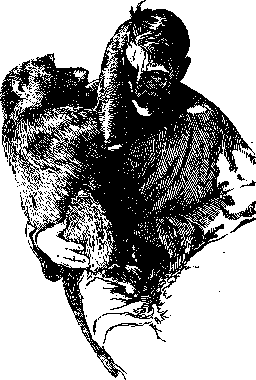
Figure 1. Baboon.
boos. An area of 3.5 hectares, intended for the stay of M. in freedom, is enclosed
by a smooth cement wall 4 m high with eaves eliminating the possibility of climbing over it. The monkey population of the
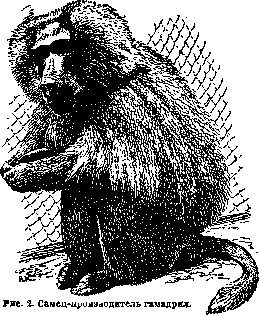
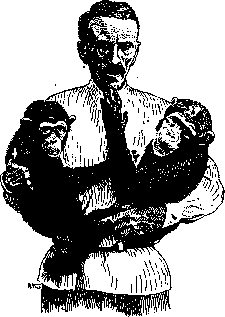
nursery was acquired in parts from the firms Rue and Hagenbeck. The attempt to obtain M. (chimpanzees) directly from their homeland, from Africa, with the help of an expedition from the Academy of Sciences that was there, was not successful: most of the M. purchased there died on the way, a few that reached Sukhumi by sea lived there no more than 2-3 weeks. Newly arriving monkeys at the nursery after admission, selection and quarantine in isolators are released into enclosures (extensive spaces enclosed by grilles and wire mesh), where M. stay almost in freedom. Anthropoids (orangutans and chimpanzees) are in a special enclosure (see separate table, figures 1 and 2). The total number of M. inhabiting the Sukhumi Nursery on January 1, 1931 was 72, including 1 orangutan' (7 years old), 7 chimpanzees (aged from 17 to 6 years); among the others - dog-headed: hamadryas baboons, baboons, macaques, rhesus monkeys and their varieties (figures 1-3). Of this total number
15 (more than 20%) of the young born already in the nursery, at ages from 1 month to 2 years. All natives of Sukhumi belong to the species hamadryas baboon. Some females gave birth in the nursery twice and have living healthy young of one and two years. Thus, since the hamadryas baboon can be considered fully adapted to the new conditions of life and has begun to reproduce, the tasks of acclimatization in relation to this species of monkeys should be considered resolved in a positive sense. As for other species of monkeys, in particular anthropoid apes, representatives of which in the Sukhumi nursery are either single in number or have not reached sexual maturity,-the question of their complete acclimatization in the conditions of Sukhumi remains open for now, although the elements of adaptation to
Figure 3. Chimpanzee. i«P"*" ль..

Figure 1. Main house-laboratory (above.) Monkey walking enclosures (below). Sukhumi. 1 I "*^i4 in * в Fig. 2. House for anthropoid apes. Sukhumi. To the article Monkeys new conditions and these animals undoubtedly have: they develop correctly and gain weight. In the organizational period, i.e., over 3 years, in the nursery a norm has been established for body temperature, pulse, respiration, urine in all monkeys in the nursery. Research has been conducted in the field of stomatology and odontology with attention paid to tooth replacement. The duration of pregnancy has been exactly established in the same dog-headed monkeys-61/2 months; they give birth to 1 young, there was a case of twins. Helminthological examinations were conducted and it was exactly established that all monkeys are carriers of various types of worms. A feeding ration has been established for subtropical conditions when using exclusively products of Abkhazia. At the center of scientific work in the nursery are experiments by physiologists on the study of the nervous activity of monkeys by the methods of Academician I. P. Pavlov. Over these years, work has been carried out by representatives of the Academy of Sciences, Committee of the Academy, Institute of Experimental Medicine, Ukrainian Academy of Sciences (physico-colloidal-chemical features of the monkey's organism), Institute of Clinical and Experimental Hematology (on the study of monkey blood and its comparison with human blood). The works of Prof. Keller were checked: "Research on the cognitive abilities of anthropoid apes.".-At present, the idea of creating conditions for the acclimatization of monkeys in our country has grown into an organization in Sukhumi by decree of the Presidium of the Central Executive Committee of the USSR of 13/VIII 1931 with a much more extensive program of the All-Union Institute for the Acclimatization of Animals of Tropical and Mountain Regions, into which the Sukhumi Monkey Nursery can enter as one of its constituent parts.
Related articles
Mentioned in
Cite this page
“Monkeys.” Soviet Medical Encyclopedia. English translation of Bolshaya Meditsinskaya Entsiklopediya, 1st ed. (Moscow, 1928–1936), ed. N. A. Semashko. https://sovietmedicalencyclopedia.pages.dev/article/monkeys/