Rabbits
Historical document, translated for reference. It reflects medical knowledge of the 1920s–30s and is not medical advice.
Summary
This article from the 1928–1936 Great Medical Encyclopedia details the anatomical, physiological, and biological characteristics of laboratory rabbits (Lepus cuniculus domesticus), highlighting their extensive use in physiological, pathological, and immunological research.
Encyclopedia article (1928–1936)
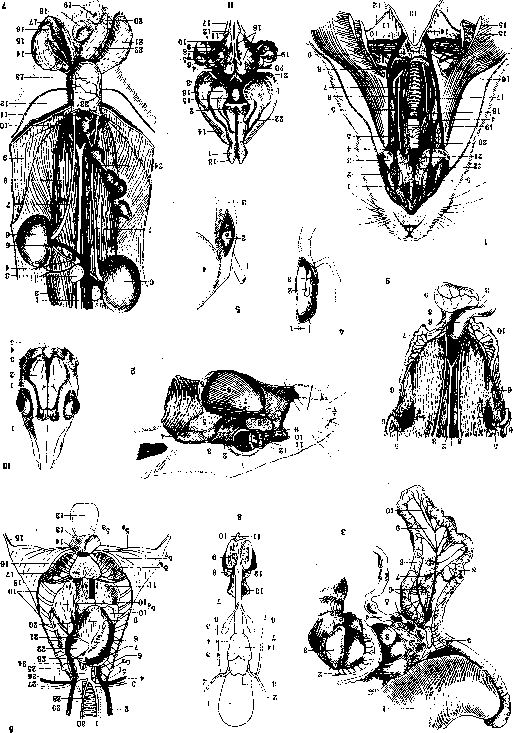
RABBITS, Lepus cuniculus domesticus, rodents of the hare family (Leporidae), are among the most widely used laboratory animals and are employed for a wide variety of physiological, general pathological, but chiefly infectious and immunological experiments. In this regard, the rabbit is particularly valuable for its susceptibility to experimental syphilis (Bertarelli, 1905), and it is precisely on this animal that a whole series of fundamental general pathological questions in syphilidology has been resolved. From the European hare (Lepus europaeus transsilvanicus), the rabbit differs by the following features: the absence of a black spot at the tip of the ear, ears equal to the length of the head, and the length of the hind foot being equal to the head length or slightly greater. The length of the rabbit's body with the head is about 42 cm. The interparietal bone is well expressed; the upper jaw is sifter-like and perforated; the choana is narrow, compressed posteriorly; a strongly developed ulna lies alongside the radius; seven cervical, twelve thoracic, seven lumbar, three sacral, and twenty caudal vertebrae. The scapular spine is strongly developed. The dental formula is: i 2/1 c 0/0 pm 3/2 m 3/3 = 28. Salivary glands are present on the head (Fig. 2): infraorbital, parotid, submandibular, sublingual. The stomach is simple. The cecum is unusually large—up to 30-50 cm in length with a diameter of 3-4 cm; the vermiform appendix, thick and cylindrical, 7-12 cm long, 0.5-1 cm thick, represents a lymphoid tissue organ. The large intestine is relatively thin. The rectum is often beaded in shape due to the presence of formed fecal pellets (Fig. 3). The common bile duct opens immediately behind the pylorus into the initial part of the long duodenum (Fig. 5); forty centimeters further along the course of the duodenum, the pancreatic duct empties into it (Fig. 4). The dimensions of the pancreas are 15-20 cm in length, 2-3 cm in width. The left lung consists of three lobes, the right of four. The apex beat of the heart falls in the third intercostal space 1 cm to the left of the sternum. The right and left superior venae cavae empty separately into the right atrium, with the trachea and the root of the lung lying between them. The aortic arch bends at the level of the manubrium sterni and the second thoracic vertebra (Figure 6); it passes caudally over the left bronchus. The brachiocephalic trunk is very strongly developed; emerging from the aortic arch, it gives off the left common carotid artery, the right common carotid artery, and the right subclavian artery. The left subclavian artery arises to the left of the aortic arch. Periodic descent of the testes is observed; depending on their position, the testes can be found either in the abdominal cavity, or in the scrotum (Fig. 7), or on the way to the latter. The uterus is duplex (Fig. 9) with each horn 6-10 cm in length; it opens into the vagina by two orifices. The ovaries lie at the level of the fourth lumbar vertebra laterally from the psoas major muscle on a very short mesentery. At the level of the fifth to seventh tracheal rings, the thyroid gland is located, sometimes without an isthmus (Fig. 1); its lateral lobes lie on the sides of the larynx. The parathyroid glands are 1-1.5 mm in size. The right adrenal gland lies medially from the right kidney; the left adrenal gland is placed next to the inferior vena cava, between it and the left renal vein (Fig. 7). The kidneys themselves lie asymmetrically: the right is shifted more anteriorly than the left. On the dorsal side of the urinary bladder lies the prostatic vesicle (uterus masculinus); dorsally to the latter is the prostate; beneath it are two seminal vesicles; on the membranous part of the urethra open two Cowper's glands, and on the sides of the penis root are the inguinal glands (Fig. 8). The anterior part of the cerebral hemispheres is strongly narrowed (Fig. 10); there are almost no sulci, and they are barely indicated. For the position of the hypophysis, see Fig. 11. The vagus nerve runs along the lateral side of the common carotid artery. From it and from the superior laryngeal nerve at the level of the lower edge of the thyroid cartilage arises the aortic depressor nerve. The phrenic nerve runs along the anterior scalene muscle obliquely in a medial direction; it receives the branches forming it from the fourth to eighth cervical nerves. Pregnancy lasts on average 31 days. The doe kindles from 2 to 15 blind young, which she nurses for up to 7-10 weeks. The eyes open from the ninth day; from the second to third weeks, the young begin to take plant food. Two weeks after giving birth, the doe can be bred again. Rabbits reach sexual maturity in the 9th month, so young stock should be segregated by sex in the 3rd month to avoid early mating. For mating...
To the illustrations of the article Rabbits.
7vZ
It is best to admit yearling or one-and-a-half-year-old rabbits for breeding. Females older than 3.5 years become sterile; rabbits older than three years are not taken for mating. A female should not produce more than 4 (3) litters per year. The lifespan is up to 8 years. Body weight, depending on the breed, is up to 8 kg. The rabbit's food: cabbage, carrots, beets, oats, barley, bran, dandelion, clover, vetch, dry hay. Poisonous to rabbits are lettuce, spurge, buttercups, hemlock, belladonna, and others. The normal body temperature of rabbits ranges between 38.8° and 39.3°. Breeds of rabbits. Rabbits have long served as a favorite object for the application of artificial selection for both sporting and industrial purposes. Many different breeds have been bred: the silky, or Angora rabbit with hair up to 25 cm long, live weight up to 4 kg. The lop-eared rabbit (belier) with long hanging ears. Belgian, or Flemish giants with a long wide body and a flat (in a lying position) back; ears not less than 15 cm in length; hair short, glossy, dense, gray color; many color variants; weight up to 8 kg. The silver rabbit is a small breed; up to 3-3.5 kg of weight; trunk short; ears 8-10 cm in length, erect, closely converging at the base with each other; hair gray, of various tones; a prolific breed that produces excellent fur in addition to meat. The Russian rabbit with brilliant white hair and a velvety black nose, ears, and paws. Crossing various breeds of rabbits is also performed for genetic research. Under the name of leporids, a supposedly hybrid between a rabbit and a hare is described, but the possibility of such interspecific crossing has not yet been established. The ancestral form for domestication and the subsequent breeding of various breeds of rabbits was the wild rabbit with gray hair and a rusty tint. On the belly and lower part of the neck, the color is white, the tail is black on top. The homeland of the rabbit is southern Europe (Iberian Peninsula). Purebred rabbits easily turn wild. Feral rabbits live in communities in hilly places with shrubby, woody, or garden vegetation, as well as in steppes. They dig deep burrows, from which they come out at night to feed. Reproducing rapidly, rabbits become the scourge of the areas they affect, because they destroy park, garden, shrub vegetation, and pastures. The mass reproduction of feral rabbits even necessitated the use of military forces to combat them, but without much result. Rabbits are bred either in a semi-wild state in fenced parks ("park rabbits") or in cages with the direct care of man. In Western Europe, rabbit meat is widely used, which, together with the profit of using wool and skins, stimulates rabbit breeding on a large scale. In recent years in the USSR, great attention has been paid to the development of industrial rabbit breeding; a rabbit-breeding trust has been organized, and numerous courses and even a faculty of rabbit breeding at the Moscow Zootechnical Institute have been established to train specialists. Parasites of rabbits and parasitic diseases. Rabbit mange manifests itself in various forms: a) ear mange, caused by the mite Psoroptes communis cuniculi or another species—Chorioptes cuniculi. Crusts accumulate in the ear canal as a result of a catarrhal state of the ear passage, causing severe irritation and itching; at the same time, there is a brownish discharge with an unpleasant odor. Mites can penetrate into the middle and even inner ear, causing serious complications. Treatment: 20 parts of olive oil and 1 part of carbolic acid or cresol. Skin mange: from the mites Sarcoptes scabiei var. cuniculi and Notoedrus minor cuniculi. In exceptional cases, Psoroptes communis cuniculi can also pass to the skin. Hair falls out, closely adhering yellowish or greenish crusts form on the skin. Treatment: lubricate with an ointment of 150 g of flowers of sulfur, 8 g of potash, and 60 g of lard. If the mite Glyciphagus domesticus accidentally gets into the ear of a rabbit, the latter develops a disease called "wry neck" (carbolic ointment is used in the ear). Chigger mites and the chicken mite Dermanyssus gallinae also attack rabbits. Of the ixodid ticks, Ixodes ricinus is found in rabbits. Dermacentor andersoni (of the American fauna) and Haemaphysalis leporis-palustris (as well as the horsefly Chrysops discalis and the rabbit louse mentioned below) can transmit Bacterium tularense to rabbits and thus spread tularemia. In the rabbit's fur live the mites Listrophorus gibbus, Cheyletiella parasitivorax, and Leiognathus suffuscus; they do not affect the rabbit's skin; the second of these feeds on the rabbit's small mites itself. Of the lice, Haemodipsus ventricosus lives on the rabbit, and of the fleas, Spilopsyllus cuniculi; in addition, Ctenocephalus canis (dog flea), Ctenocephalus felis (cat flea), Pulex irritans (human flea), and Echidnophaga gallinacea (chicken flea) can transfer to rabbits. The rabbit has its own skin botfly—Cuterebra cuniculi, the larvae of which parasitize under the skin. Of the internal parasites, the most important are coccidia Eimeria stiedae, which affect the cells of the bile ducts; intestinal coccidiosis is caused by the species E. perforans. In the duodenum of the rabbit parasitizes Giardia duodenalis (pathogenic for it, a flagellate), and Trypanosoma cuniculi is found in the blood. Helminths of rabbits belong to flukes, tapeworms, and nematodes. Of the former, rabbits have the liver fluke (Fasciola hepatica) and the lancet liver fluke (Dicrocoelium lanceolatum). Echinococcus cysts are found in the liver of rabbits. In the liver and mesentery of rabbits, metacestodes (cysticercus) of the canine tapeworm Taenia pisiformis are found; they are usually multiple; due to their pea-like shape, they received the name Cysticercus pisiformis. Under the skin and in the muscles, there is a large cysticercus of the coenurus type with a multitude of inverted heads on the wall of the common bladder; this form belongs to the species Multiceps serialis, which lives in the tapeworm stage in the intestine of dogs. When the cyst is located under the skin on its surface, a tumor up to the size of an apple protrudes. In the stomach and intestine of the rabbit parasitizes the nematode Graphidium strigosum; in the intestine, besides, there are roundworms Passalurus ambigua, Trichostrongylus calcaratus, Trichostrongylus retortaeformis, Nematodirus leporis, Trichocephalus leporis, and the acanthocephalan Echinorhynchus cuniculi. In the bronchi, the nematodes Synthetocaulus rufescens (as a rare guest parasite of the rabbit) and the rabbit-specific species Synthetocaulus commutatus—a parasite of the wild rabbit, also found in the domestic rabbit—parasitize. In the lymph nodes and lungs, larvae of pentastomids (Linguatulidae) are found. Trichinae can parasitize in the muscles. The rabbit as a laboratory animal — see Laboratory animals.
E. Pavlovsky. The rabbit from a genetic standpoint represents one of the best objects among all laboratory animals. A large number of studied genes, the combinations of which create a very large number of phenotypes (traits), makes it possible to investigate very detailedly and accurately the transmission from generation to generation of one or another hereditary trait or group of traits. First place among the genetically studied traits of rabbits should be given to coat color. 1. Genetics of coat color in rabbits. The coloration characteristic of the wild rabbit and certain domestication forms (Flanders) bears the name "agouti" (hare coloration). The characteristic grey agouti coloration is determined by the dominant gene Y (pigment distributor) zonally along the length of the hair (gene Y does not act on the belly hair of the rabbit, which in agouti is white). Depending on the presence of certain genes, agouti coloration can be blue, Havana, and yellow. All rabbit coloration genes make up an epistasic series, in the presence of all members of which the agouti coloration is obtained (genotype ABCDG). The significance of each of the factors of the epistasic series in the formation of rabbit coloration is as follows. A is the main pigmentation factor, the transition of which into a recessive state (a) causes the complete absence of pigmentation (albinism). Factors B, C, and D are amplifiers, with the combined action of which a maximum of pigment arises in the form of black coloration (genotype ABCDg). Upon the transition of gene D to a recessive state, the coloration is weakened to a blue color, as for example in blue Vienna rabbits (genotype ABCdg, ABCdY - blue agouti). Upon the transition of gene C to a recessive state, the coloration is weakened to a brown color, as for example in the Havana breed (genotype ABcDg, ABcDY - brown agouti). The recessive state of gene B gives a yellow coloration, e.g., the Thuringian rabbit (genotype AbCDg, AbCDY - yellow agouti). The four genes of the coloration epistasic series - BCDG (gene A is excluded since in the recessive state it always gives albinism) can combine variously among themselves, giving 16 phenotypes (24 = 16) (see table). 2. Types of spotting in rabbits. English spotting (dark spots on a white background) or the coloring of the English butterfly rabbit is determined by the dominant factor K. Dutch piebaldness (standard: the front half of the rabbit is white, excluding the ears and around the eyes, the back half is colored) is determined by the recessive factor s. Silver coloration characteristic of the Champagne breed is caused by the dominant factor P (mixture of colored and uncolored hairs). Along with dominant spotting, there is a gene for recessive spotting (i). 3. White rabbits. Besides white rabbits with red eyes (albinos - a), other whites are known. The White Vienna is white with blue eyes (Ax). Factor x along with factor A determines pigment development. The transition of factor A to a recessive state leads to albinism, the transition of factor x to a recessive state determines white coat coloration and blue eyes. White with brown, sometimes grey eyes is determined by the combination achbCDG (ach is an allelomorph of factor A - see below). 4. Structural and other traits. As for the rabbit's coat, among the factors determining its normal coat, three are presently known: V, R, Ku. The transition of the first to a recessive state causes Angora wool (v), exceeding normal hair in length by 3-4 times. The recessive state of the second causes the famous hair (due to its fur value) Rex (r), discovered in France in 1919, and finally the recessiveness of the third (Ku) gives a phenotype similar to Rex. Among lethal factors, a recessive factor is known which in the homozygous state produces hairless rabbits. It is also necessary to note the recessive factor (Y), which causes the yellow color of the rabbit's fat instead of the normal white. 5. Quantitative traits. Among quantitative traits inherited by the type of designated factors in rabbits, the following have been studied: ear length, weight, and dimensions. According to Castle's data, the difference between the Russian and Polish breeds is determined on average by two factors, the Russian and Belgian breeds by eight, and between the Polish and Belgian by ten factors. 6. Multiple allelomorphs. In rabbits, multiple allelomorphs form three genes (A, B, G). The most extensive series of allelomorphs is formed by gene A. The series contains 6 members: A - main pigmentation factor, ach - absence of yellow pigment - chinchilla coloration, ad - light chinchilla (reduction of dark pigment begins), am - further reduction of dark pigment (chinchilla with a brown tint in the presence of G, with g - mardar coloration); ah - acromelanistic form (Russian rabbit), a - complete absence of pigment (albinos). Gene series B contains 4 members: B - brown coloration factor, Be - epistasic black under agouti (in the heterozygous state, steel rabbit), bj - Japanese rabbit (black-yellow), b - yellow (Thuringian rabbit). Gene series G contains three members: G - grey coloration factor, go - fire rabbit, g - black rabbit. Besides these three series, according to Castle, various degrees of spotting in Dutch rabbits form a single series of multiple allelomorphs (Iw > dw > di > dw). 7. Linkage. The chromosomal complex of rabbits consists of 21 pairs of autosomes and a pair of XY chromosomes (sex). Three cases of linkage are known so far. Factor A (main pigmentation factor) lies in the same chromosome as factor B (black-brown); the crossover between them equals 34.6%. Factor K (English spotting) is linked with factor S (Dutch spotting); the crossover between them is close to 0.1%. In the same chromosome lies factor v (Angora wool as well); the crossover between v and K equals 14%. Exact information on rabbit genetics is necessary for physicians, among whom the widespread belief exists that rabbits of different coloration possess different sensitivity to syphilis, insulin, etc. It is quite possible, however, that the different sensitivity of rabbits to these agents, being determined by the hereditary constitution, depends on genes having nothing in common with coloration genes.
Related articles
Cite this page
“Rabbits.” Soviet Medical Encyclopedia. English translation of Bolshaya Meditsinskaya Entsiklopediya, 1st ed. (Moscow, 1928–1936), ed. N. A. Semashko. https://sovietmedicalencyclopedia.pages.dev/article/rabbits/