Babesia
Historical document, translated for reference. It reflects medical knowledge of the 1920s–30s and is not medical advice.
Summary
Babesia are blood parasites of large and small livestock belonging to the Protozoa type, Sporozoa class. They cause babesiosis, severe diseases accompanied by hemoglobinuria, anemia, and jaundice, transmitted by ticks.
Encyclopedia article (1928–1936)
Babesia (syn.: Piroplasma, Piroscma, Apiosoma), blood parasites of large and small livestock, belonging to the type Protozoa, class Sporozoa, subclass Coccidiomorpha, order Coccidiidea, suborder Piroplasmi-dea, family Babesiidae. - Relationship to other sporozoans: the suborder Piroplasmidea is subordinate to the suborder Haemosporidiidea, which includes the family Plasmodidae, to which the malaria plasmodia belong. Like Haemosporidiidea, representatives of the suborder Piroplasmidea parasitize in erythrocytes, but, unlike them, do not form pigment. Babesia, Nicollia, Nuttalia, Smithia, Rossiella and Gonderia, parasitic in mammals, however, probably belong to a single genus Babesia Starcovici, 1893, the most frequent synonym of which is Piroplasma Patton, 1895. B. were first described under the name Apiosoma Smith et Killborne, 1893 (=B. bigemina), as the causative agent of Texas hemoglobinuric fever of cattle. On this object, the transmission of parasitic protozoa by ticks was first proven, as well as the terminal transmission of infection through the infected eggs of the latter. B. are rounded, oval or pear-shaped bodies with one nucleus and sometimes resemble the initial stages of development of the malaria plasmodium. Dimensions vary from 0.5 to 3-4 μ. In some forms, such as B. quadrigemina, parasitic in rodents, Ctenodactylus gundi in Tunisia, as well as in B. canis, flagellated stages with a blepharoplast (see) have been described, which gives some authors grounds to associate B. with flagellates (see), attributing them to the group Binucleata (see).-Reproduction of B. occurs by a peculiar budding, during which characteristic groups of 2 or 4 bodies are formed (see Figure 1). Cultures of B. were obtained
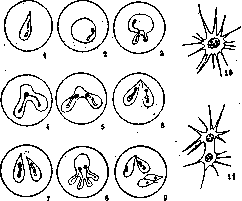
Figure 1. Babesia bigemina: 2-9 developmental stages in the erythrocytes of cattle; 10-11 developmental stages in the tick.
on a nutrient medium proposed by Bass and Jones (Bass, Johns) for malaria plasmodia (10 cm³ blood + 0.1 cm³ 50% dextrose). All representatives of the family Babesiidae parasitize in erythrocytes in mammals - cattle, pigs, horses, dogs, rodents, monkeys, in which they cause babesioses - severe diseases accompanied by hemoglobinuria, anemia, jaundice and known, mostly, under the name piroplasmoses (see Piroplasmosis). The toxic effect of B. is associated with their alleged secretion of a hemolytic poison. Mortality from babesioses reaches 30-60%. Transferred disease causes a state of prolonged non-sterile immunity.-Transmission of B. occurs by means of ticks, in whose bodies they transform into peculiar ray-like formations and, according to some authors (Koch, 1906), undergo a sexual process, which, however, has not been finally proven. Ticks transmit infection to their offspring through infection of their own eggs. Thus, the larval stages of ticks, which have never fed on blood, can also be infectious. Since the reproduction of ticks reaches its greatest development by the end of the hot period, the maximum of diseases also falls on this period. Main representatives: B. bigemina Smith, et Killborne, 1893, size 2-4 μ, causative agent of the so-called "Texas fever", or hemoglobinuria of cattle in America, Africa, Asia and in northern and southern Europe (Caucasus). The carrier is ticks of the genera Margaropus (Boophilus), in the Caucasus - M. calcaratus. - B. bovis Starcovici, 1893 (syn.: Piroplasma divergens, Microbabesia, Babesiella). Size up to 1.5 μ, parasitic in cattle. Carrier-tick Ixodes ricinus (syn.-I. reduvius), capable also of germinal transmission of infection.-B. mutans. Theiler, 1905, small forms not exceeding 1 μ; parasitic in cattle, carried by ticks Rhipicephalus evertsi, R. appendiculatus; distribution-Asia, Africa, Australia, southern Europe. Form little pathogenic, does not cause hemoglobinuria; does not give immunity.-B. motasi (carrier Rhip. bursa), B. ovis Starcovici, 1893, and B. Sergenti (syn.: Gonderia ovis) cause hemoglobinuria in sheep and goats (for the last two forms the carrier is unknown) in Asia Minor, North Africa, on the Balkans; the last form, least pathogenic, is also found in Central Asia and in Transcaucasia.:-B. caballi Nuttal, 1910; size up to 4 μ, in form resembles B. bigemina. Parasitic in horses; causes hemoglobinuria. Distribution-Asia, Africa, America, middle and southern Europe. In the USSR it is found in the middle and southern zones; was discovered in 1910 by Marcynowski and Belitzer, who established as carrier the tick Dermacentor reticulatus. In Italy the carrier is the tick Margaropus annulatus. In the middle zone of the USSR diseases with this babesiosis are extremely widespread, affecting tens of thousands of heads and having a seasonal character (spring).-B. equi Laveran, 1901 (syn.: Nuttalia), a smaller form; parasitic in horses (see Figure 2), widely distributed; in the USSR it is found in Transcaucasia, Central Asia. Carried by ticks Rhip. evertsi, R. bursa, possibly also by Hyalomma aegypticum. Causes a severe form of disease.-'Babesia canis Panna et Galli Valerio, 1895; size up to 5 μ; contains a vacuole in the protoplasm. Widely distributed in Asia, Europe and Africa. Causes anemia, hemoglobinuria, jaundice. Carrier: in South Africa-Haemaphysalis leachi, in India-Rhip. sanguineus, in Europe-Dermacentor reticulatus, in America-D. venustus.-B. vesperuginis Dionisi, 1899 (syn.: Achromaticus), parasitic in bats. A number of other species
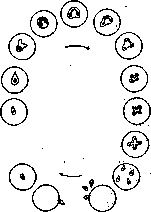
Figure 2. Development of Babesia equi in horse blood.
B. parasitic in small rodents, monkeys, antelopes, foxes and others.-Babesiosis, see Piroplasmosis.
Related articles
Mentioned in
Cite this page
“Babesia.” Soviet Medical Encyclopedia. English translation of Bolshaya Meditsinskaya Entsiklopediya, 1st ed. (Moscow, 1928–1936), ed. N. A. Semashko. https://sovietmedicalencyclopedia.pages.dev/article/babesia/