Hemoglobinuric Fever
Historical document, translated for reference. It reflects medical knowledge of the 1920s–30s and is not medical advice.
Summary
Hemoglobinuric fever is an acute disease characterized by fever, chills, bilious vomiting, jaundice, and hemoglobinuria. The etiology is uncertain, with theories including malaria, quinine use, or a distinct disease entity.
Encyclopedia article (1928–1936)
HEMOGLOBINURIC FEVER, febris biliosa haemoglobinurica (German- Schwarzwasserfever, English- blackwater fever, redwater fever, French- fievre bilieuse hematurique), is an acute disease characterized by elevated temperature, chills, bilious vomiting, jaundice, and hemoglobinuria. Etiology of H. f. is not definitively known, and several theories exist to explain it. 1. The most widespread is the malarial theory, which considers previous malaria, mainly its tropical form, as the cause of H. f. However, cases have been described where H. f. was observed in persons who never had malarial parasites in their blood; similarly, in some countries (e.g., in India, where malaria is very widespread), H. f. is an exception. However, in some places (e.g., in Africa), there is also a coincidence of these two diseases. 2. The quinine theory considers the onset of the H. f. syndrome as a consequence of quinine intake. However, cases of H. f. have been described in persons who never took quinine; moreover, in experiments in vitro, therapeutic doses of quinine failed to cause hemolysis of washed red blood cells, both from healthy individuals and from those with H. f. or malaria (Nocht, Barret, Yorke). 3. The theory considering H. f. as a disease sui generis (P. Manson, 1893); however, the search for the causative agent remained fruitless; the works of Blanchard and Lefrou, attributing the etiological role to spirochetes, have been refuted; similarly, the indication by Balfour (A. Balfour) that the basis of H. f. is the bite of some insect, the venom of which acts hemolytically, is not substantiated. Epidemiology. The disease exists in many places, but its area of distribution is endemic, mainly in low, swampy areas. From the moment of infection to the manifestation of pathological phenomena, a long period of time may pass. In endemic areas, newcomers rarely get sick after 6 months, more often - in the 2nd-3rd year of stay. Not everyone is equally susceptible. E.g., in 1885 in the Castadies prison (Sardinia) out of 800 prisoners, 24 people got sick with H. f.; during the imperialist war in East Africa, the German troops of General Lett-lov lost 60% of the medical staff from hemoglobinuria. Seasonal predominance is noted by many authors and is attributed to late summer, mainly to autumn. In the USSR, it has been noted that H. f. occurs mainly in cold periods of the year: in winter, autumn, and early spring. The geographical distribution of H. fever is quite wide: many cases in Africa; it occurs in the United States of North America (in the southern parts) and in Central and South America. In Europe - in Greece, Macedonia, Italy, Sardinia, Sicily. In Asia Minor - in the Jordan River valley, in Assam, Burma, Tonkin, on Java. In the USSR, H. f. was found in Turkestan, Transcaucasia, Bukhara, in the North Caucasus, in the Volga region, Moscow, and Leningrad. Statistics in all countries are very incomplete, as only very severe cases are registered. In the USSR, 337 cases have been described, of which 88.1% are men and 11.9% are women. Mortality ranges from 0 to 100% (on average, 41.4%). Pathological anatomy. Depending on the duration of the disease, i.e., whether death occurred at the height of the attack or after several days, the pathological-anatomical picture of H. f. may be different. In acute cases, the following are observed: jaundice of the skin and internal organs; enlarged, full-blooded, dark red-brown spleen; slightly enlarged, yellow-brown liver and also slightly enlarged, swollen, full-blooded kidneys, in the pyramids of which a delicate dark brown mottling is already macroscopically revealed, corresponding to the straight tubules filled with hemoglobin cylinders. In subacute cases, the picture of anemia predominates in the organs. Microscopically: capillaries of the liver and sinuses of the spleen are clogged with the breakdown of red blood cells; in liver cells, macrophages, and sinus endothelium - much hemosiderin (in the most severe cases - hematine); kidney glomeruli are not affected, but in the cavity of Bowman's capsules - fine-grained exudate; in the epithelium of the convoluted tubules, cloudy swelling and necrosis are often observed; the lumens of the tubules, especially the straight ones, contain fine-grained cylinders that give a positive reaction for iron in the convoluted part. Pathogenesis is little understood, as the etiological agent is unknown; it has only been established that the strongest dissolution of red blood cells occurs inside the blood vessels. The clinical picture varies greatly - from barely noticeable, insignificant, quickly passing hemoglobinuria to severe hemoglobinuria, with a decrease, and sometimes complete cessation of urination, and with a high mortality rate. Clinical phenomena consist of specific and general symptoms. Specific: rapid breakdown of red blood cells, enlargement of the spleen and liver, hemoglobinuria, albuminuria, urobilinuria, and jaundice. General - the disease develops suddenly, with a sharp increase in temperature to 40° and above (see figure), almost always with chills, vomiting, headache, pains in all limbs, and general weakness. After a few hours, jaundice appears, the amount of urine is reduced, and sometimes urination stops completely (prognosis pessima); the color of the urine ranges from the color of red wine to the color of dark beer (see separate table, attached to the article on Hypophysis, vol. VII); specific gravity is high; the urine contains a lot of protein; the reaction is most often acidic, but it can also be neutral. Upon microscopic examination - many granular cylinders, kidney epithelial cells, bladder cells, single leukocytes, a lot of reddish-brown grains (granular breakdown of red blood cells), no red blood cells. Upon spectroscopic examination of freshly passed urine - oxyhemoglobin, in standing urine - methemoglobin. Such severe cases often end fatally within 24-28 hours, sometimes they last for 7-10 days, but in most cases they still end in death. In the blood soon after the onset of the disease, the number of red blood cells sharply decreases (to 1 million); the number of monocytes increases, as well as neutrophils, among which there is a shift to the left according to Schilling. In favorable cases
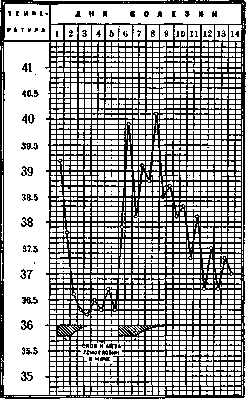
gradually urination begins, convulsions and coma disappear, and the temperature gradually decreases, and the severely weakened patient recovers very slowly.
Diagnosis. Acute onset, temperature, chills, oxyhemoglobin in the urine, and severe condition allow H. f. to be distinguished from other diseases. Thus, in febris biliosa, the urine contains only urobilin or bilirubin, but not oxyhemoglobin; paroxysmal hemoglobinuria does not give such severe clinical manifestations, it does not have such a strong destruction of red blood cells, there is no mortality, and relapses are observed (see Hemoglobinuria, hemoglobinemia). Treatment. The patient must be immediately put to bed in a warm room, warmly covered; one should carefully avoid any muscular strain and give the patient absolute rest; cardiac remedies (Ol. Camphorae, Coffein, Digitalis) are prescribed; for convulsions - Morphium, Pantopon no 0.01 per dose; plenty of fluids - if not per os, then subcutaneously or intravenously in the form of physiological solution. Calcium chloride is recommended at 0.5-1.0-2.0 per day. With quinine, one must be very careful: if the patient previously had or now has malarial parasites in the blood, then quinine should be started at 0.01-0.02 per day and the dose should be increased only very cautiously. Prevention. It is recommended to avoid colds, overexertion, and in case of malaria - to treat the latter correctly and thoroughly.
Related articles
Mentioned in
Cite this page
“Hemoglobinuric Fever.” Soviet Medical Encyclopedia. English translation of Bolshaya Meditsinskaya Entsiklopediya, 1st ed. (Moscow, 1928–1936), ed. N. A. Semashko. https://sovietmedicalencyclopedia.pages.dev/article/hemoglobinuric-fever/