Dactyloscopy
Historical document, translated for reference. It reflects medical knowledge of the 1920s–30s and is not medical advice.
Summary
Dactyloscopy is the science of studying the patterns formed by papillary lines on the fingertips. It was founded by Francis Galton, who established that these patterns are unique, unchanging, and classifiable. The method is used for criminal identification and has been adopted worldwide.
Encyclopedia article (1928–1936)
DACTYLOSCOPY (from Greek dactylos- finger and scopeo- I look), the science of the patterns formed by papillary lines on the terminal phalanges of the human fingers. The first indications of acquaintance with these drawings appear in deep antiquity. In China, Japan, and other Eastern countries, from a very remote time, fingerprints were given significance as an indisputable proof of identity. The systematic study of finger patterns was carried out mainly by Purkinje (1823), Herschel (1880), Foulds (1880), and especially Galton (1892); the latter is rightly considered the founder of dactyloscopy. Galton placed the results of his research in the foundation of D. as a method of registering criminal-professional criminals. Through careful study of finger impressions and theoretical calculations, Galton established that: 1) finger patterns, from the moment of their formation, remain unchanged throughout life under normal conditions; with age, the size of the constituent papillary lines and the distance between them change, but not the pattern itself or its characteristic structure; 2) finger patterns are individual, i.e., each person possesses a pattern belonging only to him, and 3) finger patterns, despite their infinite variety, can be classified. Galton divided all patterns into three main types: arches (see Figure 1), loops (see Figure 2), and whorls (see Figure 3), and, according to the combinations of loop and whorl patterns on the various fingers, subdivided the registration-dactyloscopy cards into 1,024 groups. Henry developed a method for further subdivision of loop and whorl patterns, based on the count of papillary lines lying between two conditional points in the central part of the pattern. Thanks to the Galton-Henry method, registration-dactyloscopy cards with the impressions of ten fingers (fingers are coated with a thin layer of printing ink and rolled in the corresponding places on the card) can be divided into 1,024 main groups and an extremely large number of subgroups. The dactyloscopy method of establishing identity was introduced into criminal investigation institutions in India in 1897, and then in England in 1901. At present, the dactyloscopy method is applied in all civilized states. Over time, other methods of classifying registration-dactyloscopy cards have been proposed, but they did not introduce essential improvements into the Galton-Henry method. In Russia, since 1907, a combined and modified system of Galton-Henry and Rouché has been applied. With the help of a local or central dactyloscopy card index, the identity of detained criminal-professional criminals who have assumed another name is established, as well as the identity of corpses of unknown citizens, if both were previously registered under the dactyloscopy system. In order to quickly establish identity from several (or even one) finger impressions left at the scene of a crime, monodactyloscopy was proposed. The essence of this system is that the registration cards with the impressions of each finger taken separately from certain groups of criminal-professional criminals are distributed in a special way: either by the form of the pattern and the count of papillary lines lying between two conditional points in the central part of the pattern, or by the name of the finger from which the impression was obtained. The finger impression found at the scene of the crime is sought in the groups of monodactyloscopy cards containing similar finger impressions. In addition to registration D., racial D. is successfully developed, concerning the distribution of the main types of papillary patterns on the fingers of different peoples. It turns out that among Europeans, arches and loops occur more often than among Asian peoples, and whorls are observed in a smaller number among Europeans. The distribution of finger patterns is different in men and women. Among Great Russian women, arches and loops are more numerous (arches - 8.44%, loops - 64.27%) than among Great Russian men (arches - 6.15%, loops - 61.73%), and whorls among Great Russian women are fewer (27.29%) than among Great Russian men (32.12%). In recent times, mainly in connection with the question of establishing paternity, studies on the hereditary transmission of finger patterns have been undertaken. This question is so complex that the existing works in this regard must be considered only as first attempts at its solution. Nevertheless, it apparently can be considered established that the following are transmitted by inheritance: 1) the general type, so to speak the style of construction, common to all finger patterns of both hands, 2) the form of the pattern, and 3) some details of the structure of the papillary lines. One can also mention comparative D., which studies papillary patterns on the terminal phalanges of human fingers and the limbs of monkeys. Data from existing works on this issue indicate a substantial difference between these patterns in monkeys and humans, namely: in the former, the papillary lines forming the center of the finger pattern have, in general, a straight direction, while in humans the central lines of the pattern are distinguished by their curvature, which is most sharply expressed in whorl patterns.
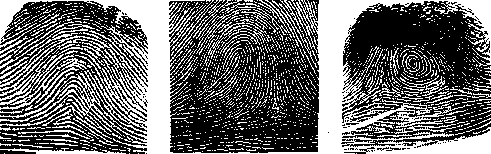
FIG. 1.
Figure 2. Figure 3.
Related articles
Mentioned in
Cite this page
“Dactyloscopy.” Soviet Medical Encyclopedia. English translation of Bolshaya Meditsinskaya Entsiklopediya, 1st ed. (Moscow, 1928–1936), ed. N. A. Semashko. https://sovietmedicalencyclopedia.pages.dev/article/dactyloscopy/