BRODMANN
Historical document, translated for reference. It reflects medical knowledge of the 1920s–30s and is not medical advice.
Summary
Brodmann was a prominent German histopathologist-psychiatrist who founded the doctrine of cytoarchitectonics of the cerebral cortex. His research revealed the layered structure of the cortex and divided it into distinct areas based on histological characteristics, providing a foundation for studying brain function and localization of organic psychoses.
Encyclopedia article (1928–1936)
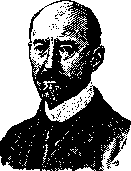
BRODMANN, Korbinian (Korbinian Brod-mann, 1868-1918), the greatest German histopathologist-psychiatrist, one of the founders of the doctrine of cytoarchitectonics of the cerebral cortex - a doctrine that opened perspectives and provided a basis for studying brain function, for localizing organic psychoses, and for psychology. At the beginning of his scientific career, Brod-mann was an assistant in the psychiatric clinic in Vienna. In 1918, Krepelin invited B. to head the histological department at the Research Psychiatric Institute in Munich, but after 5 months B. died from blood poisoning. B. created the doctrine of cytoarchitectonics (see Architectonics of the cerebral cortex). Even at the end of the 90s of the 19th century, it was considered irrefutable that the cerebral cortex is homogeneous in its structure. Thanks to the new technique of histological sections and the introduction of microscopic and photomicrographic techniques, B. managed to prove that the cortex consists of diversely constructed layers. He managed to study the cortex of different representatives of mammals (mainly monkeys), and everywhere he found a layered structure. B. proved that when dividing the surface of the brain layers, one must be guided by the fine histological structure, and that the ordinary division into lobes, gyri - is formal, external. Guided by the histological structure, B. divides the cortex into separate areas, so-called areas, of which he counts up to 50. Each area, differing histologically, also differs physiologically. Mental processes result from the interaction of many areas. B. compares the action of the cortex with the action of piano keys, where only the combination of keys achieves a melody. The division into areas does not fully coincide with the division by gyri. This division has a more universal character, making it possible to include the cortex of animals with a smooth, i.e., devoid of gyri, hemisphere. If one takes, for example, the frontal lobe, then, as one ascends the animal scale, it grows not only
in its area (in rabbits 2%, in humans 29% of the entire cortex), but also in the number of areas. The works of B. led him to anthropology and the study of the structure of the cortex in different races, which he was engaged in in recent years.
Related articles
Mentioned in
Cite this page
“BRODMANN.” Soviet Medical Encyclopedia. English translation of Bolshaya Meditsinskaya Entsiklopediya, 1st ed. (Moscow, 1928–1936), ed. N. A. Semashko. https://sovietmedicalencyclopedia.pages.dev/article/brodmann/