Expressive Movements
Historical document, translated for reference. It reflects medical knowledge of the 1920s–30s and is not medical advice.
Summary
This article discusses expressive movements in psychology as manifestations of psychological states and physiological changes, examining their origins, characteristics, and measurement through experimental methods.
Encyclopedia article (1928–1936)
EXPRESSIVE MOVEMENTS, the usual designation in psychology for movements that express some psychological state or experience. Expressive movements are, first and foremost, an expression of the more or less profound changes taking place in the organism, the other side of which is one or another subjective state. The latter is not the cause of expressive movements, but their accompanying aspect, with the common root of both processes being profound changes in physiological dynamics, sometimes (for example, during intellectual activity) associated with the activity of the central nervous system and, in particular, the cortex, and sometimes (for example, predominantly during sharp affects) with the activity of the sympathetic and secretory systems. Therefore, it is sufficient to activate one or another nervous or secretory apparatus to obtain certain 'expressive' changes, sometimes associated with voluntary skeletal musculature (mimetic and pantomimic movements), and sometimes with involuntary musculature (changes in blood circulation, pupil constriction, activity of sweat glands, etc.). The nervous system, however, is connected by such close threads with the environment and its influences that the changes in its activity that we have mentioned can occur not only only with direct irritation of one or another of its parts, but, first and foremost, under the influence of environmental stimuli, with the stimuli emanating from it being able to 'psychologically' (i.e., primarily through the mechanism of conditioned reflexes, and then through more complex and complex forms of connection with the environment) to cause significant changes in our behavior. It is precisely such a complex effect of external stimuli or internal ones, with the lability of the nervous system easily causing previously experienced states to reappear (or mobilizing the activity of certain areas of the nervous system), that is the mechanism that can cause expressive movements. The study of expressive movements is very important for psychology, as it can make it possible to objectively conclude about the presence and character of one or another psychological states, and further, about the character of physiological processes hidden from direct observation. Wundt considers the study of expressive movements one of the basic methods of psychology, calling it the 'method of expression.' (A series of works devoted to individual types and forms of expressive movements shows that in psychology in general and in objective psychology in particular, this problem has always been at the center of attention.) The question of the origin of expressive movements has been discussed in psychological literature many times. Even Darwin expressed the position that expressive movements are, in their basis, purposeful or, at least, rudiments of movements that once had a purposeful character. Such are the movements of raising the upper lip and baring the teeth in anger, having a connection with the protective reflex of baring the canines; such is the facial expression of fear, which sometimes reproduces movements that occur in the reflex of apparent death, and sometimes reveals as if remnants of other purposeful movements (thus, trembling of the legs in fear is attempted to be evaluated as a remnant of the flight reflex; pallor in fear is attempted to be explained as a purposeful outflow of blood to nerve centers, necessary for the organism to gather all its strength, etc.). Such movements, associated with an increase in body volume and 'threatening' gestures, are characteristic of almost all species of animals and are invariably connected in them with defensive reactions. There is reason to believe that the military attire of wild tribes is merely a logical continuation of these tendencies, with the only difference that here to expressive movements are joined other expressive techniques associated with primitive culture. Despite the richest material collected by Darwin and his supporters (to this view adhere Mosso, James and a number of other prominent psychologists), it should be said that the purposeful character of expressive movements can be established far from in all cases. Trembling in fear, for example, rather has an obviously non-purposeful character, not helping to escape from danger, but hindering it. In a huge number of cases (this especially applies to cases of sharp affect), expressive movements are rather the result of the direct irradiation of the excitation that has arisen onto the skeletal musculature and partly (through the sympathetic and secretory systems) onto the activity of involuntary muscles. Precisely, such a direct irradiation of excitation can explain the fact that during strong affect the normal activity of the motor sphere is disrupted and significant changes of a visceral nature occur: changes in pulse, disturbances of respiration, blood pressure, secretions of mucous and sweat glands, etc. In a large number of experimental studies, starting with Wundt, changes in the activity of respiration, pulse and blood filling of vessels have been traced in expressive movements. For the exact registration of all these changes, special instruments (pneumograph, sphygmograph, plethysmograph) are used, transmitting the corresponding movements to a graphical record (with the help of Marey's drum and rotating kymograph). Observing the changes in these processes during various affects, psychologists have established some characteristic features inherent in respiration during depression and joy, anger and fear, etc.; these changes amount to disturbances in the intensity, tempo and coordination of these movements. Below is a brief summary concerning the changes in the indicated processes during various emotional states. Changes in respiration and pulse during various emotional states (according to Lowenstein). Emotional states Amplitude of respiration Ratio of inhalation and exhalation Frequency of respiration Frequency of pulse 'and k R.o and a v Tension Relaxation Pleasure Displeasure .... Calm and depression Excitement Fright .... Fear .... + + ? + + ? + + + + + ± ? + + + + + + + + + + + + + + + (±) In general, the main distinctive feature of the changes in the expressive systems of respiration and pulse during sharp affects is the disruption of their normal course with the appearance of affect; Figure 1 shows the curve of respiration and pulse corresponding
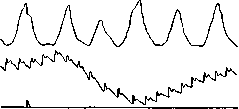
Figure 1.
to the moment (o) of a sharp negative experience of the subject. The movements of the extremities turn out to be even more expressive. If one registers the trembling of the hands in one or another emotional states, it turns out that the trembling reflects not only the character of the emotional process (suddenness, strength, duration), but also makes it possible to judge the type of nervous system on the basis of which the given affect unfolded. Figures 2a and 2b give such an example: in Figure 2a are given the curves of trembling (of the head, hands, feet) and respiration in a healthy person; at the point marked on the curve (+1), a reaction of fear was caused in the subject, which expressed itself in noticeable twitching of the extremities; with repeated evocation of fear (+2) no reaction was observed. In Fig. 2b similar irritation (+12) was pre- head from the front W.- + 2 + 2 + 2 -+- i * 1 i I I I i 1 i 1 I I i I t d Figure 2 a. sented to a hysterical person, and it is clearly seen that the trembling proceeds more sharply and lasts for a significantly longer period i^- ^-^Ч^^y^Ч/^
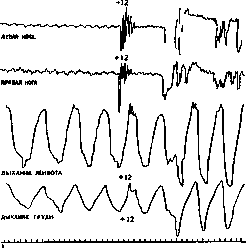
Figure 2 b.
time. Particularly valuable E. m. are the active movements of the hands, associated ('coordinated') with some simultaneous central process. In Figure 3a, hand movements in a normal state are given; in Fig. 3b—the same movements in a state of affect (a criminal shortly after murder, examined in the investigative setting); the disorganized character of the movements is quite clear. Expressive symptoms can sometimes serve as a method for determining affective complexes (for example, in hysterics). For the precise registration of E. m., some authors have used other expressive systems: thus, Sommer recorded the movement of facial (primarily frontal) musculature, and Scripture applied the registration of the phonetic side of speech, obtaining symptoms of both mental states and peculiarities of the nervous system (organic and functional diseases of it). Finally, handwriting has also proven to be an excellent expressive system, which can be considered as a series of precisely coordinated movements reflecting both personality traits and its neuropsychic states (see illustration in Graphology). In recent years, in addition to such an analytical study of E. m., a number of authors have also given a synthetic registration of E. m., as they manifest themselves in facial expression and pantomime. For the purposes of registering facial expression, pantomime, and gestures, photography and cinematographic registration are now used. Filming movements with the help of a special ultra-fast cinematographic apparatus, giving up to 300-400 frames per second (instead of the usual 16-18), makes it possible to register the smallest symptoms of E. m. and for the first time to approach their dynamics with sufficiently fine scientific methods. On a separate plate (see Vol. V, pp. 579-580, Figs. 1 and 2), there are 2 photographs of children in various emotional states; it is clearly visible that even at a relatively early age, expressive movements of facial expression are differentiated and express quite vividly this or that emotional state. The state of surprise, mixed with fear, in one child and the emotion of pleasure in the other are expressed in peculiar changes in facial expression, quite noticeable (compare the eye, lip, and facial muscles in both cases). The facial expression of surprise and interest is registered here with great clarity. The use of expressive movements is of considerable interest, and the science of them has developed into a special discipline. Expressive movements have been studied particularly extensively in the field of theater and representational and plastic arts (dance, painting, sculpture). Finally, special attention has been paid to one of the systems of E. m., possessing perhaps the maximum expressive possibilities—speech, and the problem of 'expressive speech' has again grown into a whole specific area of research, and related questions (about intonation, logical and psychological emphasis, etc.) have been developed in a number of special studies. The study of E. m. is of interest not only for psychology; it also has great practical significance for neurological and psychiatric clinics.
A. Luria.
Figure 3b. In an anat.-physiol. respect, E. m. are connected with the activity of both the cerebral cortex and subcortical formations, and the proper interaction of these 'levels' of the nervous system with each other is of essential importance. The subcortical nodes, acting autonomously in response to irritations directed to them from the periphery or receiving the main impulse from the cortex, determine motoricity, and therefore, expressive movements as its part, in very various respects. The direction of a given expressive movement depends to a large extent on which of the unconditional expressive reactions is 'mobilized' in the subcortical nodes. The intensity of E. m. is connected with subcortical excitability, which in turn is determined by constitutional peculiarities and the nature of the existing external and internal irritations; in addition, the subcortical nodes also determine the formal side of E. m.—their smoothness, distinctness, and mobility in the sequential change from one expressive movement to another. Finally, the vasomotor-secretory accompaniments of E. m. are determined by the subcortical nodes, since the latter are the highest vegetative centers. The participation of the cerebral cortex in the origin of E. m. is evident from the fact that most of these movements arise and form under the influence of social irritations and as a means of social communication (similar to speech reactions). The ultimate basis of such E. m. lies in conditioned reflex mechanisms, i.e., mechanisms characteristic of the cerebral cortex. When the hemispheres are damaged, not only the loss of individual expressive movements is observed along with the loss of many other learned actions (see Apraxia), but also the disorder of the so-called representational activity (darstellende Funktion of German authors), i.e., the distinct, logically differentiated change of E. m. In this case, the patient loses the ability to describe by a series of pantomimic actions some event or a series of events. At the same time, more primitive E. m., associated with an outburst of affect, usually proceed without noticeable disturbances. In various pathological states, disorders of E. m. manifest in the following forms. The most severe degree of weakening of E. m. is called stupor. The patient is almost motionless, does not react to emotional irritations, spontaneous facial expression is absent; vital actions (for example, eating) are performed mechanically. In some cases, these also fade away, and then the boundary between stupor and a soporous state becomes quite conditional. Stupor is one of the frequent symptoms of severe schizophrenia and severe depression in cyclophrenics; hysterical reactions can also take the form of stupor. A strong psychic or physical trauma can also cause a stuporous state in persons with previously normal mental state. Insufficiency of E. m. also manifests in the form of amimia (see). Mask-like face corresponds to a strong impoverishment of pantomimic expressiveness. Pathophysiologically, these defects should be connected with peculiar changes in muscle tone and insufficiency of centrifugal motor impulses (see Akinesia). Poverty of E. m. is also characteristic of different forms of dementia and focal lesions of the cerebral cortex; in these cases, the scarcity of E. m. is entirely due to defects of higher neuropsychic activity. The opposite of the above states is excessive production of E. m. Such overproduction is characteristic first of all for the category of diseases with a hyperkinetic symptom-complex. In chorea, double athetosis, and torsion spasm, whole synergistic groups of muscles are randomly involved in hyperkinesis, the contraction of which sometimes imitates the most diverse mimetic and pantomimic acts, without this being accompanied by corresponding subjective states (and therefore corresponding objective changes in higher nervous activity). The same splitting between the external form of reaction and the central neuropsychic process is also observed in schizophrenia. This splitting has, however, a deeper character here, since the E. m. of the schizophrenic occur against a background of general emotional dullness, not at all characteristic of most patients of the previous category. Excessiveness of E. m. can occur in some schizophrenic states without signs of splitting, when general motor agitation corresponds, for example, to certain delusional ideas. Such centrally motivated excessiveness is particularly characteristic of manic states in cyclothymics. The disorderliness, sharpness, and logical incoherence of E. m. in these patients are an expression of the same peculiarities in their neuropsychic dynamics. Similarly, in hysteria, E. m. reflect the extreme affective instability of the hysteric, as well as the specific content of his neuropsychic complexes.—Of the qualitative disorders of E. m., their stereotypy (monotonous repetition) should be noted, often observed in schizophrenics. Sometimes stereotypy has an obviously compulsive character (perseveration) and in this form is characteristic both of obsessive-compulsive neurosis and of organic diseases of the brain, in which perseveration of E. m. often goes hand in hand with a general impoverishment of E. m. and with a disorder of higher representational activity (see above). Involuntary laughter and weeping, characteristic of diseases of the thalamic region and often occurring in pseudobulbar paralysis, differ in quality from the corresponding E. m. of normal adult people (have a distinctly infantile character). Particularly complex qualitative disorders of E. m. include mannerism and posing, characteristic in their sharp manifestations in schizophrenics and hysterics.
Related articles
Mentioned in
Cite this page
“Expressive Movements.” Soviet Medical Encyclopedia. English translation of Bolshaya Meditsinskaya Entsiklopediya, 1st ed. (Moscow, 1928–1936), ed. N. A. Semashko. https://sovietmedicalencyclopedia.pages.dev/article/expressive-movements/