Wolff
Historical document, translated for reference. It reflects medical knowledge of the 1920s–30s and is not medical advice.
Summary
Kaspar Friedrich Wolff (1733-94) was one of the greatest biologists of the 18th century and a founder of modern embryology. He defended the theory of epigenesis against preformation and made important discoveries in embryonic development.
Encyclopedia article (1928–1936)
WOLFF, Kaspar Friedrich (Kaspar Fried-ricn Wolff, 1733-94), one of the greatest biologists of the 18th century and one of the founders of modern embryology. He graduated from the Medical-Surgical Academy in Berlin and was a student of Meckel. In 1759 he defended his famous dissertation "Theoria generationis", in which he rebelled against the doctrine of preformation, i.e., the predetermination of organs in the embryo, and became a defender of the doctrine of epigenesis, i.e., the gradual development
\ '
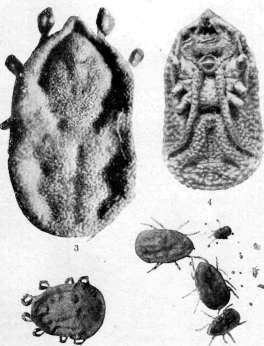
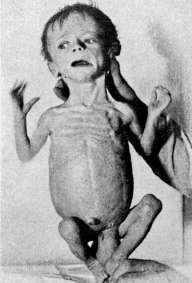
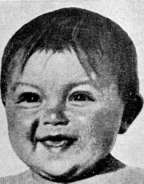
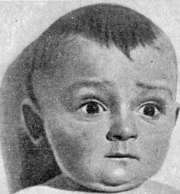
Figure 1 and 2. Facial expressions of a child in different emotional states (1-pleasure; 2 attention associated with fear. Photographs borrowed from K. Chukovsky's "Little Children"). Figure 3. Tick Ornithodorus lahorensis. Figure 4. Tick Ornithodorus talaje from the ventral surface. Figure 5. Tick Ornithodorus moubata. Figure 6. Tick Ornithodorus lahorensis, different phases of development. Figure 7. Severe form of atrophy with inguinal hernia in a 10-month-old child (according to Pfaundler).
TO THE ART. Typhus fever, Voltaire face, Expressive movements. of organs from simple rudiments. W. was an exact observer and first established the process of formation of the intestinal and neural tubes through the formation of folds of the embryonic layers. In 1766 he was invited by Catherine II to the Academy of Sciences in St. Petersburg, of which he remained a member until his death, working in the fields of anatomy and physiology. W. also worked on questions of plant anatomy, anticipating Goethe's ideas about metamorphosis. Particularly remarkable is W.'s research "De formatione intestino-rum" (St. Petersburg, 1768). In 1789 he published the work "Von der eigentiimlichen u. wesent-lichen Kraft der vegetabilischen u. anima-lischen Substanz", in which he set forth his views on the life force, believing that in the processes of formation of organic forms, the peculiarities of nutrition are important. The manuscripts of Wolff are kept in the library of the Academy of Sciences of the USSR.
Related articles
Mentioned in
Cite this page
“Wolff.” Soviet Medical Encyclopedia. English translation of Bolshaya Meditsinskaya Entsiklopediya, 1st ed. (Moscow, 1928–1936), ed. N. A. Semashko. https://sovietmedicalencyclopedia.pages.dev/article/wolff/