Arthroplasty
Historical document, translated for reference. It reflects medical knowledge of the 1920s–30s and is not medical advice.
Summary
Arthroplasty is a surgical procedure on joints aimed at restoring or correcting joint function, particularly in cases of ankylosis or contracture. The technique involves exposing bone ends, resecting them appropriately, and interposing soft tissue to create a new joint.
Encyclopedia article (1928–1936)
ARTHROPLASTY (from Greek arthron-joint and plassein-to form), any plastic operation on joints, having as its purpose the restoration or correction of joint function. We speak of the restoration of joint function when its free mobility is either completely lost, as, for example, in bony or fibrous ankylosis, or sharply limited, as in arthrogenic contracture. As for the correction of function, we speak of it when free mobility of the joint is preserved but subject to pathological deviations, as, for example, in habitual dislocations or subluxations. The operative mobilization of a joint is indicated both in the aftermath of injuries that have directly or indirectly led to deformation of the joint, its ankylosis or arthrogenic contracture, and in the loss of mobility as a result of one or another disease of the joint. Of course, intervention in these cases is indicated only when there is sufficient reason to consider the given pathological process as completely finished and when there is no need to reckon with the danger of opening such latent foci that could give a fatal flare-up of the old process for the joint being operated on. In this respect, infectious arthritis on the basis of typhoid, paratyphoid, gonorrhea, and staphylococcal infection present less danger; whereas tuberculous and streptococcal arthritis require special caution, as they can, after many years, give a dangerous recurrence in connection with mobilization intervention. The history of the development of the joint mobilization method briefly amounts to the following. The earliest attempt to mobilize an immobile joint is the method known under the name of forced straightening (brisement force). Despite the unsatisfactory results, this was until the second quarter of the last century the only known method used for this purpose. To obtain mobility of the hip in ankylosis of the hip joint, Barton (Barton, Philadelphia) in 1826 first performed a pseudoarthrosis on the femoral neck without interposition. In 1880, Wolff (Wolff, Vienna) proposed a method which he called arthrolysis, but this method also, in terms of the stable mobilization of immobile joints, did not justify expectations. In the second half of the last century, it seemed that such a method had been found when Ollier (Ollier, Lyon) and Langenbeck (Langenbeck, Berlin) put forward their subperiosteal resection of joints (see Resection). This operation was the greatest step forward in the development of limb surgery. French surgeons, remaining true to the method of their famous compatriot, still today consider classical resection the preferred method for mobilizing the shoulder and elbow joints. In ankylosis of these two joints, in many cases, one can indeed get by with only resection and achieve satisfactory functional successes; but for the wide mobilization of large joints of the lower extremity (especially the knee) it is undoubtedly insufficient. Resection, as a typical operative intervention, prepared the ground for the wide application of that method by means of which, in the last three decades, it has been possible to actually resolve the problem of mobilizing ankylosed joints. The essence of A. contains three technical moments: 1) wide exposure of the joint ends of bones, 2) modeling resection of the joint ends according to the functional requirements of the given joint, 3) interposition (plastic surgery) of soft tissue, isolating the resected bone ends from each other. A. very quickly gained wide distribution and at present—among both foreign and Russian surgeons—has established itself as the method of choice among interventions on ankylosed joints. Among the surgeons who most contributed to the development of arthroplastic technique and published excellent successes achieved in this field, the following should be mentioned: Murphy, Baer, Campbell (America), Payr, Lexer, Schepelmann (Germany), Putti (Italy). In the Russian literature, the question of A. is addressed in the works of Vreden, Yeletsky, Shanin. French authors, as already said, still defend wide resection according to Ollier (Ollier). Thus, for example, Santy at the last International Congress of Surgeons in London (1923) denied the essential advantages of A. over resection; Leriche, Chaput, and Berard hold the same view. The method of transplanting an entire joint to obtain mobility also deserves mention. Since the publication by Lexer of his two cases, where he replaced resected knee joints with new ones, obtained from freshly amputated extremities of other patients, reports have followed on complete and partial joint transplants (Kuttner, Herzberg, Oehlecker, Sievers, Katzenstein, Petrashevskaya, Bukhman). The transplantation of entire joints, although accompanied by success in individual cases, hardly has great practical significance and, in any case, can be successfully replaced by A., which is simpler, safer, and more convenient for subsequent functional treatment. However, A., in order to give a good functional result, requires the mandatory observance of the following conditions: 1) correctly indicated indication, 2) impeccable asepsis, 3) good technique, 4) systematic postoperative functional treatment. The question of the indication for A. in most cases must be resolved from the point of view of indicatio functionalis. Thus, for example, bilateral ankylosis of the hip or knee joints, unilateral ankylosis of the hip joint with ankylosis of the knee joint, ankylosis of the knee joint in a flexed position, ankylosis of the elbow joint at an obtuse angle—all these forms of ankylosis serve as a direct indication for arthroplasty, since they themselves cause a very high degree of disability, whereas, for example, ankylosis of the elbow joint at a right angle or ankylosis of the knee in the extended position of the extremity, as more favorable in static and functional relations, 33S rather constitute a relative indication. In general, it should be noted that indications for arthroplasty on the upper extremity
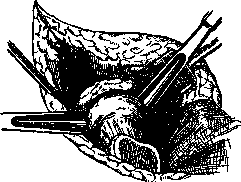
Fig. 1. Mobilization of an ankylosed hip joint according to Payr. by surgeons are set much wider than on the lower, since there arthroplasty is technically much simpler and systematic postoperative functional treatment can be carried out incomparably more easily.- Arthroplasty should be considered contraindicated in children with incomplete growth (arthroplasty on the lower jaw is permissible at any age). Arthroplasty is contraindicated in the presence of acute and subacute inflammatory phenomena from the joint, in the presence of fistulas, in paralysis of the muscles moving the given joint; atrophy or mild degenerative changes in the muscles are not a contraindication—on the contrary, they are rather curable after mobilization of the joint. In tuberculous and streptococcal arthritis, it is necessary to approach arthroplasty with greater caution—only several years after the process in the joint has completely subsided. In active tuberculosis of the knee, shoulder, and elbow joints, simple resection is indicated; arthroplastic resection with subsequent mobilization usually has to be abandoned. The most essential technical moment in arthroplasty is the treatment of joint surfaces and interposition. To restore free mobility of an ankylosed joint, it is first of all necessary to create bone surfaces corresponding to the mechanics of the given joint. The closer the resected joint end of each bone approaches the anatomical norm, the more favorable will be the functional fate of the new joint. The general principle of any arthroplastic resection is the creation of a new joint socket and a new joint head. For this, flat and grooved chisels, manual and electric burrs, bone forceps, resection knife, and file are used. When modeling the joint ends, it is necessary to resect as much as is required for the free sliding of the new head in the new socket; too wide a resection can lead to the formation of a loose joint. The padding (interposition) of soft tissue, isolating the freshened surfaces of the newly formed joint ends from each other, is considered obligatory by almost all surgeons. At present, fascia serves as the material for it. Murphy (Murphy) and his school use a pedicle flap due to the greater viability of such a flap. Payr, Putti, Campbell, and others use free transplantation, in which the flap is taken from another extremity
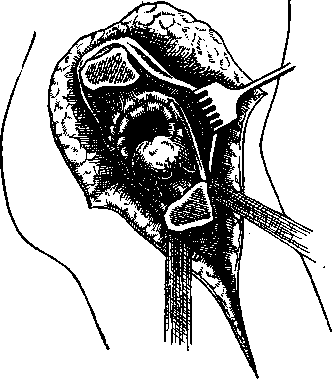
Figure 2. The joint is mobilized. The femoral head and joint socket
covered (according to Raug) with a fascia freely transplanted to the soft tissues and sutured along the edges. The flap is usually fixed (with several sutures along the edges) to the newly formed 'head'; one should try to avoid the formation of excessive folds. Lexer recommends using fatty tissue for interposition, believing that loose joints are more often observed when fascia is used as padding material; on the other hand, fat is a good biological hemostatic material, which certainly plays a certain role in the technique of arthroplasty due to the danger of a blood clot (from bleeding bone) forming in the cavity of the new joint. This danger can, however, be avoided in another way, without resorting to fat; moreover, it should be remembered that the transplanted fat easily undergoes decomposition, forming fat droplets which are then exuded through the wound. Furthermore, muscle flap plasticity was also recommended for interposition; this method is now abandoned. The American Baer, who has worked extensively on the problems of arthroplasty, uses almost exclusively the pig's bladder, treated with solutions of chromic acid of various concentrations, for interposition. The final functional results of any arthroplastic operation, however, depend not only on the good technique of the operation itself; an equally (if not the most important) role in this respect is played by the correct and systematic application of postoperative functional treatment. In the mobilization of an ankylosed joint, arthroplasty as such is only the introductory act, and the results of a technically flawless operation can easily be reduced to almost zero if the patient is not provided with systematic application of exercises with active (and partly passive) movements along with all other physical therapeutic means (galvanization, massage, local active hyperemia, etc.). In order to create the possibility of early movement in the newly formed joint, it is necessary to immediately place this joint in conditions where the intra-articular pressure would be persistently lowered. For this, it is first necessary to bring the muscles of the given limb into a state of atony, which is best achieved by constant traction in the semi-flexed position of the limb. Many use a plaster cast or various types of splints for the initial period, and then, when the time comes for exercises, massage, etc., they resort to traction, suspension, and the use of movable splints. Exercises can be begun on the upper extremity after 6-8 days, on the lower after 10-14 days post-operation. The movements must be strictly dosed—first passive movements are used, then active movements; they should be performed at first with extreme caution, being satisfied with a small amplitude, and, gradually increasing the latter, systematically continue these exercises for no less than 6-8 weeks, simultaneously applying massage and other physiotherapeutic procedures. After arthroplasty on the lower extremity, the patient should not be allowed to bear weight on it firmly before the expiration of three months (use crutches!).
Related articles
Mentioned in
Cite this page
“Arthroplasty.” Soviet Medical Encyclopedia. English translation of Bolshaya Meditsinskaya Entsiklopediya, 1st ed. (Moscow, 1928–1936), ed. N. A. Semashko. https://sovietmedicalencyclopedia.pages.dev/article/arthroplasty/