Railway Carriage
Historical document, translated for reference. It reflects medical knowledge of the 1920s–30s and is not medical advice.
Summary
An overview of railway carriages from a sanitary and hygienic perspective, detailing their types, construction, lighting, heating, and ventilation systems as used in the Soviet Union and internationally in the 1930s.
Encyclopedia article (1928–1936)
RAILWAY CARRIAGE (from English waggon), as a temporary dwelling for passengers who are in unusual conditions for them and therefore can more easily be subjected to diseases, is of great importance from a sanitary and hygienic point of view. With the large extent of the railway network of the USSR, a passenger's stay in a carriage can last up to two weeks; in addition, a carriage can also play a major epidemiological role by successively transporting healthy passengers after contagious ones. Two main types of carriages are distinguished: passenger and freight, and by the number of axles—two-, three-, four-, and six-axle. Passenger carriages at the present time are made, mainly, as four-axle, on two Pullman bogies; simple two- and three-axle carriages are not as convenient and are gradually being phased out of long-distance trains and are used, mainly, in suburban and local traffic. According to the body design, passenger carriages are divided into corridor (with doors in the front and rear walls) and non-corridor (with doors in the side walls). Non-corridor carriages are relatively common on the railways of Western Europe. In the USSR, exclusively corridor carriages are used. The most convenient type of carriage is the so-called "resort" carriage, with a side corridor along the entire carriage and with compartments with sleeping berths isolated on one side of the corridor. With this arrangement, the passage of the train crew and passengers does not disturb the remaining passengers in the compartments, and in addition, a greater possibility of isolating and grouping individual passengers and their groups is created. Water closets and washbasins are arranged at both ends of the carriage (see Figure 1). Special compartments are set aside for the conductor and for heating. Entry into the carriage is arranged through vestibules at both ends of the carriage.

Figure 1. Scheme of a long-distance carriage: 1—vestibule; 2 and 3—corridor; 4—lavatories; 5—boiler room; 6—conductor's compartment; 7–11—compartments for passengers.
The dimensions of such a carriage are 9 compartments with 4 seats each. The length of the compartment is 1,990 mm, the width is 1,620 mm, the height in the central part is 2,900 mm. The area of the compartment is 3.223 sq. m, the cubic capacity is 9.349 cubic m, per 1 passenger—0.805 sq. m and 2.337 cubic m, the width of the corridor is 950 mm, the length of the lavatory is 1,990 mm, its width is 1,000 mm. The length of passenger carriages varies: 12.5, 14.5, 18, 20, and 22 m. Their tare weight is 16, 17, 33, and 42 tons. The number of seats ranges from 28 to 40 sleeping and from 55 to 78 daytime seats. Most common are corridor carriages, without a corridor and without separate isolated compartments, but only with compartments separated from each other by backs that do not reach the top and rise for the arrangement of the upper berth (see Figure 2). According to internal finish, carriages in the USSR are hard and soft, of which the former are easier to subject to sanitary processing. Both types

Figure 2. Scheme of a long-distance carriage: 1, 2, and 3—compartments for passengers; 4—conductor's compartment; 5—lavatory; 6—boiler room; 7—vestibule; 8—corridor; a—long bench for two passengers in sleeping carriages and for three in daytime ones; b—short bench for one passenger; c—small table.
consist of sleeping and daytime carriages. The carriage body consists of wooden (in the USSR) or steel (in America, England, and Germany) beams sheathed on both sides with narrow boards (sheathing). Externally, the walls are sheathed with iron of 1.5–2 mm. The space between the two rows of boards is filled with some heat-insulating material (cork, felt, roofing felt, etc.). The floor is made double or even triple, with insulating interlayers. Window dimensions are 465 mm x 850 mm, and in large 20–22-meter carriages—1,100 mm x 900 mm. Externally, near the window frames, "paravans" are arranged to protect against dust and sparks from the locomotive and to enhance ventilation. If its front plate is placed at an angle of 135° to the carriage wall, and the second is pressed against the wall, then dust and sparks rejected by the first paravan will not get into the window, and the wind, rushing past the window, will enhance the ventilation of the carriage through the window. Artificial lighting is produced by candles, gas, or electricity. Candles are lit in special lanterns equipped with tubes for venting combustion products to the outside and holes at the bottom of the lantern for air inflow. The inconveniences and uneconomical nature of this method lead to its gradual replacement by other lighting methods. Gas is supplied to the carriage through a pipeline under a pressure of up to 10 atmospheres and is collected in receivers with a capacity of up to 10,000 liters placed under the carriage. From the receiver, gas is conducted through the carriage gas pipes under a pressure of 6–7 atmospheres to gas lanterns, while its pressure is preliminarily reduced in a special apparatus, the "pressure regulator," to 0.65 atmospheres. The gas burner is equipped with an incandescent mantle. Lanterns are usually arranged in combination with ventilation so that the ventilator simultaneously serves as an exhaust for the lantern. The luminous intensity is usually equal to 20 and 40 normal candles. Gas lighting is now used relatively rarely; it is being displaced by electric lighting. All the variety of applied electric lighting systems (up to 20) can be reduced to the following main varieties: 1. The train is lighted from its own central electric station placed either on the locomotive, as in Germany (steam-dynamo), or in the luggage carriage or in a special separate carriage (dynamo with an oil, kerosene, or steam engine). 2. The electric station is placed in one of the passenger carriages (carriage-station) and lights, in addition to its own carriage, up to 10 other "idle" carriages having only wiring, or up to 5–6 carriages (carriage-substation). 3. Each carriage is equipped with its own small dynamo-machine and lights only itself (autonomous carriage). 4. The carriage is lighted by a dynamo-machine driven from the carriage axle. 5. The carriage is serviced by a storage battery system charged from some power station. The luminous intensity of the applied bulbs is usually equal to 16–20 candles, in corridors—10 candles. Each bulb is equipped with its own switch. Heating of carriages is produced by 1) iron stoves (almost exclusively in former 4th-class carriages), 2) heated air conducted through pipes from an air-heating chamber (rarely used), 3) water and steam heating systems (most frequently used). With the water heating system, water is heated to 70° in a boiler located at the end of the carriage in a special compartment, goes through pipes laid at the top along the carriage, descends at the end of the carriage into the lower pipes, through which it returns to the boiler. Water is pumped into the boiler manually by an Alveier pump from a special reserve water tank. The heating surface of the pipes must be from 0.15 to 0.4 sq. m per 1 cubic m in order to maintain a temperature of 20° in the carriage. With steam heating, the steam boiler is placed either independently in each carriage, in a special compartment, or in a special carriage-steam generator, usually placed in the middle of the train for uniform heating of both its halves, or steam is obtained from the locomotive boiler, in which case the steam located in the locomotive boiler under high pressure is reduced by means of a reducing valve to a pressure of 1.5–2 atmospheres and only then admitted into the carriage pipes. The pipe system in the carriage is laid at the bottom of the carriage, along the side walls; the pipes discharging steam and condensation water into the reserve water tank are also located here. The pipes of individual carriages are connected by rubber sleeves with nuts. When heating from the locomotive, the steam supply is regulated by the driver at the direction of the train conductor crew; in other systems, special stokers look after this. Steam-air heating is also sometimes used, in which, by means of an injector device (thermo-circulator), the passing steam is mixed with air sucked into the device. This steam-air mixture is then directed into the heating pipe network (Horovitz system). Appropriate supervision of heating by well-trained stokers is necessary. To monitor the temperature, each carriage is equipped with several thermometers. Ventilation of carriages in the USSR is produced almost exclusively by an exhaust fan of the Korshunov system (see Figure 3). It consists of six truncated cones entering one into the other in such a way that passages remain between them. The upper three truncated cones have their vertices facing upwards, the lower three—downwards. The junction of the upper half with the lower represents a sharp rib, against which the air rushing towards the moving carriage is broken into two streams passing through the passages between the conical surfaces and exiting behind the device. This creates a rarefaction of air inside the cylindrical pipe onto which the apparatus is put and by which it is connected to the ventilated room, and an air draft from the carriage is established. The ventilator is sometimes connected with gas burners for the purpose of exhaust of combustion products. With heating, the ventilator is not connected. In general, on the railways of the USSR, ventilation has not been connected
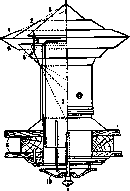
Figure 3. Korshunov ventilator (left half—sectional view): 1, 2, and 3—upper conical surfaces; 4, 5, and 6—lower conical surfaces; 7—pipe connecting the ventilator to the carriage; 8—carriage ceiling; 9—stop connecting the lower surface to the corresponding upper one; 10—cover (inner).

with heating, as is done on the railways of some states of Western Europe and America, where air captured by special funnels located on the roof of the railway carriage is directed along the steam heating pipes and, having heated up from them, enters the interior of the railway carriage, while the stale air is extracted by fans connected to gas lamps.
Water supply of the railway carriage (for heating, washbasins, and water closets) is provided through a system of pipes receiving water from reserve water tanks usually placed in the heating compartments or washrooms. Water is poured into the tanks by buckets or from water mains using hoses through hatches or funnels opening on the roof of the railway carriage. The tanks must be arranged so that they are accessible for inspection, cleaning, and flushing, and must hold at least 20 buckets. To save space, water closets are arranged together with washbasins. The floor is lined with tiles (in soft railway carriages) or iron, concrete, cement, or asphalt (in hard railway carriages). The walls (wainscot) are also lined with tiles or oilcloth (in soft ones) or painted with oil paint (in hard railway carriages). The washbasin and toilet bowl are made of cast iron enameled, earthenware, or porcelain. The bowl is flushed with water that enters the bowl through a pipe from the aforementioned water tank. Excreta are discharged through an opening in the floor onto the track, where they are to be cleaned up by track watchmen. In order to prevent the contamination of station soil and populated areas, water closets are closed for use when the train passes through them. On some American railways, it is not the water closets that are locked, but airtight shutters in the bottom of the toilet bowl. They are also closed when the train passes through rivers serving as a source of drinking water supply. The list of such rivers is published by public health authorities. In suburban trains, a flushless toilet system is used. Water closets on Western European railways are supplied with toilet paper, sometimes specially cut paper for lining the toilet seat, soap, and a common towel; on some American railways, with individual towels, with the towels attached by rings to a wire running from the shelf where the towels are kept to the basket for dirty towels into which passengers throw the towel after using it. There are also decanters for drinking water with individual paper cups. The use of common cups and towels is prohibited by the health regulations of the railways of the United States of America.--The interior equipment should provide for the convenience of passengers, especially in long-distance railway carriages. To increase the number of sleeping places, the backs of the sofas are made liftable, with ladders or devices (retractable iron fingers) for climbing up. Conductors are supplied with a stock of blankets, mattresses, and bed linen that has been washed, disinfected, and stored in sealed bags. German railways, for an additional fee in hard railway carriages, issue special soft seats with footrests for the legs and a headrest. Folding tables are made near the windows. Shelves and niches above the corridor ceiling are arranged for luggage. The railway carriage is supplied with ashtrays and spittoons (in each compartment) and two garbage cans at the ends of the railway carriage. In soft railway carriages, the sofas are upholstered with dense hemp fabric (ticking) and covered with rep-ticking covers that are replaced every time. Plush and cloth, formerly used, are going out of use due to high cost and unhygienic nature. The floor is covered with linoleum, and the walls with oilcloth (linkrusta). In the USSR, railway carriages of the Direct Communication Sleeping Car Administration are distinguished by the greatest comforts and the best arrangement meeting hygienic requirements. Suburban railway carriages have the simplest arrangement; they have no sleeping accommodations, tables, flush toilets, etc. Former 4th-class railway carriages, which are currently being phased out, represent a type approaching a boxcar-heater and are poorly suited for long-distance travel. The dining car (see figure 4) is usually arranged in a large Pullman railway carriage: part of it is set aside for the restaurant proper (for 40 people) with a cubic capacity of 2.2 cubic meters per passenger, and part for the kitchen and buffet with cabinets and shelves. The kitchen houses a cast-iron stove on legs and a boiler for boiling water. Iceboxes for food storage are sometimes made in boxes under the vestibule floors, and sometimes a special compartment is set aside for this. Inside they are lined with zinc.--The lecture railway carriage (sanitary and hygienic exhibition, cinema railway carriage, etc.) is usually a Pullman railway carriage in which, except for two compartments for the service personnel, a water closet, and a boiler room, all the remaining space is set aside for a hall to place exhibits, demonstrate films, etc. The railway carriage is equipped with top lighting through a skylight, which saves a large wall area for hanging exhibits. A booth is installed for the motion picture projector.

Figure 4. Diagram of a dining car: 1-vestibule; 2-corridor; 3 and 4-dining room; 5-buffet; 6-kitchen; 7, 8 and 9-storerooms; a-tables; b-cupboards and drawers for tableware and provisions; c-stove. -= 13 15 l___l 1___1 5 4 ш Figure 5. Diagram of a consultation railway carriage for infants: 1-entrance; 2-corridor; 3-registration desk; 4 and 5-boxes; 6-waiting room; 7-doctor's consulting room; 8-corridor; 9-doctor's compartment; 10-nurse's compartment; 11-attendant's compartment; 12-lavatory for patients; 13-lavatory for staff; 14-kitchen; 15-corridor; 16-boiler room; 17-storeroom, lined with non-combustible material. These carriages serve many stations and the surrounding rural population according to a special schedule, remaining at a station for several days. Ambulatory cars, dental ambulatory cars, malaria stations, and the like are usually arranged according to a single type: two or three compartments are set aside for medical and service personnel, one compartment is allocated as a consulting room, and a large compartment is given over to a waiting room for patients. The carriages are supplied with appropriate furniture and cabinets with slots for instruments, apparatus, reagents, and medicines. The laboratory car, in addition to the staff compartment, has two compartments for chemical and bacteriological (or other) analyses, and one compartment for experimental animals. In plague laboratories, a special compartment is set aside for work with plague cultures. The furnishings and upholstery of this compartment must provide for the possibility of its complete disinfection. The carriage is supplied with equipment according to a special list of the People's Commissariat of Health. The laboratory car serves to take the first measures against a plague epidemic. The mother and infant welfare consultation car (see Figure 5), in addition to the staff compartment, doctor's office, and waiting room, also has a room for preliminary examination of children and boxes for isolating patients. Sometimes one of the vestibules is used to set up a milk kitchen. The sanitary car for transporting patients to the nearest hospitals has a staff compartment, a compartment for non-contagious patients, and sometimes a special compartment for contagious ones (see Figure 6). In addition to the usual doors, there is also a wide door in the side wall for bringing in stretcher patients. The carriage is supplied with cots, stretchers, linen, dressings, and medicines. The cots are of the usual webbed type, or Krieger frames are installed. The carriage serves 2–3 neighboring districts. The sanitary carriage of an auxiliary train to provide assistance in railway accidents consists of three compartments: a) an examination and dressing room, b) a ward for the injured, and c) quarters for the medical personnel. The dressing room must have, in addition to appropriate furniture (a dressing table and a cabinet for instruments and medicines), X) п ^p £L Figure 6. Diagram of the sanitary carriage of an auxiliary train: 1-wide entrance for bringing in stretchers; 2-compartment for examination and dressing of the injured; 3-compartment for the injured; 4-corridor; 5-compartment for medical personnel; 6-lavatory; 7-vestibule; 8 and 9-storerooms; a-cots; b-dressing table. washbasin, and enhanced lighting. The ward contains 4 cots, 4 spare cots for the second tier (Krieger frames), and stretchers. Double doors for bringing in stretcher patients are located on the end side, which, although it requires moving the railway carriage away from the adjacent one, provides convenience for loading the wounded in the event of wrecks on embankments with slopes from which it is impossible to bring a wounded person through the side door. The inventory list and the order of use of the railway carriages are provided for by instructions of the People's Commissariat of Health. The bath car is usually housed in a freight car, half of which is used as a undressing and dressing room, and the other half as a shower room. Hot water is supplied either from the locomotive or from a special boiler placed in the boiler room of the carriage. Water is piped to the showers along the walls of the carriage. The floor and wainscot are lined with waterproof material (galvanized iron). Drainage is through holes in the floor. The isolation car serves for the temporary isolation of inhabitants of housing undergoing disinfection. The carriage has a shower and bathroom for those being isolated, a hearth for food preparation, and a staff compartment. The teplushka (heated freight car) is a freight car with double lining of walls, floor, and ceiling, with insulation of felt, roofing felt, Swedish cardboard, or other heat-insulating materials. It is equipped with a cast-iron stove, plank beds or boards for them, and a footboard for entering the carriage. In the case of transportation of military units, special requirements are provided in agreement with the military department; in the case of transportation of resettlers, on the basis of a special agreement between the People's Commissariat of Railways and the People's Commissariat of Agriculture. The maintenance of railway carriages in a sanitary condition, their cleaning, disinfestation, and disinfection are regulated by special rules and instructions of the People's Commissariat of Health and the People's Commissariat of Railways (People's Commissariat of Railways Order No. 1843 of September 13, 1924; Instruction on the cleaning and maintenance of the railway carriage in cleanliness No. 8562 of May 25, 1926; Instruction on the disinfection and disinfestation of the railway carriage No. 8613 of June 8, 1926, etc.). Tank car—see Water supply. Disinfection chamber car—see Disinfection. Refrigerator car—see Perishable goods.
S. Kazansky.
VAGONEVROSE, see Vegetative neuroses.
Related articles
Cite this page
“Railway Carriage.” Soviet Medical Encyclopedia. English translation of Bolshaya Meditsinskaya Entsiklopediya, 1st ed. (Moscow, 1928–1936), ed. N. A. Semashko. https://sovietmedicalencyclopedia.pages.dev/article/railway-carriage/