Autoclave
Historical document, translated for reference. It reflects medical knowledge of the 1920s–30s and is not medical advice.
Summary
This article describes the autoclave as a device for steam sterilization under pressure, operating on the principle of a Papin digester. It details the construction, typical usage, and safety procedures for sterilizing medical instruments and bacteriological media in the early 20th century.
Encyclopedia article (1928–1936)
AUTOCLAVE (from the Greek autos—self and Latin clavis—key), a device for steam sterilization under pressure, constructed on the principle of a Papin digester. An autoclave is a hollow, thick-walled boiler of cylindrical shape with a screw-on, hermetically sealing lid and a double bottom. The autoclave is equipped with a pressure gauge, as well as a safety valve and a steam exhaust pipe. For bacteriological purposes, autoclaves are used in which the pressure can be brought up to 3 atmospheres. Autoclaves are heated by gas, kerosene, or electricity. Autoclaves can be 1) of the ordinary type (see Figure 1), used primarily in bacteriological practice, and 2) of the horizontal type (see Figure 2), more often used in surgical practice
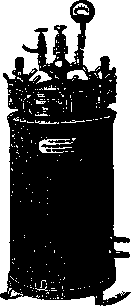
Figure 1.
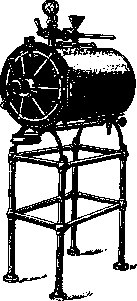
Figure 2.
for the sterilization of dressing materials and instruments (see Sterilization). Almost all nutrient media used in bacteriology (broth, agar, potato, etc.) are sterilized in an autoclave; as are glassware and glass instruments with rubber parts that cannot withstand dry sterilization, dressing materials, instruments, etc. Usually, sterilization in an autoclave is performed at 120° for 20 minutes (which, according to the table of Dulong and Arago, corresponds to two atmospheres of pressure) or at 115° for 30 minutes (corresponds to 1 1/2 atmospheres of pressure). Method of use: water is poured into the bottom of the autoclave, the items to be sterilized are placed on the grate located at the bottom of the autoclave, the lid is screwed on while leaving the steam exhaust pipe open, and heating of the autoclave begins. After some time, the water begins to boil, and steam, initially mixed with air, comes out through the steam exhaust pipe; soon, the continuity of the steam jet indicates that all the air has been displaced from the autoclave, and the steam exhaust pipe is closed. As soon as the steam output has ceased, the pressure gauge begins to register an increase in pressure inside the autoclave. Having brought the pressure inside the autoclave to the desired level, the heating of the autoclave is reduced so that the pressure is maintained at one level for the entire time necessary for sterilization. After this, the heating is stopped, the pressure is allowed to drop to atmospheric, and the steam exhaust pipe is opened. Upon cooling of the autoclave, the sterilized objects are removed from it, and the sterilization is considered complete. One should avoid overheating the autoclave, which can occur with careless handling of the safety valve. In the event of overheating of the autoclave and the failure of the safety valve, the autoclave may explode, destroy the room in which it is located, and cause severe injuries to the person performing the sterilization. To control the temperature of the autoclave, it is recommended to use powdered substances with a specific melting point. To check the temperature at 110°, benzonaphthol is used; for 113°, antipyrine; for 121°, benzoic acid. Indicators—safranin, brilliant green—are usually added to the above-mentioned substances, which color the powdered substance in the corresponding color at the moment of its melting.
V. Vygodchikov.
Related articles
Mentioned in
Cite this page
“Autoclave.” Soviet Medical Encyclopedia. English translation of Bolshaya Meditsinskaya Entsiklopediya, 1st ed. (Moscow, 1928–1936), ed. N. A. Semashko. https://sovietmedicalencyclopedia.pages.dev/article/autoclave/