Dressing Material
Historical document, translated for reference. It reflects medical knowledge of the 1920s–30s and is not medical advice.
Summary
This article describes dressing materials used in surgical procedures and wound care, outlining their requirements and various substances that can be used, including their absorption capabilities as studied by Preobrazhensky and others.
Encyclopedia article (1928–1936)
DRESSING MATERIAL, material used in operations and dressings with the aim of drying the operative field or wound, stopping bleeding, protection from external harmful influences, for absorption of wound discharge, and in the treatment of wounds. The following requirements are made of D. m.: 1) good absorption capacity, 2) rapid drying, 3) possibility of sterilization without deterioration of properties, 4) absence of properties irritating tissues, 5) elasticity, and 6) low cost. The great importance of the first two properties of D. m. in the treatment of both clean and infected wounds was long ago pointed out by Preobrazhensky, Neuber, and others. The first of them developed the doctrine of the so-called "physical antiseptics". A well-absorbing D. m. dries the wound of its discharge, which is a good nutrient medium for bacteria. With rapid drying of the D. m., an outflow of wound discharge from the wound outward is created, whereby toxins and bacteria are as if washed out of the wound. There is quite a significant number of substances that to a greater or lesser extent meet the requirements made of D. m. These include: gauze, cotton, lignin, granulated peat, canvas, flannel, moss, peat, jute, kraft paper, wood wool, cellulose wool, hemp, asbestos, glass wool, charcoal, sand, ash, and many others. The absorption capacity of D. m. was tested by Preobrazhensky and a number of other authors, the first of whom gives the following table: Table 1. Material Simple cotton . . . . . Hemp tow . . . . Peat........ Moss......... Kraft paper. Gauze....... Defatted cotton Wood wool . .
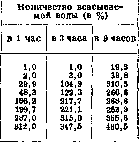
Table 2.
Simple cotton wool ** . . . Hemp ....... Peat......... Moss......... Paper pulp . Degreased gauze Degreased cotton wool Wood wool . . . Weight with water * 148.0 94.0 185.0 222.0 136.0 137.0 156.0 110.0 Loss of water at room temperature for 1 day for 2 days for 3 days 26.0 42.0 38.0 42.0 26.0 45.0 38.0 69.0 50.0 66.0 82.0 74.0 46.0 84.0 69.0 85.0 81.0 112.0 116.0 76.0 108.0 117.0 87.0 * The weight of all dressing materials was the same, namely 23.0. ** Moistened in a certain amount of water at room temperature and brought to a weight of 148.0. However, the absorption by dressing materials of such substances as pus or blood does not occur analogously to the absorption of water. One of the best materials in this regard is gauze. Since the latter also has other positive qualities (softness, flexibility, does not clog the wound), it is the most important and most frequently used dressing material. Along with gauze, cotton wool and lignin are also of great importance. Gauze as a dressing material is used as white hygroscopic material. From it are made dressings, compresses, semi-compresses-pieces of various sizes of gauze, folded in two, three, four times, with edges turned in so that individual threads do not remain in the wound. The size of such compresses and dressings can vary approximately from 3 x 3, 8 x 8, 30 x 30, 50 x 10 (semi-compress) to 50 x 30 cm (compress) and etc. Small compresses are used for drying the operative field, the wound. Larger compresses serve to protect the operative field from external infection, from the leakage of blood and infectious contents when opening body cavities, abscesses, etc., and when moistened in hot physiol. solution protect internal organs (e.g., intestinal loops) from drying out and cooling. To gauze compresses placed deep in the wound during operations, long threads with beads on the end are sometimes attached, which can be numbered. These threads are left outside and protect against the possibility of leaving the compress deep in the wound. Gauze balls and lumps of hygroscopic cotton wool, wrapped in gauze, serve for cleaning the edges of the wound and etc. during dressings. Tampons-strips of various lengths (up to 1/2 m) and various widths (from 2.5 cm to 10 cm) of gauze folded in two with turned-in edges. Used for tamponade of wound cavities with the aim of stopping bleeding, for suction of purulent and other exudate from the wound. Tamponade is also used in wounds where infection may develop. Tampon Mikulicha-see Blood vessels-surgery. In addition, from gauze are made so-called n a-p l a s t e s-narrow strips of cotton wool, wrapped in gauze, used for closing clean sutured wounds; over them is placed a piece of gauze, fixed to the skin with collodion, kleol and etc. Gauze bandages (see) are used as a dressing material, fixing the bandage. For bandage bandages, unbleached gauze can be used. Bandages of hygroscopic gauze can be used for tamponade of wounds. Finally, gauze bandages are also part of immobilizing bandages-starch, plaster (see Plaster bandages) and etc. Cotton wool is used both as hygroscopic and gray, the latter only as a heat-retaining and padding material (heating compresses, splint and plaster bandages). Having high absorbency and drying quickly, so-called hygroscopic cotton wool is a very valuable dressing material. Cotton wool applied over gauze on the wound increases the absorbent properties of the dressing and protects the wound from external harmful influences. The disadvantage of cotton wool is its relative expensiveness.-Lignin (alignin, Ligninum) has acquired great importance as a dressing material: the latter is a yellowish-white, finest corrugated sheets of paper. It is obtained from crushed wood, flax and etc. masses by treating them with acids. Microscopically it consists of split cellular elements of wood, bast fibers of flax. Its absorbency is great-1 g of lignin, moistened in water for 5 minutes, after the water has drained, should weigh no less than 14 g. It withstands sterilization well, is stored in a dry, dust-free room. Good absorbency, lightness, low price have contributed to the 26 widespread use of lignin as a dressing material. It is especially suitable for dressing wounds with large amounts of exudate. Its disadvantage is low elasticity. All other materials used as dressings have relatively less importance compared to gauze, cotton wool and lignin. Korpiya-a dressing material widely used in the past. It consists of random in composition threads, mostly cotton, but sometimes also linen. At present, hygroscopic korpiya is used, for which it is subjected to appropriate treatment with caustic and carbonate alkalis of various strengths and under various conditions. Degreased in this way, washed and wrung out korpiya is torn apart by hand or on carding machines. The absorbent capacity of hygroscopic korpiya is quite satisfactory, no lower than that of gauze and cotton wool. The comparative cheapness of korpiya and its hygroscopic properties make it a good dressing material, capable of replacing not only cotton wool and gauze, but also lignin.-Granuleza-see Granulosis.-Jute (jute, Indian hemp). Fibers resembling flax are obtained from young shoots of the Indian plant Corchorus. It contains cellulose in combination with tannin. It is used in the form of skeins, gauze-covered pads, in mixture with cotton wool. It has good hygroscopic properties. At present it is almost not used.-Wood wool (Ramenta ligni, Lana ligni) is obtained by grinding wood into fibers; its mixture with hygroscopic cotton wool is called wood wool (Gossypium ramentum). The absorbency is small. Used for padding.-Cellulose wool. By processing cellulose is obtained a material, in its properties similar to cotton paper. Mixed with cotton wool it is called cellulose wool. Somewhat greater use, especially in wartime conditions, is made of peat and moss (Sphagnum). Peat is cleaned of large parts; earth is sifted out. Used in the form of slabs. It absorbs moisture well. Moss is cleaned of impurities, dried, sewn into gauze bags of various sizes, sterilized. In addition, it is used in mixture with cotton wool.-Although the absorption and drying capacity of some of the substances listed above is higher than that of gauze, cotton wool and lignin, other properties make their use as dressing material less convenient. There are also a number of substances that can be used as dressing material, but their practical significance is negligible. One of the basic qualities of dressing material, namely not to be a source of infection, is achieved by using aseptic and antiseptic dressing material (see Antisepsis and asepsis) during operations and dressings. Sterilization of dressing material-see Sterilization. For providing first aid on the battlefield, in production, in the home setting, it is convenient to use dressing material sterilized in small packets (see Individual packet). Sterile dressing material has at present received very widespread use. The so-called antiseptic dressing material, obtained by impregnating with various antiseptic substances (iodoform, vioform, sublimate, carbolic acid, xeroform, dermatol and etc.), has significantly less importance. In view of the fact that many antiseptic substances in dry and dissolved form do not exert a noticeably harmful effect on the growth of bacteria and their bactericidal action is manifested only in the wound, for example due to the splitting off of iodine from iodoform, it is necessary when preparing antiseptic dressing material to observe the conditions of the strictest asepsis. There are several methods for preparing antiseptic dressing material: 1) rubbing antiseptic powder into the dressing material; 2) impregnating the dressing material with some substance serving to fix the antiseptic agent (glycerin), followed by dusting it with the powder; 3) impregnating the dressing material with a solution or suspension of the antiseptic substance, after which the dressing material is wrung out by hand or on special machines, and then dried. The dressing material is impregnated with solutions or suspensions of various concentrations: 0.5% (sublimate), 10, 20, 30% and etc. (iodoform and etc.). The most widely used among antiseptic dressing materials at present is iodoform dressing material, used mainly in the treatment of purulent wounds. Usually iodoform tampons are used. Iodoform is either rubbed into the dressing material or the dressing material is impregnated with a suspension of iodoform (e.g. iodoform 120.0, ether 800.0, wine alcohol 1,000.0, glycerin 120.0, gauze 1,200.0; iodoform 25.0, alcohol and ether aa 500.0, glycerin 25.0). In addition to iodoform, the dressing material is also impregnated with other antiseptic substances. Sublimate dressing material-sublimate gauze (0.5%) is prepared by the following formula: sublimate 6.0, wine alcohol 50.0, glycerin 50.0, distilled water 1,700.0, purified gauze 1,200.0 or instead of alcohol and glycerin 6.0 NaCl is added. Sublimate dressing material is sometimes used in preparing individual packets. Impregnation of dressing material with sublimate is done in a dark room. Gauze with carbolic acid (10%)-liquid carbolic acid 132.0, wine alcohol 1,000.0, glycerin 200.0, water 300.0. This mixture is used to impregnate 1,200.0 of gauze, which is then hung for drying in a dark room.
Gauze with dermatol (5%)—dermatol 60.0, glycerin 120.0, distilled water 1,650.0, purified gauze 1,200.0. In the same way is prepared 10% dermatol gauze. Gauze with viioform (5%)—viioform 60.0, wine alcohol 300.0, glycerin 60.0, distilled water 1,350.0, purified gauze 1,200. Previously viioform is dissolved in alcohol; water and glycerin are added after. In addition to impregnating dressing material with antiseptics, impregnation with hemostatic and other substances is also used. Hemostatic cotton (with iron chloride) (20%)—crystalline iron chloride 2,000.0, wine alcohol 6,000.0, water 11,500.0. With this solution 10 kg of purified cotton is impregnated. Dried and stored in a dark place. Gauze with iron chloride (20%)—iron chloride 240.0, wine alcohol 500.0, water 1,000.0, purified gauze 1,200.0. Dressing material with ferropyrin (10%) is also used as a hemostatic. Cotton with ferropyrin (10%)—ferropyrin 1,000.0, glycerin 250.0, cold water 19,500.0. 10 kg of purified cotton is impregnated. Dried and stored in a dark place.—Gauze with ferropyrin (10%)—ferropyrin 120.0, glycerin 60.0, water 1,700.0, purified gauze 1,200.0.—Dressing material with stypticin is used mostly in dental surgery. Gauze with stypticin (33⅓%)—stypticin 200.0, glycerin 25.0, distilled water 375.0, hygroscopic gauze 500.0. Cotton with stypticin (20%).—Stypticin 200.0, glycerin 30.0, distilled water 1,900.0, hygroscopic cotton 1,000.0. Dried in a dark place. In addition, impregnation of dressing material with analgesic (2% cocaine cotton) and other medicinal substances is also used. The aforementioned dressing material is stored in glass jars with ground stoppers. When using antiseptic dressing material, it is necessary to keep in mind the possibility of poisoning from it (iodoform, sublimate). For economy of gauze, due to its relative high cost, the latter can be used repeatedly. Only gauze used in clean operations is suitable. Compresses, tampons, bandages stained with blood are thrown into a vessel with a soda solution or ammonia solution, then washed, boiled in a soap solution, rinsed and dried.
Related articles
Mentioned in
Cite this page
“Dressing Material.” Soviet Medical Encyclopedia. English translation of Bolshaya Meditsinskaya Entsiklopediya, 1st ed. (Moscow, 1928–1936), ed. N. A. Semashko. https://sovietmedicalencyclopedia.pages.dev/article/dressing-material/