Desmurgy
Historical document, translated for reference. It reflects medical knowledge of the 1920s–30s and is not medical advice.
Summary
This historical article from the 1928-1936 Soviet medical encyclopedia defines desmurgy as the branch of practical surgery studying the application of various bandages and dressings. It covers traditional bandaging techniques, materials like gauze and muslin, and specialized bandages such as slings and triangular bandages.
Encyclopedia article (1928–1936)
DESMURGY (from the Greek desmos - bond), is a branch of practical surgery that studies the application of various kinds of bandages. In the Russian language, there are two terms - povyazka (bandage) and perevyazka (dressing), used either as synonyms or with different meanings; in the latter case, dressing is understood as a whole, of which the bandage forms a part. - A bandage represents, as it were, the outer part, the shell of a dressing, playing a more mechanical role, i.e., securing the dressing to a wound (covering bandage), exerting pressure (pressure bandage), immobilizing a joint or a bone fracture site (immovable bandage), or producing traction (traction bandage). Under the name of dressing, one understands more of the therapeutic part of the matter, mainly in relation to wounds and ulcers, keeping in mind the antiseptic and aseptic properties of the "dressing material" and its physical properties. Under the name of dressing, we also understand the act of changing the bandage. Modern advances in surgery in the treatment of wounds and skeletal injuries and the rapid development of orthopedics at the present time have especially highlighted the necessity of studying desmurgy in all its technical diversity, reflecting the scientific movement of surgery. Accordingly, the teaching of desmurgy has been transferred to a clinical setting. - The mechanical task
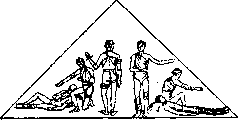
Figure 1.
of a bandage consists first of all in covering one or another part of the body to protect it from external influences and to secure applied therapeutic agents upon it. This goal can be achieved by simplified devices in the form of so-called triangular bandages, slings, T-shaped bandages, and others. A triangular bandage is a triangular piece of calico or other fabric obtained by cutting a square measuring 70-90 cm along the diagonal (see Figure 1). The triangular bandage is suitable for the rapid covering of an injured part of the head (see Figure 2), abdomen (see Figure 3), chest, back, shoulder, buttocks, hand (see Figure 4), and foot. It finds particularly wide application in combat situations or in the accidental conditions of a factory, mine, apartment, etc. The triangular bandage covers the site of injury with its middle, while the three ends are tied on the opposite side of the body, or two ends are tied and the third is tucked under a second triangular bandage applied in the form of a cravat around the neck (see Figure 5) and in the form of a belt around the waist. The advantages of the triangular bandage are the speed of the achieved coverage; the disadvantage is its low strength and lack of airtightness. The technique of applying the triangular bandage, both abroad and with us, is depicted on the field of its fabric (see Figure 1). The triangular bandage is also used for purely mechanical purposes of suspending the forearm in disorders of the upper

Figure 2.
extremity. - The sling bandage is an oblong rectangular piece of fabric, torn along
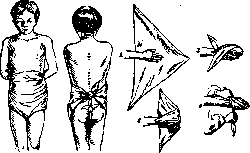
Figure 3.
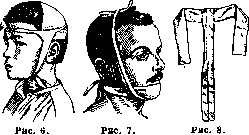
Figure 4. from both ends not quite to the middle, so that 4 ends are obtained. The sling bandage is convenient for the rapid covering of convex parts of the head - the back of the head, forehead, chin, nose. Its solid part covers the site of the injury, and the crossed ends are tied on a distant side (see Figures 6, 7). - The rectangular bandage is applied using a square piece of fabric folded in half, but not quite symmetrically. When applied to the head, four angles hang down; of these, the outer ones are tied under the chin, and the inner ones are brought forward and tied behind on the neck. - The T-shaped bandage is the letter T made from wide strips of fabric. It is used in dressing the nose, perineum, and to support the scrotum instead of a suspensory (see Figure 8). The roller bandage consists in wrapping a part of the body with layers of a long strip of fabric, previously tightly rolled using a special simple machine or by hand. The fabrics for making the bandage can be very diverse. Among them, the most frequent application is found in so-called gauze, i.e., cotton checkered

Figure 5.
fabric of various densities. The advantage of gauze lies in its cheapness, air permeability, and elasticity. The latter quality significantly facilitates the technique of applying a roller bandage. Different

Figure 9.
two grades of gauze are distinguished - soft and hard (starched). The latter is impregnated with starch paste; the former represents the most commonly used material. The art of applying a roller bandage consists in ensuring that the layers of the bandage lie evenly, without forming pockets or slipping. This goal is achieved by certain technical methods while observing known systems of applying bandage turns. The width of the bandage should vary appropriately to individual cases within the range of 4.5 cm to 20 cm. The head of the bandage - its rolled part - when used should, as it were, roll, fitting tightly to the part of the body, without unrolling to avoid folds (see Figure 9). The first turns of the bandage, covering each other, are intended to secure the beginning of the bandage by friction of the contacting layers. Roller bandages are distinguished into: circular, spiral, cruciform, and figure-of-eight. Circular and spiral turns are applicable to a cylindrical part (thigh, arm). The region of joints, which changes its contours during movement, is covered by a series of figure-of-eight bandage turns, a series of crosses in which (see Figure 10) resembles the arrangement of grains in an ear of corn (spica bandage). This application system is used on the shoulder, femoral, ankle, and wrist joints, on the thumb of the hand, and others. Strengthening of the bandage with material economy is achieved by stitching it at the crosses with coarse thread. The cruciform bandage, covering, for example, the back of the neck or knee, represents essentially a figure-of-eight with an immovable cross point (see Figure 9). - Besides gauze, other fabrics possessing greater density or elasticity are used for making bandages. These include: calico, linen, flannelette, flannel, and even rubber fabric. The use of these fabrics is intended for greater airtightness in the so-called warming compress or ointment treatment, as well as a certain pressure for edema and varicose veins. Knitted bandages possess special elasticity and convenience upon application; 'ideal' bandages, manufactured
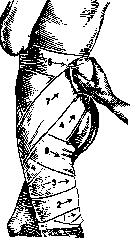
Figure 10.

Figure 11.
Made from crumpled paper fabric, these represent a foreign product possessing great tensile strength. The second layer in the dressing usually consists of cotton wool. The softness, elasticity, and porosity of this material reduce its role to protecting the affected area from external injury, to softening the pressure of the bandage (especially the hardening type), and to protection from cold. The value of cotton wool varieties depends on the degree of its cleaning, on impurities of dirt, on the length of its fibers and elasticity. The color of cotton wool plays a lesser role, although whiteness serves as a greater guarantee to the eye of its purity. The so-called hygroscopic cotton wool represents a product, degreased by boiling in alkali and possessing capillary properties. In terms of elasticity, this cotton wool is inferior to ordinary. In the outer layers of the dressing, the hygroscopicity of cotton wool is superfluous. Substitutes for cotton wool in a mechanical sense are other fibrous products, such as jute, hemp, flax, and wood derivatives, starting from shavings and ending with pure wood cellulose (lignin). Moss and peat are also used for the purpose of replacing cotton wool. For wartime needs, cotton wool is prepared in a compressed form; its packets, like bandages, receive a wrapper of corresponding, different colors. The tasks of D. also include the study of dressings that provide immobility for the purpose of rest for the diseased or injured part of the body. In former times this was achieved by the use of various splints (shin) and grooves, made of cardboard, wood (see figure 11), wire, iron, aluminum, etc. For improvising splints serve household items like lath, twigs, bundles of straw (see figure 12), umbrellas, scabbards from sabers, etc. The technique of immobilization has greatly improved and simplified with the invention in the middle of the 19th century of the so-called hardening dressings, forming a box for including the injured part. The material for impregnating the first hardening dressings was starch paste (Seutin). The appearance of factory-made starch gauze contributed to the further spread of the starch dressing, consisting of several layers of starch bandage soaked in boiling water with strips of cardboard laid between them. After that, the plaster dressing found special, even greater use. The modern technique of its application consists in that the affected part of the body (limbs and spine) is wrapped with gauze bandages dusted with plaster, moistened in warm water. The number of necessary layers depends on the massiveness of the dressing, into which metal, wooden, and cardboard splints can also be inserted. After starch and plaster, other hardening substances came into use: glue, water glass, cottage cheese, celluloid, gelatin. Hardening dressings require special instruments for their removal (Seutin's, Stille's scissors, etc.); usually these dressings are applied over a layer of cotton wool. The process of applying or changing the dressing should be arranged with the least disturbance to the patient and with convenience for the surgeon. In case of mild injuries to the head, trunk, and limbs, the patient is placed in a sitting position. Dressing in a lying position is facilitated by the use of special dressing tables with supports under the sacrum (see figure 13). Among the methods used in D. for the purpose of immobilization, traction holds an important place, most simply achieved by the pull of a weight by means of strips of bandage, glued to the skin with an adhesive composition or with strips of adhesive plaster (see figure 14). More energetic traction, acting directly on the skeleton, is achieved by means of a nail driven through the bone [Steinmann; see separate table (vol. VI, pp. 113-114), figs. 1, 2, 3, 12 and 13].
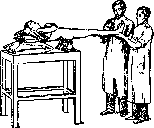
Figure 13.
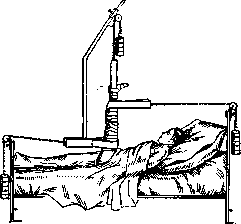
Figure 14.
Automatic traction on the upper extremity is achieved by the use of rubber rings attached to wooden splints (Borchgrevink). Traction of the lower extremity on the move is obtained by the use of Thomas and Taylor apparatuses [Thomas, Taylor; see separate table (vol. VI, pp. 117-118), fig. 17]. An important department of D. is the application of dressings to wounds. The rules relating to this have entered a completely new channel since the birth of methods for combating wound infection, based on the first discoveries of bacteriology. Dressing materials and medicinal substances, used empirically without a clear understanding of the tasks pursued, have given way to purposeful, scientifically based substances. The dressing material, directly applied to the wound, is required to be of absolute purity and capable of absorbing liquid. These tasks are achieved by steam sterilization, degreasing of the material, if possible porous. Soft gauze, directly applied to the area of the wound, has thus displaced the former dirty and fatty corpia. The technique of modern aseptic wound dressing consists in providing the greatest possible cleanliness of the wound area and the material applied to it. The second part of the matter - drying the wound - is achieved by applying gauze in a loose form without covering with tissues impermeable to air and moisture (oilcloth, waxed paper). The role of hygroscopic cotton wool in this sense proved to be insignificant. Substitutes for gauze are various materials that absorb water, such as moss, peat, shavings, lignin, etc. The wound should be protected by a layer of gauze from their direct contact. More energetic drying of the wound is achieved by introducing into its depth strips of rare gauze (tampons) or else rubber, glass, bone drains. The tasks of D. in striving to achieve aseptic dressing should be facilitated by the arrangement of the surgical department, especially the operating room and dressing room, created to reduce sources of wound contamination. Requirements of asepsis are imposed on the instruments, the surgeon's clothing, the operating table. Corresponding to the successes in this direction, the sphere of application of so-called antiseptic substances directly on the wound or for impregnating dressing material has decreased. However, the experience of the last war contributed to the restoration of the importance of chemical means in the fight against severe wound diseases. Preparations of iodine, chlorine, carbolic acid and many others began to be used again. For the possible protection of wounds from primary contamination, in the army is supplied with ready-made, hermetically sealed dressing packets, containing a small amount of sterile dressing material (bandage, gauze compress).
Related articles
Mentioned in
Cite this page
“Desmurgy.” Soviet Medical Encyclopedia. English translation of Bolshaya Meditsinskaya Entsiklopediya, 1st ed. (Moscow, 1928–1936), ed. N. A. Semashko. https://sovietmedicalencyclopedia.pages.dev/article/desmurgy/