Bandages (a269)
Historical document, translated for reference. It reflects medical knowledge of the 1920s–30s and is not medical advice.
Summary
Bandages are strips of material used for binding, supporting, or compressing body parts. This article describes the various types of bandages, their dimensions, parts, materials, and methods of preparation.
Encyclopedia article (1928–1936)
BANDAGES (Latin - fascia, German - Verband, Binde, French - bandage, English - bandage, roller). All names for bandages in various languages indicate that bandages are something binding, connecting, supporting. Bandages are pieces of cloth or tape, 3 to 15 cm wide and 7 to 10 m long. The width of bandages depends on which part of the body they are applied to: the narrowest bandages are used for fingers, while the widest are used for bandaging the abdomen. The following parts of a bandage are distinguished: the initial head - the free end, the terminal head - the end that lies in the center of the rolled bandage, and the body - the entire mass of the bandage. Additionally, two surfaces of the bandage are distinguished: the inner surface, or belly, facing the body of the bandage, and the outer surface, or back. Bandages can be single-headed or double-headed. Single-headed (see Figure 1) refers to a bandage rolled into one roll and thus having initial and terminal heads. Double-headed - having two terminal heads, i.e., rolled from two opposite ends (see Figure 2), and so-called T-shaped bandages, resembling the letter T. Depending on the material, bandages are: 1) gauze, 2) linen, 3) flannel, 4) calico, 5) knit, 6) non-rubberized elastic (Ideal bandage), 7) rubberized elastic, 8) rubber (Esmarch), 9) paper, 10) cotton, 11) starched, 12) plaster. Gauze bandages have the widest application. They are prepared from pieces of gauze by tearing it into strips of a certain width or cutting with scissors. Tearing along the thread, after first cutting the end, is only possible for good, dense types of gauze; loose gauze must be cut (otherwise it shrinks). The selvage of the gauze must be torn off before preparing the bandage, as a bandage with selvage cannot be applied evenly. Bandages are rolled either by hand or by machine. For ordinary bandaging, evenly and tightly rolled bandages are needed, which is difficult to achieve by hand and only with great skill. Usually, bandages are rolled on machines. The simplest and most common is the small Bruns machine (see Figure 3), on which one bandage of any width can be rolled at a time. The device

Figure 1.
Figure 2. it shrinks). The selvage of the gauze must be torn off before preparing the bandage, as a bandage with selvage cannot be applied evenly. Bandages are rolled either by hand or by machine. For ordinary bandaging, evenly and tightly rolled bandages are needed, which is difficult to achieve by hand and only with great skill. Usually, bandages are rolled on machines. The simplest and most common is the small Bruns machine (see Figure 3), on which one bandage of any width can be rolled at a time. The device
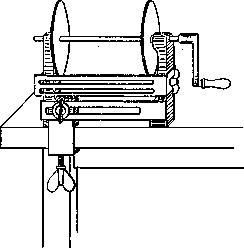
Figure 3.
this is clear from the illustration. In large-scale production of bandages, large machines are used, into which the entire gauze cloth with pre-torn edges is inserted at once. These large machines not only roll the gauze cloth into bandages but also cut the gauze into ribbons with knives contained in the machine. The knives move sideways, and bandages of any width are obtained. The other types of bandages do not have such a mass production method, except for paper bandages, which are widely manufactured in factories in Germany. Gauze bandages have wide application for covering wounds, as they can be easily sterilized. As retaining, fixing bandages, they are little suitable, as they are made of a weak material that easily stretches and twists into bundles. However, in wound dressings, gauze bandages are irreplaceable due to their low cost and hygroscopicity (which is important for wounds with large amounts of discharge). In cases where gauze bandages need to be applied tightly (e.g., a splint for a limb fracture), the bandage should be moistened in hot water without unrolling it, then applied with the required force, and when the bandage dries, it will shrink, and the dressing will be stronger. As a general rule, bandaging should be done from the periphery to the center, placing the bandage evenly so that it does not constrict anywhere. Gauze bandages are removed either by cutting them with special scissors with blunt ends when the bandage is soiled, or, if it is clean, it is unrolled and immediately rolled up for reuse after preliminary washing and sterilization.-Cloth bandages are used like gauze bandages, but they are significantly inferior to gauze ones in both practicality and ease of bandaging. They can be made from new and old cloth (the latter is even softer), but must be freshly washed. The edges of cloth bandages fray easily; to avoid this, they are loosely overcast with thread along the edge. Tight overcasting will cause the edges of the bandage to constrict while the middle remains loose when bandaged. These bandages wash well.-Flannel bandages are much more expensive and stronger and are used as fixing dressings with or without splints (when it is necessary to maintain a dressing holding the bandaged area with constant force for a long time: e.g., in varicose veins, leg edema; fractures of limbs, to support the walls of the abdomen). They are not used for wounds with purulent discharge, as washing them damages them and makes them coarser and less elastic.-Muslin bandages are cheaper than flannel ones, and their application is the same (they are used for applying traction in limb extensions, for which they are glued to the skin with glueol or mastizrol).-Knitted bandages are prepared from knit fabric like a straight stocking, and come in different widths. They are very good for all fixing dressings, especially for bandaging the abdomen in early ambulation after laparotomies.-Unrubberized elastic bandages (Ideal bandages; for a time called Japanese bandages) resemble bandages knitted in one row, are very elastic, and lie very well when bandaged. They are used as fixing bandages and in cases of varicose veins in the legs and ulcers of the same origin. They are an excellent substitute for rubber elastic stockings, and with skillful bandaging, they give even better results. They should be washed without stretching, wrung out by kneading in the hands rather than twisting, and dried by placing on a flat surface rather than hanging on a rope, so that the bandage retains its elasticity.-Rubberized elastic bandages are used like the Ideal bandages, but they are much worse as they allow little air to pass through.-Esmarch's rubber bandages, about 7-10 cm wide, made of thin, elastic rubber. They are most often used for exsanguination of limbs according to Esmarch and for congestive hyperemia according to Virchow (see Bier method).-Paper bandages made of corrugated paper found wide application in Germany during the imperialist war. They are very cheap. They are irreplaceable for fixing a cotton padding on the skin under hardening dressings, plaster and others, as they lie as evenly as the Ideal bandage due to the corrugation, and are incomparable with gauze bandages, which do not lie as evenly on cotton.-Cotton bandages made of so-called Vienna cotton are used as preliminary bandaging on the skin under hardening dressings. These cotton bandages do not need other fixation.-Starch bandages are used only for fixation, usually in non-severe cases of fractures. Before use, they are soaked in hot water. The dressing obtained is light but not very strong.-Plaster bandages are used exclusively for strong fixation not only of limbs but also of the trunk, in the form of plaster corsets and plaster beds. The most secure fixing dressings are obtained. Their use is particularly widespread in bone-joint tuberculosis and fractures (see Plaster dressings, corsets, beds). т. Zaceshsh. BINUCLEATA, binucleate, a term applied to certain protozoa. Strictly speaking, the only correct application of this term would be to rhizopods having two equivalent nuclei, e.g., Amoeba binucleata, and to so-called higher infusoria (Euciliata), which have a complex nuclear apparatus consisting of two non-equivalent nuclei—a macronucleus and a micronucleus, of which the first primarily carries out vegetative functions, while the second participates in the sexual process, forms chromosomes, is the carrier of hereditary properties, and under certain conditions—in connection with conjugation (see) and endomixis (see)—can regenerate a dying macronucleus. Based on the existence of this kind of morphological and functional binuclearity, Schaudinn (1894-95), and later Goldschmidt (1904), constructed a hypothetical theory of the dual nature of chromatin, according to which in all protozoa, including mono-nucleate ones, there are always two kinds of chromatin: vegetative trophochromatin and generative idioplasm, indistinguishable morphologically but functionally different. Another theory of binucleate protozoa arose from Schaudinn's work on the study of trypanosomes (see), for which the presence of a second nucleus, the kinetoplast, from which the flagellum originates and which is therefore associated with locomotor function, is typical in addition to the main nucleus carrying vegetative and reproductive functions. This theory, later developed in detail by Hartmann and his school, is based, however, on insufficiently proven facts, as primarily the nuclear nature of the kinetoplast, which indeed gives a positive Feulgen reaction in some cases, has not been finally proven. Nevertheless, based on these data, Hartmann created within the class of flagellates a special systematic group, namely, the order Binucleata, to which, in addition to the family Trypanosomatidae, he also included other families such as Babesiidae and Plasmodiidae (see Plasmodium), thus separating the latter from the class Sporozoa (see Sporosoa), to which most authors assign them, and classifying them as flagellates. In this respect, Hartmann relied on Schaudinn's erroneous views on the development of Haemoproteus (a coccidiomorphous blood parasite of birds, etc.), to which he attributed binucleate trypanosome stages, whereas in this case trypanosomes were merely a concomitant and completely independent infection. Nevertheless, Hartmann systematically proved the binucleate nature of a number of definite Sporozoa, finding in them traces of the presence of a kinetoplast, and to this day continues to defend the independence of the order Binucleata, occupying an isolated position among modern protozoologists in this matter. G. Epshtein. BINZ, Karl (1832-1913), a famous pharmacologist. From 1860 to 1908, he was a professor of pharmacology in Bonn, where he founded the Pharmacological Institute in 1868 [previously such institutes had been founded by Buchheim in Dorpat in 1840 and by Falck in Marburg in 1867]. From Binz's institute, about 300 works were published in 40 years; about 100 belong to Binz himself. Of these, the most important is his comprehensive research on quinine as an agent affecting various organs of the animal organism as well as microorganisms. This research made it possible for Binz to assert that certain species of the latter are the cause of malaria. Then there is Binz's research on the effect of alcohol (influence on metabolism, temperature, blood circulation), in which Binz is a defender of the stimulating effect of alcohol, which Schmiedeberg and his school deny. In addition, Binz investigated the pharmacology of iodine preparations, essential oils, analgesics, etc. In his research, Binz sought especially to illuminate questions having a connection with clinical practice. His book 'Grundzüge der Arzneimittellehre', which went through 13 editions by 1908 and was translated into 7 languages (including Russian), and his more extensive work 'Vorlesungen über Pharmakologie' (also translated into Russian) gained extraordinary popularity. These works, devoted to experimental pharmacology, rightfully deserve to be counted among the most important guides to pharmacology, by which two generations of physicians studied this science.
The main contribution of B. is that, along with Buchheim, Schmiedeberg, Magendie, Claude Bernard, Lauder Brunton, and others, he helped to establish the view of pharmacology as an experimental science, whereas at the beginning of the 19th century it was taught as a discipline relying exclusively on clinical data. B. also conducted a number of studies on historical-medical issues.
Related articles
Cite this page
“Bandages (a269).” Soviet Medical Encyclopedia. English translation of Bolshaya Meditsinskaya Entsiklopediya, 1st ed. (Moscow, 1928–1936), ed. N. A. Semashko. https://sovietmedicalencyclopedia.pages.dev/article/bandages-2/