Krukenberg Hand
Historical document, translated for reference. It reflects medical knowledge of the 1920s–30s and is not medical advice.
Summary
The Krukenberg hand is a plastic surgical procedure developed by Krukenberg to create a functional grasping organ from a forearm stump after amputation. This operation transforms the residual limb into an active, sensitive pincer-like hand that allows patients to perform fine motor tasks.
Encyclopedia article (1928–1936)
KRUKENBERG HAND (Krukenberg), a plastic operation named after its author, who proposed it to alleviate the helplessness of those disabled patients who have had their forearm amputated. K. published his proposal in 1917. In 1889, the Italian Vanghetti solved the problem of creating a kinematic prosthesis for an artificial hand and developed this idea in his monograph, which appeared in 1906. The kinematization consisted of the following: from the remaining muscles of the stump, a motor loop or (from antagonists) motor loops were created, which through various mechanisms (hooks, springs, wires, rollers) were connected to the fingers of the artificial hand and caused these fingers to bend and extend, activating them. During the war, Vanghetti's ideas were further developed in the works of Sauerbruch, in his "power cushions," and then in his "tunnelization" of the stump muscles. This kinematization of prostheses did not become widely used. K., approaching the solution of the problem from another angle, sought to make the stump of the limb, the residual limb, into an organ that could grasp, completely active, sensitive, tactile. This task was brilliantly solved by him for amputated forearms. The operation according to K.: from the remaining radius and ulna, two giant fingers are made, in such a way that each of these bones retains its muscles, vessels, nerves. The deficiency of skin is compensated for by transplantation. The patient easily learns to coordinate the work of the regrouped muscles, and a new, completely active organ is obtained, very similar to a pincer. The operation can be performed under an Esmarch tourniquet, but it can also be done without one. The plan of the operation is as follows (Fig. 1 and 2). Starting 7 cm from the elbow bend, the incision is first made along the flexor side of the forearm and then crosses the stump to the same height on the extensor side. The incision is made closer to the ulna bone in order to preserve more skin for complete coverage of the radial finger. The median nerve is shortened by 7 cm, the ulnar nerve by 2 cm. M. flex. digit, superfic. is divided longitudinally into two parts—ulnar and radial. The muscles unnecessary for the functioning of the thumb and m. flex, digit. profundus are removed (Fig. 3). The interosseous septum is incised so that the bones can be separated to the maximum. The flexors are grouped together with sutures on both the ulnar and radial sides. Thus, the ulnar part of the divided m. flex, digit, superfic. is sutured to m. flex, carpi ulnaris, and the radial part to m. flex, carpi radialis; this way, strength and simultaneity of movement are gained. It goes without saying that the lower the forearm is amputated, the stronger the pincer obtained in K.'s operation, but a quite satisfactory result was also obtained in cases where the amputation was made at the border of the upper third with the middle third of the forearm.
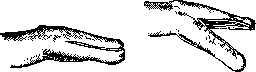
Figure 1.
Figure 2. The operation ends with the skin being drawn over the newly formed fingers. Usually, there is not enough skin to cover the finger formed from the ulna. This defect is filled either with a Thiersch graft, or, even better, according to the proposal of K. himself, a two-stage skin graft from the patient's abdomen is made. A flap of the appropriate length and width is cut on a pedicle and sutured to the skin over the defect of the finger. After 12-14 days, the pedicle is severed and final sutures are placed. - After complete
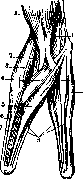
Figure 3. 1-m. biceps; 2-m. sup. brachii; 3-m. supin. long.; 4-m. pronat. teres; 5-m. flex. carpi rad.; 6-m. ext. carp. rad.; 7-radius; 8-m. flex. dig. sublimis; 9-m. flex. carpi uln.; 10-m. palm. long.; 11-m. brach. int. healing of the wound, the patient begins to exercise in grasping movements, which can be developed to such a degree of fineness that the disabled person can freely unfasten and fasten buttons on his clothing.
The Moscow Prosthetic Factory supplies disabled persons with a Krukenberg hand with a special case, in which are placed the most necessary items for daily use: knife, fork, spoon, toothbrush, etc., with special handles convenient for grasping.
Related articles
Mentioned in
Cite this page
“Krukenberg Hand.” Soviet Medical Encyclopedia. English translation of Bolshaya Meditsinskaya Entsiklopediya, 1st ed. (Moscow, 1928–1936), ed. N. A. Semashko. https://sovietmedicalencyclopedia.pages.dev/article/krukenberg-hand/