Costo-Articular Line
Historical document, translated for reference. It reflects medical knowledge of the 1920s–30s and is not medical advice.
Summary
The costo-articular line is an anatomical landmark connecting the first left costochondral joint to the free end of the 11th rib, used for determining spleen size. The article also discusses crutches (К.), their proper use, potential complications, and various designs.
Encyclopedia article (1928–1936)
COSTO-ARTICULAR LINE (Linea costo-articularis). A line connecting the first left costochondral joint with the free end of the eleventh rib. It serves to determine the size of the spleen, the dullness of which in the normal case reaches this line with its lower anterior edge, but should not extend beyond it. Crutches are prescribed in cases of loss of one lower limb, as well as in diseases or injuries of the spine and lower limbs. Crutches serve as a means of locomotion. Where possible, such as in the loss of a lower limb, paralysis of the legs, etc., crutches should be replaced by appropriate apparatuses, prostheses, etc.; therefore, the use of crutches should be limited. Improper use of crutches can lead to severe and prolonged disorders of innervation from the brachial plexus, known under the name of crutch paralysis. With prolonged use, changes in the statics of the body (scoliosis) may also occur. Therefore, when issuing crutches, it is necessary to instruct how to use them. It is forbidden to transfer the entire weight of the torso to the support of the crutch in the axillary region. - The form of crutches can be very different. Gocht proposed a crutch for leg amputation; on the crutch there is a special support for the stump (Fig. 1). Pinar invented a crutch, which with its lightness and strength makes it possible to change the level of height in the axillary and hand support points. Schlick creates support on the crutch both in the area of the wrist joint and from the side of the middle part of the forearm, supported by a half-ring. Usually so-called American crutches with a handle are used (Fig. 2). - The correct choice of the length of the crutch is important, especially the distance from the axillary fossa to the handle. - The main weight should be transferred to the hands and wrists, while the axillary area should be compressed to a slight degree. Excessive walking should be avoided. The lower part of the crutches is diverted from the torso in order to transfer part of the pressure to the lateral surface of the chest
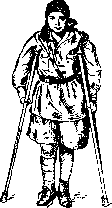
Figure 1.
Figure 2.
Related articles
Cite this page
“Costo-Articular Line.” Soviet Medical Encyclopedia. English translation of Bolshaya Meditsinskaya Entsiklopediya, 1st ed. (Moscow, 1928–1936), ed. N. A. Semashko. https://sovietmedicalencyclopedia.pages.dev/article/costo-articular-line/