Ulnar Nerve
Historical document, translated for reference. It reflects medical knowledge of the 1920s–30s and is not medical advice.
Summary
The ulnar nerve is one of the major nerves of the upper extremity, originating from the brachial plexus and innervating specific muscles and sensory areas of the hand. This article describes its anatomy, variations, pathologies including injuries and paralysis, and associated clinical signs like 'claw hand' and 'preacher's hand'.
Encyclopedia article (1928–1936)
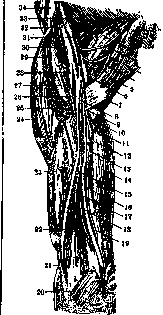
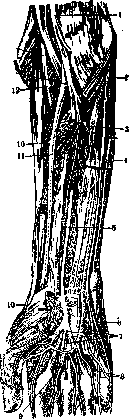
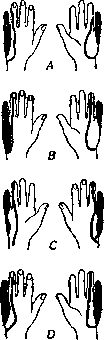
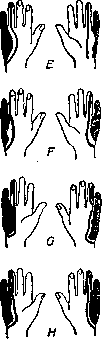
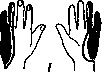
ULNAR NERVE, syn. n. cubitalis, ulnar nerve, one of the large nerves of the upper extremity, mixed. It originates from the brachial plexus, initially passing medially to the a. brachialis (fig. 1), then goes behind the septum intermusculare mediale toward the sulcus nervi ulnaris humeri, where it lies directly on the bone between the epicondylus medialis humeri and olecranon; from here it passes between the initial bundles of m. flexoris carpi ulnaris to the anterior surface of m. flexoris digitorum profundi, where there is an anastomosis between Martin-Gruber between U. n. and n. medianus; distally U. n. goes along with a. ulnaris along the radial edge of m. flexoris carpi ulnaris and in the middle of the forearm, sometimes closer to the hand, dividing into ramus dorsalis manus and ramus volaris manus (fig. 2). The branches of U. n., their topography and anastomoses-see Human nerves.-U. n. innervates m. flexor carpi ulnaris, m. flexor digitorum profundus, m. abductor digiti quinti, m. flexor brevis digiti quinti, m. opponens digiti quinti, m. adductor pollicis, m. flexor pollicis brevis (deep head), mm. lumbricales IV et III and all m. interossei; the sensory areas of U. n. extend to the volar surface of the hand from the skin of the palm corresponding to V and the middle of IV finger, from the little finger and the ulnar half of the ring finger, and on the dorsal surface of the hand from the ulnar half, from the back of V, IV fingers and the ulnar side of the proximal phalanx of III finger.-The following variations occur: U. n. |3 innervates only m. lumbricalis IV or in addition m. lumbricalis III; m. flexor digitorum profundus may receive innervation from U. n., and m. adductor pollicis from n. medianus. In rare cases, all muscles of the thenar receive innervation from U. n. On the other hand, cases have been described where mm. interossei and lumbricales were not affected in paralysis of U. n. and contracted when irritated by electrical current from n. medianus. Variants of cutaneous innervation-see fig. 3.
e. m. e. t. xxx.
Pathology. U. n. is affected more often than n. medianus, but less often than n. radialis. In wounds, fractures, on the shoulder and forearm U. n. is often affected together with n. medianus. With non-critical changes occurring in both nerves simultaneously, the hand sometimes takes a position called
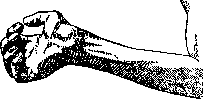
Figure 4. "Preacher's hand" ("main en predicateur").
"main en predicateur" (fig. 4). With preservation of the muscles innervated by n. radialis, it is characterized by hyperextension of the hand, extension of the fingers in the proximal phalanges and flexion in the middle and nail phalanges. Isolated lesion of U. n. is observed in the sulcus n. ulnaris, where the nerve lies directly on
Figure 4. "Preacher's hand" ("main en predicateur").
bone, with damage to the medial condyle of the humerus. The nerve can be involved not only during fracture or contusion, but also years after trauma due to compression by callus. In subjects with a flat sulcus n. ulnaris, dislocation or subluxation of the nerve may occur with trauma; painful phenomena in this case are caused by subsequent neuritis. Relatively light but prolonged pressure of the elbow on a hard support (during sleep, under anesthesia) can cause mild paralysis due to nerve compression. Professional paralyses of U. n. have been described in those who habitually rest on the elbow, such as glass blowers, telephone operators, etc., and compression of branches of U. n. in the hypothenar area in cyclists. Mild lesions of U. n. manifest as pain syndromes of the type of pure neuralgia or accompanied by motor disturbances; trophic disorders characteristic of neuritis are not observed in this case. Isolated primary neuritis of U. n. is rarely observed as a complication in some infectious diseases, for example in typhus, sepsis, dysentery, syphilis, in appendicitis, in poisoning with chemical warfare agents. Often U. n. is affected in polyneuritis. Neuritis of U. n., in addition to pain symptoms, manifests as motor disorders (atrophic paralysis, paresis), sensory disturbances (fig. 3) and trophic skin disorders; Dupuytren's contractures have also been described in connection with neuritis of U. n. In paralysis of U. n., flexion of the hand is impaired
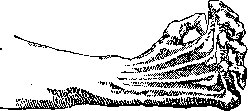
Figure 5. Claw hand.
and does not occur toward the ulnar side, movements of the little finger are impossible, when shifting fingers the little finger remains abducted, flexion of IV and V fingers and partially III is limited; adduction of the thumb is weakened. Due to atrophic paralysis of the interosseous and lumbrical muscles, hyperextension of the proximal and flexion of the middle and terminal phalanges occurs with spread fingers; "claw hand"-Aran-Duhen's hand (fig. 5) results. In paralysis of the ulnar
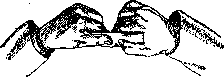
Figure 6. Froman's test.
nerve in the patient, fine movements in the fingers are disturbed, he cannot bend the nail phalanges of the last three fingers, cannot scratch with the nail of the little finger. Froman's test consists in the patient having to firmly hold a sheet of paper between the index and thumb of both hands, stretching it sideways. Instead of adduction of the thumb, flexion of its terminal phalanx occurs (fig. 6). Treatment and prevention-see Neuritis, Neuralgia, Polyneuritis. In dislocation of U. n., bone-plastic operations may be performed, aimed at strengthening U. n. in the sulcus n. ulnaris.
s. Shishkov.
Related articles
Mentioned in
Cite this page
“Ulnar Nerve.” Soviet Medical Encyclopedia. English translation of Bolshaya Meditsinskaya Entsiklopediya, 1st ed. (Moscow, 1928–1936), ed. N. A. Semashko. https://sovietmedicalencyclopedia.pages.dev/article/ulnar-nerve/