Duchenne-Erb Paralysis
Historical document, translated for reference. It reflects medical knowledge of the 1920s–30s and is not medical advice.
Summary
Duchenne-Erb paralysis is a partial paralysis affecting the upper brachial plexus, resulting from damage to the fifth and sixth cervical nerve roots. It causes characteristic muscle weakness in the shoulder and upper arm, with specific sensory disturbances and reflex changes.
Encyclopedia article (1928–1936)
Duchenne-Erb Paralysis (Duchenne, Erb), a partial paralysis, specifically an upper neuritis of the brachial plexus (plexitis); it affects the following muscles: deltoideus, biceps, brachialis internus, supinator longus; in addition to these, the mm. supinator brevis, supraspinatus, infraspinatus, subscapularis, teres major, pectoralis major (portio clavicularis) may also be involved (Fig. 1). D.-E.p. results from damage to the fifth and sixth cervical nerve roots. If neighboring nerve roots are also involved, paralysis of other muscles appears: serratus anticus major, rhomboideus, levator anguli scapulae; moreover, mild affection is observed in the following muscles: triceps, extensor and flexor radiales, pronator teres, palmaris, extensor and flexor pollicis. The clinical picture consists of atrophy of the shoulder muscles, scapula alata, inability to perform pendulum movements of the scapula, to raise and abduct the shoulder, to flex the arm at the elbow; the reflex from the biceps and the radial reflex disappear; sensory disturbances affect the area of Cv-Cvr, i.e., in the form of a long band of hypesthesia along the entire limb on the outer surface of the arm and forearm (Fig. 2). Above the clavicle, outward from the lower end of the m. sternocleidomastoideus, lies the so-called Erb point, which is painful on palpation; irritation of this point with electric current causes general contraction of all muscles involved in D.-E. paralysis.
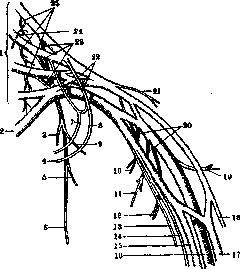
Figure 1. Diagram of plexus brachialis (pars supra-et infraclavicularis): 1-n.n. cervicales; 2-n. dorsalis; 3-branch for m. levat. scapulae; 4-branch for mm. subclav., pector. maj., min., delt.; 5-n. for m. serrat. post, sup.; 6-branch for m. serrat. ant. maj.; 7 ram. int.; 8-ram. ext.; 9-branch for m. rhomb.; 10-n. for m. subscap.; 11-branch for m. latiss. dorsi; 12-branch for m. teres maj.; 13-n. cut. brachii int.; 14-n. cut. brachii med.; 15-n. ulnaris; 16-n. radial.; 17-n. medianus; 18-n. musculo-cut.; 19-n. circumflex.; 20-a. subscap.; 21-a. suprascap. for mm. supra- et infrasp., teres min.; 22-n. thorac. ant.; 23-n. thorac. post.; 24-for n. phrenic; 25-a. for mm. scaleni, m. long, colli. (After Heitzmann.)
Etiology in most cases is traumatic: direct trauma, injury, trauma during childbirth, dislocation of the shoulder, compression of the plexus against the first rib by the clavicle, bringing the clavicle to the spine, stretching and even tearing of the plexus due to forced abduction and elevation of the shoulder. Awkward movements during gymnastic exercises or hanging by the arm when carelessly getting into a train can lead to tearing or stretching of the corresponding nerve roots and cause D.-E. paralysis. Obstetric paralysis present a typical picture of the same disease. Paralysis during anesthesia, as a result of prolonged compression of the plexus due to a special position of the hands, manifest with the same syndrome; sometimes these latter paralyses are bilateral; it is possible that paralysis develops here under the influence of intoxication and nerve compression. People carrying heavy loads (stonemasons, coal miners, soldiers) sometimes contract the same disease. Infectious, intoxicating and other etiological factors of neuritis can in turn play a provocative role. Diseases of the spine and tumor (cancer, tbc) can cause the same symptom complex. Usually the paralysis is of an atrophic nature with changes in electrical excitability. - Pathological anatomy of the disease is general with that of neuritis in general (see Neurites).-The course of the disease corresponds to the degree of damage; with deep damage - many months, and sometimes more than a year.-The prognosis is not always favorable. In preventive terms, special measures during difficult labor, during narcotization and operations, when carrying heavy loads are particularly valuable. Diagnosis is based on the typicality of the picture. It must be differentiated from paralysis of the lower brachial plexus (Dejerine-Klumpke paralysis, see) and paralysis of the entire brachial plexus.-Treatment - according to general rules
Related articles
Mentioned in
Cite this page
“Duchenne-Erb Paralysis.” Soviet Medical Encyclopedia. English translation of Bolshaya Meditsinskaya Entsiklopediya, 1st ed. (Moscow, 1928–1936), ed. N. A. Semashko. https://sovietmedicalencyclopedia.pages.dev/article/duchenne-erb-paralysis/