Bandages (a198)
Historical document, translated for reference. It reflects medical knowledge of the 1920s–30s and is not medical advice.
Summary
Bandages are devices used to strengthen the abdominal walls, enhance the action of the abdominal press, and hold internal organs in as normal a position as possible. They are divided into hernia and abdominal-belt types, with hernia bandages specifically designed to prevent hernia protrusion through pressure from a spring and pad.
Encyclopedia article (1928–1936)
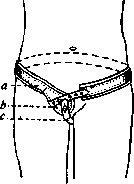
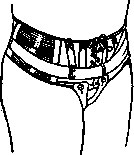
BANDAGES (from French bandage - bandage), devices used to strengthen the walls of the abdomen, enhance the action of the abdominal press, and hold internal organs in as normal a position as possible. They are divided into hernia and abdominal-belt types; the latter should not be confused with abdominal warmers used for warming the abdomen. - Hernia bandages are used in the case of expansion of the inguinal and other rings with a tendency to form hernias, as well as in hernias expressed to a greater or lesser degree, primarily inguinal, scrotal, femoral, and partly umbilical, with the aim of holding the hernial sac in the abdominal cavity and preventing it from coming out under the skin through the hernial opening ("hernial gates"). These tasks of the bandages (see figure 1) are performed by the force of a spring with a pad, which produces uniform, constant pressure on the hernial opening, preventing the hernia from protruding. The basis of the bandage is a strip of spring steel, curved so that it fits snugly against the pelvic girdle and is placed to the side above the area of the greater trochanter of the femur, behind - above the upper part of the sacrum, and in front curves obliquely downward and forward (neck of the bandage) in the direction of the hernial opening, where it would end with the pad. The spring is made of varying degrees of elasticity depending on the size of the hernia and the force of the pressure it produces. The spring is covered with soft types of leather materials with a thin felt lining. To the front end of the spring (neck) is riveted a metal elliptical-shaped platform, which serves as the base for the pad. This platform is covered with a canvas bag, which is tightly packed with resilient material (deer hair, horsehair, cotton wool, sponge rubber, etc.). In more expensive types of bandages, the pad is made of hollow rubber, filled with glycerin under a certain pressure; for the same purposes, a special rubber mass patented by the Berlin firm Levi is used. Depending on the nature and size of the hernia, pads are of various shapes and sizes - inguinal, scrotal, femoral, anatomical (see figures 2-5). For bilateral hernias, bilateral bandages are used; they consist as if of two unilateral bandages (right and left), the ends of the springs of which are held at the back in the leather covering with straps on buttons, allowing some increase and decrease in the size of the bandage (see figure 6). For milder cases of initial hernias, there are bandages without springs - the pad is connected to a wide elastic belt, placed in the same way as the spring bandage; this type of bandage covers the hernial opening less reliably. - Bandages for umbilical hernias are made mainly without springs, in the form of a wide belt, equipped with a fairly wide round pad in the center of which there is an elastic elevation, the size of which exceeds the hernial opening; in children, to avoid saturation with urine, the pad is covered with thin rubber or celluloid glue. - The bandage should fit snugly and not shift with various movements of the body; for this purpose, soft straps (from calico, flannel, or rubber tubing) are added to the bandage - thigh straps, which prevent the bandage from moving upward. Bandages can only be used for reducible hernias; they should be put on while lying down, after first pushing the hernial sac through the hernial opening (reducing the hernia). While walking, one should observe that parts of the hernia are not pushed out from under the pad, especially when coughing and sneezing. Long-term use of bandages leads to a certain degree of atrophy of the superficial and deep tissues, as well as partial adhesion of them at the site of pressure from the pad. Such changes complicate the performance of a radical herniotomy operation and do not give a sufficiently stable postoperative scar. Bandages cannot cure a hernia; therefore, they should be prescribed only in cases where a radical operation is contraindicated or the patient categorically refuses it. Abdominal-belt bandages are used in diseases, prolapses and displacements of internal organs, enteroptosis, in hernias of the abdominal wall, obesity (large pendulous abdomens), in weakness of the abdominal walls, as well as preventively during pregnancy, after childbirth and abdominal operations (laparotomies) to protect the surgical wound from early stretching. The action of the abdominal bandage, in general, comes down to the fact that it produces pressure of the required force in certain parts, under the influence of which the contents of the abdominal cavity move; thus, a greatly expanded, low-lying stomach is lifted upward together with the intestinal loops by the pressure of the bandage on the lower part of the abdomen. Mobile kidneys, especially with a relaxed, flabby abdominal press, are irritated by jolts when walking and during physical work; a bandage used in such cases gives the kidney a more calm position and brings it closer to its normal location. For a more complete effect in cases where the kidneys are easily displaced, it is useful to attach bean-shaped pads (renal) to the bandage, which indent the abdominal wall below the physiological position of the kidneys and prevent them from shifting, although their action cannot be considered very reliable. In some diseases of the female genital organs
<rrsSH





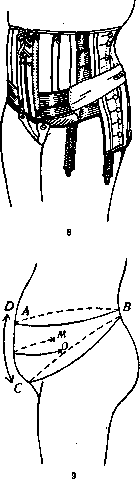
1. Inguinal bandage: a-spring; b-pad; c-thigh strap. 2. Hernia bandage with inguinal pad. 3. Hernia bandage with scrotal pad. 4. Hernia bandage with femoral pad. 5. Hernia bandage with anatomical pad. 6. Bilateral inguinal bandage. 7. Abdominal bandage type I Romanovsky. 8. Abdominal bandage type IV, corset bandage with side closure. 9. Direction of lines for taking measurements of an abdominal bandage.
Abdominal bandages, by maintaining constant uniform pressure on the abdominal walls, especially in its lower part, provide rest to the pelvic organs and push upward the pressing intestinal loops; this is particularly important with frequent forward bending of the trunk and, generally, when working in a bent position, when the action of the flaccid abdominal muscles, due to the approximation of their attachment points, significantly weakens and the organs of the abdominal cavity freely move at this time. In hernias of the abdominal wall, the bandage tightly closes the opening with its area, counteracts intra-abdominal pressure and does not allow the hernia to protrude. In general obesity, when the muscles of the abdominal press become flabby, pendulous, huge-sized abdomens result; the diaphragm and abdominal organs descend, abdominal breathing almost completely disappears, and pulmonary breathing is difficult; severe symptoms of respiratory and cardiac disorders occur. In such cases, the abdominal bandage is a valuable means for improving the disturbed balance: it tightens the abdomen, lifts it upward and helps the action of the abdominal press. Freed from excessive stretching, the abdominal muscles begin to return to normal tone, and fat deposits, under the influence of constant pressure, atrophy. During pregnancy, the abdominal bandage enhances the action of the abdominal press, lifts the abdomen upward and, thus, prevents excessive stretching of the abdominal muscles. In addition, the constant uniform pressure of the abdominal bandage, especially during physical labor, keeps the fetus in a certain position and prevents the possibility of its improper displacement. After childbirth, the muscles stretched by pregnancy should contract as completely as possible; abdominal bandages free the muscles from excessive work and restoration of their tone occurs more quickly and completely. Abdominal bandages are made, predominantly, from dense fabrics, partly elastic; the best material is kutile (a dense corset material); dense canvas, ticking, elastic, kolomyanka, as well as mesh fabrics can be used. The abdominal bandage is composed of several separate strips of material, cut according to special patterns depending on the shape of the abdomen and type of bandage. The cut strips are sewn together and reinforced with strips of whalebone, horn, or thin steel (in very large bandages); the front and back parts of the bandage are connected by a tape passing over the crests of the iliac bones (see figure 7). In front, the bandage has lacing for adjusting the degree of tightening by the upper edge; in the back it fastens with buttons by means of tapes, the ends of which are directed forward, to the lower edge of the bandage, and are tightly fastened to a buckle. Another type of bandage—without tapes, with lacing in the back and side fastening with buttons; this is the bandage-corset type; the necessary support of the abdomen from below in it is achieved by the action of an elastic cord attached to the middle of the lower edge of the bandage and rising toward the lumbar region, where it fastens to hooks or buttons. The type of bandage during pregnancy differs from the previous ones mainly in that the cut of its front part, more convex (spherical), corresponds to the shape of the abdomen during pregnancy; the whalebone strips securing it must be very elastic; it should uniformly tightly grip the abdomen and pull it upward with an elastic cord. As a rule, high bandages should not be made without special need: they, during movements of the trunk, especially when bending, cut into the hypochondrium, epigastric region, hinder work and cause painful sensations. High bandages with a front wall of 26 cm or more are allowed with high-located hernias of the abdominal walls or with very pendulous abdomens; in such cases they are made of the corset-bandage type, with side fastening, which in the practice of the Leningrad Institute of Prosthetics bears the name: "fourth type with side fastening" (see figure 8). Bandages with a front wall 22 to 26 cm high are made during pregnancy (rounded front) and after childbirth (flat front), in diseases or displacement of the kidneys and umbilical hernias in relatively full persons; this is the third type of bandage. The second type, with a front wall height of 15 to 22 cm, is used in diseases of the female genital organs, in fresh scars after appendicitis operations, removal of uterine tumors, fixation of the kidneys, as well as in movable kidneys and enteroptosis in persons of moderate fullness. The first type—Romanovsky's (see figure 7), with a wall height of 10 to 13 cm, is prescribed in diseases of the stomach and partial enteroptosis in persons with a poorly pronounced abdomen. This type of bandage, despite its small height, gives excellent therapeutic results. All types of bandages should be put on in a lying position, especially in enteroptosis. So that during walking the bandage does not shift upward on the abdomen, stocking elastics and thigh straps are attached to it. It should be mentioned about the good effect of knitted bandages according to the Lebedev system during pregnancy. In movable difficult-to-hold kidneys, excellent results are achieved by wearing a spring with a pelvis renal bandage of the Turner system. Bandages made of wide rubber tape, tightly gripping the abdomen and thighs, help reduce fat deposits of the abdominal walls. Besides those described, there are still quite a few varieties of abdominal bandages, but they have no special advantages and great practical significance. The measurement for a hernia bandage is taken with a centimeter tape, which should encircle the sacrum and thighs above the greater trochanters and meet above the hernial opening. It is necessary to indicate, comparing with something, the size of the hernia, its direction (inguinal, femoral, inguino-scrotal), reducibility, age of the patient, occupation and physical build. The measurement for an abdominal bandage is taken according to fig. 9: circumference at the level of the navel (AB), at the level of the pubis (BC), height of the intended front wall (CD) and distance between the upper anterior crests of the iliac bones (MO); the latter distance should be measured in standing and lying positions. It is also necessary to indicate the nature of the disease, general build and shape of the abdomen (round, transversely stretched, pendulous and sunken). Bandage makers—masters making hernia and abdominal bandages. In former times this term designated master orthopedists engaged in making not only bandages but also all kinds of orthopedic apparatus, devices and artificial limbs. In the USSR, the production of bandages on a large scale is carried out in the State workshops of the Leningrad Institute of Prosthetics and at the Moscow Prosthetic Plant named after N. A. Semashko.
V. Albrecht (Bandl), the retraction ring of contraction, is formed during childbirth in the uterus between its upper, actively contracting part and the lower, passively stretching segment. The B. r. r. occurs because the upper segment of the uterus, contracting during contractions, becomes thicker, while the lower one, stretching in width and length (dilation of the uterine cervix), becomes increasingly thinner. The boundary between these two segments is marked on the inner surface of the uterus in the form of a muscular ridge, on the outer surface of which corresponds a groove. There were many disputes about the localization of the contraction ring. Thus, Schröder believed that the B. r. r. passes somewhat higher than the internal os, while Bandl himself considered that the upper border of the ring coincides with the internal os. At present, most obstetricians identify the B. r. r. with the so-called uterine isthmus. The B. r. r. is particularly sharply expressed in cases where the presenting part meets great resistance in its forward movement; the lower segment in such cases is greatly stretched, and the retraction groove, especially clearly palpable during contractions, rising higher and higher, may reach the navel. Above Bandl's contraction ring, a thick muscular wall is palpable, below—a stretched, painful, greatly thinned wall of the isthmus and cervix. The B. r. r. passes transversely or somewhat obliquely. Together with other signs (severe painful contractions, restlessness, fear of the parturient) the B. r. r. is the most important sign of threatening rupture of the uterus. Bandl's contraction ring should not be confused with the constriction on the abdominal wall formed by a full bladder.
Related articles
Mentioned in
Cite this page
“Bandages (a198).” Soviet Medical Encyclopedia. English translation of Bolshaya Meditsinskaya Entsiklopediya, 1st ed. (Moscow, 1928–1936), ed. N. A. Semashko. https://sovietmedicalencyclopedia.pages.dev/article/bandages/