Gloves
Historical document, translated for reference. It reflects medical knowledge of the 1920s–30s and is not medical advice.
Summary
This article discusses the use of gloves in medicine for achieving asepsis and protecting hands from contamination. It covers the history, types, proper usage, sterilization methods, and advantages of gloves in surgical and pathological practices.
Encyclopedia article (1928–1936)
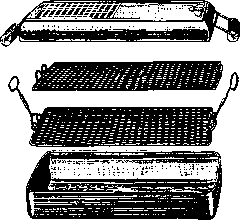
Gloves are used in medicine for the purpose of achieving asepsis or protecting hands from contamination during various non-aseptic examinations and procedures. The impossibility of achieving sterility when using any of the numerous methods for preparing hands for surgery (see Antisepsis and Asepsis) served as the reason for introducing gloves. Gloves were first proposed in 1897. Rubber gloves were proposed by Zoege von Manteuffel, while fabric gloves were proposed by Mikulicz. There are indications that gloves were also used by Halsted as early as 1889. Fabric gloves are currently used little, because when moistened they become easily permeable to bacteria; this inconvenience can be partially eliminated by frequent changing. Fabric gloves are most suitable during procedures not involving their moistening (passing instruments, dressing materials, etc.), as well as for wearing over rubber gloves to better preserve the latter and for holding and extracting slippery internal organs. However, this reduces tactile sensitivity. Fabric gloves are sterilized in an autoclave. Rubber gloves, due to their impermeability, fully resolve the issue of sterility of the surgeon's hands. Gloves are made from rubber of varying thickness, which affects their strength and the degree of reduction in tactile sensation. There are various sizes of gloves. It is very important to use sizes corresponding to the size of the hand, because gloves that are too large do not adequately fit the fingertips, which significantly reduces sensation and makes finger work difficult; conversely, tight gloves quickly cause a feeling of numbness, especially if they are thick-walled. In America, gloves are made from a plaster cast taken from the operator's hand. Thick gloves are usually used for anatomical work, autopsies, and in purulent surgery. In operations where tactile sensation plays a very important role, thin rubber gloves (even up to condom thickness) are used (Figs. 1 and 2). In this regard, the French Chaput gloves are the most convenient and durable. They are made of good thick rubber, and their essential feature is that they do not restrict finger movements, do not tire them, and do not impair tactile sensitivity. This is achieved by the fact that the fingers of Chaput gloves are extremely short and wide. If a Chaput glove is worn correctly, it reaches halfway up the forearm, and the rubber stretched at the fingertips becomes as thin as a condom. Gloves are put on washed and treated hands according to one of the accepted methods. For easier glove application, hands are moistened with alcohol, sterile glycerin, or talc is poured into the gloves, but then the hand must be completely dry. Before removing gloves, it is better to stretch them under running water at a faucet - this facilitates removal and thus preserves the gloves from tearing. Before removing gloves, they should be thoroughly washed with soap and water so that drops of blood or other protein substances do not dry on them, which severely damages the rubber.--Gloves can be sterilized in an autoclave or by boiling. The first type of sterilization is more reliable, but after this, gloves become stiff, quickly lose elasticity and tear. When sterilizing in an autoclave, it is necessary to thoroughly dust the inside of the gloves with talc, otherwise they may stick together. Boiling is done in plain water for 15 minutes. Gloves are placed in the sterilizer wrapped in cloths so that the rubber does not touch the walls and bottom of the sterilizer. A special boiler for gloves (Figs. 3 and 4), designed for this purpose, was invented by the French orderly Leclec. When boiling, it is necessary to ensure that no air remains in the fingers, otherwise the fingers float up and are not sufficiently exposed to temperature. The advantages of rubber gloves are so obvious that it is difficult to object to their use. The widespread adoption of gloves speaks to their appropriateness. In 1911, Küttner wrote that 53% of surgeons operate all cases with gloves, 34% in septic cases, 7% in septic and some aseptic cases, and only 6% without gloves.--The disadvantages of rubber gloves are generally considered to be 1) reduced tactile sensation, 2) their high cost, and 3) tearing of gloves during surgery. The first disadvantage is largely eliminated when using thin gloves, and especially Chaput gloves. The high cost of gloves is offset by good wound healing and consequently a reduction in other expenses - for dressing materials and for maintaining patients. Contamination of the wound during glove tearing due to the leakage of 'glove juice' is possible and represents the most serious disadvantage. Only by careful attention to gloves during surgery and quick changing can the entry of bacteria into the wound be avoided. Gloves are especially useful in military situations, as their use allows for rapid sterilization of hands, and also enables transition from an infected wound to an aseptic one.--In pathological-anatomical practice, gloves have also become widespread. Gloves should especially be recommended for autopsies and for congenital syphilitics (i.e., in maternity home practice), as the corresponding corpses often abound with spirochetes. The form of gloves for pathologists has recently been changed in that they can be worn on either hand, i.e., both (front and back) halves of the gloves are glued together strictly along the midline, including the thumb. Before putting on gloves, hands should be dusted with talc.
Fig.
Box for sterilizing and storing gloves.
f. Yanishevsky. 51fr Gloves from the point of view of hygiene. The main hygienic requirements for gloves are as follows. Gloves should protect the hands in cold weather from excessive heat loss. In summer, gloves should be moisture-absorbent (hygroscopic) and air-permeable to easily absorb moisture from the skin and quickly release, remove outward the products of skin evaporation (sweat accumulated on the skin can always contain a certain amount of bacteria). Gloves should protect the skin from mechanical damage: scratches, abrasions, etc., and not allow dirt and dust to penetrate. With appropriate strength, gloves should be soft, elastic, pliable, so as not to destroy the ability of maximum tactile sensation, and should evenly and easily fit the hand and fingers. The wrist joint should be covered by them. Narrow, tight gloves promote improper blood circulation and easier cooling in cold weather. Tightening the wrist with tight fasteners also leads to impaired blood circulation, stagnation, and swelling. Fasteners and seams should not chafe and irritate the skin. Gloves, as easily soiled from contact with various objects, should be easily cleanable, and summer gloves should be washable. In addition to gloves used in everyday life, gloves can have a special purpose as special work clothing, i.e., aim to protect from various influences of the production process: chemical agents - acids, alkalis (chemical industry), temperature effects - radiation (glass, metallurgical industries), various mechanical irritations, friction (conductor, drivers, earthworks) and a number of other special hazards requiring protection of the hands (electrical engineering, radiology, etc.). Depending on different seasons of the year, the material of gloves varies. Usually, gloves for winter are made from wool, fur, down as the most porous materials containing a larger amount of air, and therefore less heat-conductive and better preserving heat (see table). Coefficient of heat conductivity (in small calories) (according to Rubner). Air..................
0.0000684 Rabbit skin (fur outward) ....
0.0000689 Rabbit skin (fur inward) ....
0.0000682 For autumn and spring, leather gloves with and without lining are more convenient, and finally for summer - cotton, linen, silk gloves. For special work clothing, leather, canvas with asbestos impregnation, rubber gloves, etc., are mostly used. The form of gloves varies: gloves having a compartment for each finger, and gloves-mittens or gauntlets having one common compartment for all four fingers and a separate one for the thumb. In terms of heat preservation, the latter form has the advantage, as air, as a poor heat conductor, surrounds the fingers in a thicker and more even layer, but in terms of free finger function and preservation of tactile sensation, this form is inconvenient.
Related articles
Mentioned in
Cite this page
“Gloves.” Soviet Medical Encyclopedia. English translation of Bolshaya Meditsinskaya Entsiklopediya, 1st ed. (Moscow, 1928–1936), ed. N. A. Semashko. https://sovietmedicalencyclopedia.pages.dev/article/gloves/