Abrasion
Historical document, translated for reference. It reflects medical knowledge of the 1920s–30s and is not medical advice.
Summary
Abrasion is a superficial injury to the skin caused by friction or pressure from poorly fitted clothing, footwear, or straps. This article discusses the causes, prevention, and treatment of abrasions, particularly as they affect military personnel.
Encyclopedia article (1928–1936)
Abrasion, usually a superficial injury to the external coverings of the skin, observed as a result of friction or pressure (compression) from poorly fitted clothing, footwear, belts, or straps of bags carried over the shoulder, etc. The practical significance of abrasion is mainly in relation to the feet. As a mass disease, abrasion of the feet occurs most frequently in the army. In infantry units, especially after long marches, this disease often leads to significant losses in the personnel of the unit (according to observations by Penkovsky, Verbov, and others) up to 30% or more; during the imperialist war, individual registers had abrasion in up to 50% of personnel (Lvov). Abrasion of the feet increases fatigue, raises energy expenditure, makes walking tiresome and painful, and in general leads to a decrease in the combat capability of the unit; in more severe cases, the affected individuals are put out of action. According to external appearance and patho-anatomical picture, three degrees of abrasion are distinguished: 1st degree - limited redness, pain on pressure; 2nd degree - inflammatory phenomena with the formation of exudate and separation of the superficial layers of skin from deeper ones in the form of a blister with serous or bloody contents; 3rd degree - violation of the integrity of the skin (the blister bursts) with the formation of excoriation, which with deeper skin damage turns into ulcers.
Abrasion is most commonly found on the toes (from 28.4% to 52% according to various observations), then on the sole, and least of all at the ankles. The most affected areas by abrasion are the plantar surface of the foot (47.5% of all abrasions according to Kofman):
2.5% The causes of abrasion of the feet are several. The main, most frequent cause is poor fitting of footwear, especially made from thick and coarse leather and often having various design defects that cause the formation of folds, wrinkling of the heel counter, etc. The second in importance is improper use of footwraps and defects in the footwraps themselves: poor quality and insufficient size of the footwrap material. A rarer cause of abrasion of the feet is improper structure or defects of the foot (ingrown toenail, calluses). The most frequent causes of abrasion are the construction of footwear and its improper fitting (according to Kofman): Construction of footwear..............
14% Improper wrapping of footwraps . .
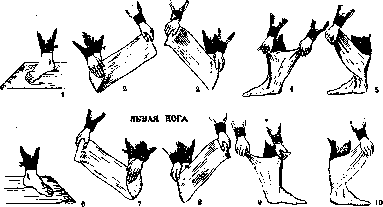
12% Defects of the foot . . . . ........... 3% Other causes............... 5% At the same time, however, it must be borne in mind that in the formation of abrasion, not one but several causal factors often play a role - for example, defects in footwear and inability to put on footwraps, improper fitting of footwear and poor quality of footwrap material, etc. An important predisposing factor, to which the authors studying this issue point, is increased sweating of the feet. Such sweating with poor foot care and especially with improper wrapping of footwraps easily leads to maceration of the skin and subsequent abrasion. The main measures to combat abrasion come down to eliminating the causes listed above. In addition to proper fitting of footwear, great importance is attached to preliminary breaking-in of footwear; therefore, any long marches in new, just-issued, unbroken-in footwear should not be undertaken to avoid abrasion. Important is also the observation of the condition of the footwear itself: timely repair, regular cleaning of the footwear with polish (to soften the leather), as well as observation of the cleanliness and integrity of footwraps and their proper use, and thorough foot care (frequent washing, cutting of nails). Among medicinal measures, formalinization in the form of wiping (but not washing) the feet for 2-3 days before a march with a 5-10% solution of formalin can be recommended. This remedy is advisable in cases of sweaty feet. Good effect (according to the experience of Karpin) is also achieved by formalinization of boots by pouring 5-7 drops of 40% formalin into the boots before a march. Great work on combating abrasions has been carried out in recent years in the Red Army. Here, on the one hand, attention was directed toward developing a more rational last and establishing proper sizing of footwear (see Footwear), and on the other hand, great attention was paid to issues of fitting footwear, rules for putting on and using footwraps, and foot care [in a specially issued instruction in 1930 (circular NKVM, 1930, No. 33), detailed practical instructions are given on all these issues]. To junior commanding officers and company sanitary instructors is assigned the duty of teaching incoming young Red Army soldiers the rules for putting on footwraps and caring for feet and footwear. Wrapping of footwraps is recommended to be done following certain rules (see illustration). A properly worn footwrap should fit tightly around the foot, without leaving extra folds, especially on the toes, heel, and the dorsum of the foot. To avoid rapid wear and tearing of footwraps, the ends should be alternated each time the foot is wrapped. The footwraps themselves should be changed more often, especially in summer; during rest or overnight they must be dried. The decrease in the incidence of abrasion of the feet recently noted in the Red Army (see table) is to a large extent due to the measures listed above. Abrasion of the feet in the Red Army (per 1000 persons). Years Red Army | Beginning composition personnel 1926/27 ......... 135.9 128.7 114.1 131.9 91.44 32.3 27.9 27.7 27.5 17.98 1927/28 ......... 1928/29 ......... 1929/30 ....... 1930/31 ......... ; In cavalry units, instead of abrasion of the feet, one sometimes has to deal with abrasion in the area of the buttocks and thighs. The cause of this type of abrasion is poorly fitted trousers or long johns (which due to extra folds can press on the skin) or defects in the saddle (patches). A contributing factor is the poor posture of poorly trained riders. This type of abrasion has no great practical significance.
Related articles
Mentioned in
Cite this page
“Abrasion.” Soviet Medical Encyclopedia. English translation of Bolshaya Meditsinskaya Entsiklopediya, 1st ed. (Moscow, 1928–1936), ed. N. A. Semashko. https://sovietmedicalencyclopedia.pages.dev/article/abrasion/