Volleyball
Historical document, translated for reference. It reflects medical knowledge of the 1920s–30s and is not medical advice.
Summary
A 1930s overview of volleyball, describing the court dimensions, basic rules, and its role as a physical education tool. The article highlights the game's physiological benefits, noting its suitability for adolescents and patients in sanatoriums, while advising on injury prevention.
Encyclopedia article (1928–1936)
VOLLEYBALL (from English volley—on the fly and ball—ball), a type of team ball game that first appeared in America; volleyball began to spread quite widely in the USSR, approximately from 1924–1925. The game is played on a rectangular court (standard dimensions 18 x 9 m). The court (see figure) is divided into 2 squares by a net (tennis-type), secured to posts and rising above the ground: for men at a level of 2 m 40 cm, for women—2 m 30 cm, for adolescents—lower. The ball used for volleyball is leather, of a lightweight type. Two teams (6 people in each) participate in the game, positioned in a specific order on both sides of the net. The rules of the game are simple. The essence of the game consists of throwing the ball between teams over the net (by hitting with one or two hands) within the limits of the court so that the ball, without touching the ground, is in the air the whole time ("on the fly"). Each team strives to ensure that the ball thrown to the opponent's half cannot be hit back.
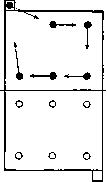
Volleyball has certain educational qualities; it accustoms players to coordinated work and to fulfilling a specific role in a collective. Thus, for example, for success in the game, all players must well "hold" their place; players standing at the back line, as a rule, should not hit the ball immediately to the opponent, but pass it to their partners, who find it more convenient to throw it over the net, etc. Volleyball develops speed and accuracy of movements, especially of the upper limbs. With fairly versatile exercise of all the major muscle groups, volleyball is characterized by a position of strong ex-
tension during jumping. Court for the game
ing the ball in volleyball. To the corners
up with the ball are drawn "squares"
movement, especially service squares, from above
useful as a corrective exercise, for correcting stoop (school-age). Indicated is the movement of players clockwise (after each win or loss).
professional). The physiological load during volleyball, especially for beginners, is relatively small, which makes it accessible to adolescents of both sexes, elderly persons, and also an interesting and useful entertainment in rest homes and for a number of categories of patients in sanatoriums. Nevertheless, with the improvement of technique, the pace of the game increases significantly, in connection with which the load also increases. Therefore, for adolescents and persons with suboptimal health, volleyball must be dosed, and as a rule, no more than 1-2 games are allowed for them. When playing on indoor courts, it is necessary to pay attention to the appropriate ventilation of the room and measures to prevent the floor from being slippery. To reduce the number of injuries to the ligamentous-articular apparatus of the hand and fingers, as well as leg injuries (from blows and stepping by partners) encountered in volleyball—the ball for women's play should be of lightweight weight (for adolescents, in addition, of reduced size), and footwear—necessarily of a light type. In order to prevent abrasions on the knees during falls in serious games, rubber knee pads are used.
Related articles
Mentioned in
Cite this page
“Volleyball.” Soviet Medical Encyclopedia. English translation of Bolshaya Meditsinskaya Entsiklopediya, 1st ed. (Moscow, 1928–1936), ed. N. A. Semashko. https://sovietmedicalencyclopedia.pages.dev/article/volleyball/