Surgery (Surgery, the science of medical aid to the)
Historical document, translated for reference. It reflects medical knowledge of the 1920s–30s and is not medical advice.
Summary
Surgery is the medical science of providing aid to the wounded. The term 'field surgery' was introduced by Pirogov. The subject of field surgery is the study of the effects of mechanical means of armed combat on the human organism and the organization of surgical aid for those injured in battle.
Encyclopedia article (1928–1936)
Surgery, the science of medical aid to the wounded. The term 'field surgery' was introduced by Pirogov. The subject of field surgery is the study of the effects of mechanical means of armed combat on the human organism and the organization of surgical aid for those injured in battle. In this connection, field surgery arises and is organized in accordance with the development of medical and sanitary affairs (see Military Sanitary Affairs, Surgery). If we do not count Homer's 'Iliad,' then the oldest work dealing with questions of field surgery was written by Heraclides in the 1st century B.C. under the title 'Soldier.' The systematic organization of military sanitary affairs in general and field surgery in particular began only with the establishment of regular armies, i.e., in the era of the Roman Emperor Augustus. The first work in the Latin language specifically treating of combat injuries was written in the 1st century A.D. by Celsus. In the section on military injuries, the ligation of bleeding vessels is mentioned for the first time, and it is recommended to tie off separately the central and peripheral ends with the vessel being cut between the ligatures. Injuries to the lungs, kidneys, skull, spinal cord, and intestines are described vividly and truthfully; the surgical treatment of open fractures, pseudoarthroses, etc., is indicated. Among the military physicians of the Trajan era, Archigenes is most famous. His improvement in amputation technique—preliminary ligation of vessels, wrapping the limb to shift the tissues upward from the site of section—was forgotten and not surpassed in the next 15 centuries. In the 2nd century lived the most outstanding of the ancient surgeons—Antyllus, memorable in the history of field surgery for developing the surgical treatment of aneurysms and the technique of tracheotomy. From the 7th to the 11th centuries, the authority in surgical questions was Paul of Aegina. In his seven-volume book 'Hypomnema,' a special chapter is devoted to the symptomatology, course, and treatment of wounds. Here for the first time mention is made of special transport for delivering the wounded from the battlefield to dressing stations. The Middle Ages mark a long period of cultural stagnation and the decline of scientific medicine. Field surgery was one of the few sources from which medicine drew fresh material and new ideas in opposition to the traditions of Galen and the Arab school. For example, in the 13th century, the father and son Borgognoni, in the 14th century, Mondeville (Henri de Mondeville), proclaimed on the basis of experience with traumatic material the paradoxical opinion that wounds should heal without suppuration and that this could be achieved with alcohol dressings. Expelled from the monasteries by decrees of the Roman popes (ecclesia abhorret a sanguine), surgery rushed into empiricism, found temporary refuge in the knightly military orders, and firmly settled in the cities, attaching itself to the guild apparatus and becoming a craft close to or identical with the profession of barbers. Medical affairs once again, as in the ancient period of history, split into 'medicine' of physicians and 'surgery' of paramedics. The first had all the privileges of scholarship, while the second was considered an 'ignoble' profession, adjacent to the profession of executioner. Only during war did the 'feldsher,' that is, translated into Russian 'field barber,' triumph de facto, although even on the battlefield de jure he could not operate without the sanction of a 'physician.' Emperor Charles V in 1548 was forced to issue a law proclaiming barbers an 'honorable' estate. Domestic and especially military trauma persistently demanded qualified assistance. Public opinion called distinguished paramedics surgeons and equated them with medical doctors. From among the people came, for example, the greatest surgeons of the 16th century, Franco (Pierre Franco) and Paré (Ambroise Paré). Paré has significance as a reformer of field surgery. In 1545, he declared it a harmful error, rooted since the 15th century through the authority of Vigo, to treat gunshot wounds with red-hot iron and boiling oil. His second reform concerned operative technique: to amputate at the level of healthy tissues, without waiting for demarcation; to stop bleeding with ligatures, not cauterization. The third innovation consisted in supplying amputees with proper prostheses instead of wooden stumps. Finally, special emphasis should be placed on the significance of Paré as a teacher of surgery. He did not know the Latin language, wrote his works in French, and thereby ensured their wide dissemination not among scholarly physicians, but among practicing surgeons. Paré had his predecessors in the new view on the treatment of gunshot wounds. In Italy, Maggi experimentally produced such wounds (the first systematic experiments) and came to the conclusion about the harm of cauterizing them for treatment. Even earlier, in the middle of the 15th century, two German 'surgeons,' Brunswig and Gersdorf, advised using not boiling, but warm oil for washing gunshot wounds. The book of the former is the oldest printed work on surgery in the German language. Emperor Maximilian I (died in 1519), 'the last knight' and the first organizer of a state mercenary army of 'landsknechts,' greatly contributed to the improvement of firearms, especially artillery, and also regulated the matter of aid to the wounded. Paramedics were attached to each military unit and were obliged, together with their 'assistants,' to remove the wounded even during battle. Subsequently, with the introduction of standing armies, the fate of the severely wounded became more deplorable. For example, in Prussia, according to the regulations of 1726, which were in effect until the end of the 18th century, the removal of wounded left on the battlefield was allowed only after the end of the battle. Field hospitals for the direct delivery of the wounded from the battlefield to them are mentioned for the first time at the end of the 16th century. From the time of Paré until the 19th century, France retained its leading role in field surgery, despite the fact that it was not until 1743 that the professions of surgeon and barber were officially separated. The growing demand for surgeons with each war led to the establishment of state medical-surgical schools. In Russia, as early as the time of Peter I, such a school was created at the Moscow 'hospital' in 1706. It is interesting to compare this with the fact that in Prussia, which earlier than other Western European countries regulated state health care, the first medical-surgical school for the needs of the army was founded only in 1724, and the first higher military medical school, the Academy of Emperor Joseph, was established in Austria in 1785. The equality of surgery with medicine, which seemed unacceptable in Austria and Germany until the end of the 18th century, encountered no obstacles in Russia, which organized medical affairs late, but immediately connected them with the military-sanitary service, and thereby with field surgery. The first professor of surgery in Russia, Shreiber, upon his appointment in 1742 as a teacher in the St. Petersburg general hospitals, was provided with instructions that imposed on him the duty of preparing 'for the army both on land and on water, skilled physicians.' In France at the dawn of the 19th century, alongside the greatest military genius, Napoleon, his companion in 25 campaigns and more than 460 battles, Larrey (Larrey), appeared—the greatest master of field surgery and reformer of the medical-evacuation aid to the wounded. The daring of Larrey as a field surgeon is unparalleled. In the Borodino battle, in one day he performed about 200 amputations and performed them not in a hospital, but in the field, creating for this purpose special flying detachments, the so-called 'ambulances.' He operated in the pre-antiseptic and pre-anesthetic period of surgery, but he operated in such a way that he excised large joints in several minutes and with such low mortality that, for example, out of 18 cases of shoulder disarticulations, only 3 died. Instead of anesthesia, he used cold in winter and amputated without pain at -19°. His immobile dressings made of egg white, white lead, and camphor alcohol allowed him to evacuate the operated immediately to the deep rear, bypassing intermediate stages without harm. Throughout the entire 18th century, the requirement for the preventive opening of gunshot wounds (preventive débridement) prevailed. It originated from the notion that all gunshot wounds are poisoned due to the poisonous properties of gunpowder and bullets. Larrey, like other outstanding surgeons before and after him, knew how to act independently of the traditional pattern and correctly combine the operative treatment of wounds with careful treatment of damaged tissues. The famous field surgeon of the English army during the Napoleonic wars, Guthrie, widely used the modern method of operative treatment and primary closure of gunshot wounds of the chest cavity. The principle consisted in the removal of all foreign bodies and bone fragments with subsequent suturing of the defect in the chest wall. The successes were so obvious that hermetic closure was preceded by aspiration treatment. Guthrie mentions an original method that then came into practice: non-combatant soldiers, especially musicians, were made to suck with their mouths penetrating chest wounds. Larrey also systematically evacuated blood and air from the pleural cavity, but with dry cups applied to the corners of the wound, and then applied a glue dressing. The individual merits of individual surgeons and the excellent results of their treatment in hundreds of cases do not, of course, diminish the significance of the fact that many thousands of wounded then remained without proper assistance. It could not have been otherwise. It was first necessary to create a systematic organization of military sanitary affairs in general.
The soil for fundamental reforms was prepared by the revolutionary movement of the masses, the abolition of serfdom, and the growth of factory industry. The introduction of universal conscription and the increase in armies made the task urgent. The principles of field surgery as mass aid to the wounded were first clarified by Pirogov. He is the founder of modern field surgery precisely because as early as the 1860s he saw 'true progress' in 'preventive medicine' and attached primary importance not to the practice of treatment, but to military-sanitary administration. Pirogov called war a 'traumatic epidemic.' This name was appropriate at the time as a call to public opinion to fight war as a national disaster. But besides this, it is characteristic as evidence of the widespread prevalence of wound infections during war and the vague understanding of their causes. The works of Pasteur, Semmelweis, and Lister opened a new era in surgery. On a large scale and for the first time under field surgery conditions, antisepsis was tested during the Russo-Turkish War of 1877-78. Pirogov's book 'Military Medical Affairs...' aptly reflects the evolution that had taken place in field surgery since the time of the Crimean campaign. Reyer's technique for anti-putrefactive measures in gaping wounds consisted in wide opening of the bullet channel with removal of bone fragments, scraping the wound with a sharp spoon, and washing with a 5% carbolic solution; all this in an atmosphere saturated with carbolic vapors. Another, opposite extreme is represented by Bergmann's technique for gunshot bone and joint wounds: wrapping the broken limb in a thick layer of 10% salicylic wool, then an Esmarch rubber bandage, and finally immobilization in a large, closed plaster cast. Along with this, for field surgery, the old 'open method' of wound treatment according to Burow and the new Moscow method of 'aeration hermeticism' by Kostarev were recommended. The latter consisted in tightly suturing the wounds and leaving them without a dressing, covered only by a mesh. Pioneers of antisepsis under field surgery conditions were also N. V. Sklifosovsky and N. A. Vyalyaminov. The question of the conditions determining the suitability of one or another antiseptic method remained unclear. Pirogov even treated with irony Reyer's 'demanding doctrine' about the necessity of 'primary' treatment of wounds according to Lister right at the dressing stations. Meanwhile, Reyer's figures—mortality of 10-14% with primary and 61% with secondary application of Lister's method—are of great historical interest. They anticipate the conclusions of the experimental works of Friedrich and Brunner in the 1890s on the possibility of mechanical or chemical disinfection of wounds only within a certain period of time. Reyer's tactics found confirmation in the material of the 1914-1918 war in the sense that operative disinfection, given a certain property of wounds, is necessary. The dependence 'of the properties of wounds, mortality, and success of treatment primarily on various properties of weapons and especially on projectiles' was one of the basic theses of Pirogov. There is no doubt that the development of field surgery is closely linked to the evolution of means of destruction. Features of modern combat trauma. In the theses on military danger, adopted by the Plenum of the ECCI in 1927, future war was called mechanized. 'Each country will be turned into a huge factory of means of destruction. The motor will play the decisive role in the matter of mechanized killing. But precisely because military technology has reached the highest degree of development, capitalist states will have to throw enormous masses into areas of military operations... At the same time, thanks to the widespread use of aviation, the destructive power of the latest bombs, and the long range of artillery fire, the difference between front and rear will be erased.' Thus, under modern conditions, military operations are directed not only against the living and material force at the front, but also against supply and command centers in the rear. Second, what strikes the eye is the quantity and quality of means of struggle, their enormous mass and variety, their high cost and lethal effect. Third, this is military tactics, calculated on the maneuverable mobility of motorized and armored forces, on the suddenness of a concentrated blow by land, sea, and air forces. Examining the effect of various combat means on the human organism, we observe mechanical, thermal, chemical, infectious, and psychic effects. Projectiles play the leading role among weapons of struggle, combining all types of traumatic effects. Wounds from cold weapons are becoming rare, but the bayonet and rifle butt, saber, pike, etc. still retain their significance in hand-to-hand combat. Combat damage can also include mechanical injuries from wire entanglements, wolf pits, and other artificial obstacles. A new type of mechanical weapon in the imperialist war constituted airplane arrows, which when scattered from great height deeply pierce the body (Figure 1). Finally purely

Figure 1. Airplane arrows (reduced about 2 times).
Mechanical injuries should include those from so-called 'secondary projectiles.' When bursting soil, trenches, and dugouts, artillery, high-explosive, and other projectiles throw up clods of earth, stone fragments, and other particles, which, when hitting the body, cause wounds. Wooden splinters, glass and brick fragments during fighting in populated areas, horse bones during cavalry skirmishes, everyday items in soldiers' pockets, combs, coins, buttons, and especially wristwatches often become such secondary projectiles. Firearms by zones of action can be divided into the following types: 1) hand grenade, thrown at a distance of 30-40 m, with a fragment radius of about 10 steps; characterized by multiple, burned, blind wounds of the skin and soft parts with ragged edges; often inexperienced throwers have self-inflicted injuries to the right hand and forearm; 2) revolvers of various systems, effective at an average distance of up to 50 m; penetrating power is relatively small, wounds resemble former rifle wounds inflicted from a distance; 3) rifle grenade, launched with the help of a rifle and effective at distances up to 600 m; 4) rifle for hitting individual targets - up to 400 m, and automatic rifle for group targets - up to 1 km; 5) mortars, which have gained great importance as a simple and very effective means for fragmentary, chemical, and incendiary damage to the enemy at distances of 2-3 km with bombs weighing 10 kg and more; 6) light and heavy machine guns; the former for mass shelling of living targets up to 1 km, the latter up to 4 km, with a rate of fire reaching 1,000 per minute; 7) infantry artillery pieces of 20-57 mm caliber, disassembled, light, rapid-fire (100-100 shots per minute), with a range of 6 km or more; 8) light guns of 76 mm caliber and howitzers for high-angle fire of 114-122 mm caliber; range of the former - 14 km, the latter - 11.5 km; 9) heavy field guns - 107-120-mm guns and 152 mm howitzers; range of damage from 20 to 30 km; 10) super-heavy guns of 150 mm caliber and more on special railway platforms with a range of 50-150 km; 11) aerial bombs weighing up to 2,000 kg, dropped from airplanes or airships. Mechanical trauma from fragments of grenades, mines, and bombs is often combined with thermal and chemical effects. But the imperialist war also introduced burns and poisonings as special types of combat injuries. Invented by engineer Fiedler on the eve of the world war, flamethrowers were adopted by all armies. A mixture of coal tar and gasoline was expelled under pressure from compressed nitrogen from metal cylinders, ignited at the outlet and sprayed in a stream of burning liquid over an area of 40-70 m. Electricity in the form of high-voltage currents was passed through wire obstacles, but in this form it could not become a regular means of combat. The revolution in technique and tactics associated with the mass use of chemical agents was all the more significant (see Chemical warfare agents). Sound and light irritants, used independently in ancient times, are now only an additional, but still powerful factor in traumatizing the central nervous system. Field surgery, which deals mainly with gunshot wounds, must build its therapeutic and preventive measures taking into account the general condition of the soldier. From the point of view of military surgery, rifle and machine gun fire is generally characterized by injuries with a long bullet channel, with multiple perforated organs, with crushing and 'lateral' action at a certain flight speed. This creates diagnostic and therapeutic difficulties. (Various types of blunt and pointed bullets are shown in figures 2-7.) Recognition cannot be satisfied with topographic-anatomical data, but must also take into account the clinical picture. Crushing wounds are accompanied by large tissue defects and present special requirements in terms of primary and sequential treatment. Lateral action occurs in the form of indirect contusion or rupture of organs and tissues located near the bullet channel, with visible integrity of the intermediate layer. For example, a bullet that has pierced the spinous process of a cervical vertebra and has not touched the dura mater can cause fatal damage by lateral action: paralysis and death from focal hemorrhage in the spinal cord; the wounded person may die from penetrating peritonitis, although only the musculature of the abdominal wall has been pierced by the bullet: a filled intestine burst under the pressure of the lateral wave of a rapidly passing projectile. A similar explanation is found for cases of rupture of the spleen or liver in the wounded, if the integrity of the peritoneum is confirmed by examination of the bullet channel. A feature of modern projectiles is their large kinetic energy with a relatively small weight. But the effect depends on the properties of the object no less than on the action of the projectile. This is especially clearly manifested in objects of complex biological structure. A tubular bone reacts differently than spongy or flat bone. All other conditions being equal, a bullet can smoothly pierce the femoral condyle, while its diaphyseal part may be shattered and the muscles and skin torn from within by bone fragments.
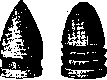

Figure 2. a-18 mm rifle bullet from the Napoleonic wars; b-14 mm bullet with Minié cup from the Crimean War (reduced).

a
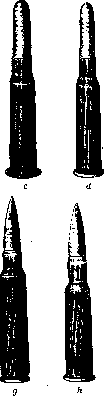
Figure 3. Various types of bullets (reduced): a-Krka; b-Berdan; c-Russian jacketed 3-line; d-Japanese jacketed 2-line; e-Japanese pointed 6.5-mm; f-German S 8.2-mm; g-English 8-mm; h-Russian 8-mm. i channel, with visible integrity of the intermediate layer. For example, a bullet that has pierced the spinous process of a cervical vertebra and has not touched the dura mater can cause fatal damage by lateral action: paralysis and death from focal hemorrhage in the spinal cord; the wounded person may die from penetrating peritonitis, although only the musculature of the abdominal wall has been pierced by the bullet: a filled intestine burst under the pressure of the lateral wave of a rapidly passing projectile. A similar explanation is found for cases of rupture of the spleen or liver in the wounded, if the integrity of the peritoneum is confirmed by examination of the bullet channel. A feature of modern projectiles is their large kinetic energy with a relatively small weight. But the effect depends on the properties of the object no less than on the action of the projectile. This is especially clearly manifested in objects of complex biological structure. A tubular bone reacts differently than spongy or flat bone. All other conditions being equal, a bullet can smoothly pierce the femoral condyle, while its diaphyseal part may be shattered and the muscles and skin torn from within by bone fragments.


Fig. 4. a-dum-dum bullet; b-English bullet with hollow tip upper part (reduced).
Fig 5.
Components of an explosive or pointed bullet. rupture muscles and skin coverings. Remarkably, the direction of such crushing action not only corresponds to the flight of the projectile but is also directed toward the entrance wound of the bullet. The same is observed in even more complex variety in cranial injuries. When a bullet hits the head, the cranial vault may remain intact, while deep cracks may extend in characteristic directions at the base. This depends exclusively on the architecture of the skull, not on what weapon causes the injury. If specificity for projectiles can be recognized in the intensity of action, rifle bullets in this respect sometimes surpass fragments of high-explosive grenades. However, for small units, the action of the latter is so varied that the patterns of cranial injuries are better studied on bullet wounds. The most important feature of gunshot wounds to the head

Figure 6. Aluminum-lead English bullet: a-externally; b-on cross-section; c-with broken tip (reduced).
Figure 7. Various types of deformation of jacketed rifle bullets. P. devoted much labor and energy to the study and development of a new branch of surgery-surgery of the nervous system, creating in the institute he headed in 1924 a special department of surgical neuropathology. In his organizational and scientific-pedagogical activities, P. responds sensitively to the demands of the times, having devoted a number of works to issues closely related to the building of socialism in our country. Such are works on the fight against industrial and agricultural traumatism. Along with his multifaceted pedagogical and scientific-organizational activities, P. actively participates in the public life of the country, constantly being among the active organizers and builders of new forms of Soviet medicine. He was a member of the board of the Leningrad Regional Health Department and a member of the Leningrad Council of Workers' and Deputies' Deputies. Member of the Varshavsky Society, chairman of the Leningrad Society of Orthopedic Surgeons and vice-chairman of the Russian Surgical Society of Pirogov. Of P.'s 72 printed works, in addition to the dissertation mentioned, the following should be noted: 'Basic issues of the fight against industrial traumatism and its consequences' (Sov. Khir., vol. I, issue 1, 1931); a number of chapters in major collective guides: 'Trophic diseases of the extremities' (chapter in 'Guide to Practical Surgery', ed. by S. Girgolav, A. Martinov, and S. Fedorov, vol. IX, M.-L., 1931); 'Tumors of the brain' (chapter in the book 'Malignant Tumors', ed. by N. Petrov, vol. I, L., 1932) and published separately: 'Materials on the pathology and clinic of diseases of the proximal part of the large intestines from the point of view of surgical therapy' (L., 1918); 'On new methods of surgical therapy of trophic disorders in injuries of the peripheral nervous system of the extremities' (L., 1923); 'Fundamentals of practical traumatology' (L., 1926).
Related articles
Mentioned in
Cite this page
“Surgery (Surgery, the science of medical aid to the).” Soviet Medical Encyclopedia. English translation of Bolshaya Meditsinskaya Entsiklopediya, 1st ed. (Moscow, 1928–1936), ed. N. A. Semashko. https://sovietmedicalencyclopedia.pages.dev/article/surgery/