Glossy Skin
Historical document, translated for reference. It reflects medical knowledge of the 1920s–30s and is not medical advice.
Summary
Glossy skin is a trophic disorder of the skin of the lower extremities, particularly the fingers. It begins with slightly thickened, smooth, shiny, tense, bluish-red skin that later becomes pale, waxy, thinned, and atrophied, often accompanied by neuralgia.
Encyclopedia entry (1928–1936)
GLOSSY SKIN (dermatitis essentialis neurotica, liodermia essentialis, atrophoderma neuroticum, peau lisse, лоснящаяся кожа), a trophic disorder of the skin of the lower extremities, particularly the fingers. Initially, the skin appears slightly thickened, smooth, shiny, tense, bluish-red, and subsequently takes on a pale, waxy color, thins out and atrophies. Cracks, abrasions, blisters, and ulcers often develop. Nails are frequently disfigured. Neuralgia is usually present. G. was first observed in a patient after the radial nerve was severed (Denmark). Cause: arteriosclerosis and damage to trophic nerves (as a result of trauma, myelitis, or constitutional diseases such as gout and rheumatism). Prognosis: according to Mitchell, the disease spontaneously disappears in most cases. Treatment: elimination of the underlying nerve disorder, tonic agents (arsenic and iron) and local applications (massage and electricity).
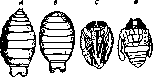
Figure 1. Stages of transformation: L-larva; B-puparium; C and D-pupa, removed from puparium, from below (C) and from above (D).
Figure 1. Stages of transformation: L-larva; B-puparium; C and D-pupa, removed from puparium, from below (C) and from above (D).
Related articles
Cite this page
“Glossy Skin.” Soviet Medical Encyclopedia. English translation of Bolshaya Meditsinskaya Entsiklopediya, 1st ed. (Moscow, 1928–1936), ed. N. A. Semashko. https://sovietmedicalencyclopedia.pages.dev/article/glossy-skin/