Muscle Atrophy in Diseases of the Nervous System
Historical document, translated for reference. It reflects medical knowledge of the 1920s–30s and is not medical advice.
Summary
This article from the 1928–1936 Soviet medical encyclopedia details muscle atrophy caused by various nervous system disorders, including cerebral and spinal paralysis, peripheral nerve damage, and specific conditions like progressive muscular atrophy.
Encyclopedia article (1928–1936)
MUSCLE ATROPHY IN DISEASES OF THE NERVOUS SYSTEM. I. Muscle atrophy in cerebral paralysis can be observed in cerebral paralysis of children, i.e., in childhood hemiplegia, diplegia, etc.; in this case, atrophy is usually observed not only in muscles but also in bones; muscle atrophy affects most muscles of the limbs; such muscle atrophy is considered as a delay in development; in the spinal cord in such cases a decrease in the amount of gray matter of the spinal cord is observed. Muscle atrophy can also be found in adult hemiplegics, usually some time after the appearance of hemiplegia; the proximal parts of the limbs are affected, and more often the upper limbs; sometimes atrophy of the bones is observed; as well as vasomotor trophic disorders. Degeneration reactions, as a rule, do not occur. The appearance of such muscle atrophy is explained by insufficient trophic regulation of muscle tissue by the gray matter of the spinal cord due to the loss of cerebral trophic centers.
MUSCLE ATROPHY IN DISEASES OF THE NERVOUS SYSTEM
60S
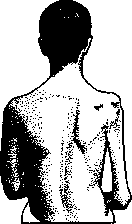
can be found in adult hemiplegics, usually some time after the appearance of hemiplegia; the proximal parts of the limbs are affected, and more often the upper limbs; sometimes atrophy of the bones is observed; as well as vasomotor trophic disorders. Degeneration reactions, as a rule, do not occur. The appearance of such muscle atrophy is explained by insufficient trophic regulation of muscle tissue by the gray matter of the spinal cord due to the loss of cerebral trophic centers.-II. Muscle atrophy in spinal paralysis. In various toxic-infectious processes affecting the anterior horns of the spinal cord (e.g., in poliomyelitis), in various destructive processes in them (e.g., in hemorrhage), progressive muscle atrophy can be observed (see Fig. 1). This type of muscle atrophy is characterized by the presence of fibrillary twitchings and a change in electrical excitability - from quantitative decrease to complete degeneration reaction; often also by a symmetrical type of distribution of muscle atrophy. In acute childhood poliomyelitis, after some time, muscle atrophy develops in the paralyzed muscles, usually affecting a large part of the muscles of the limb; over time, a delay also occurs in the development of the bones of this limb; vasomotor-trophic disorders appear; in the final stage of the disease, muscle atrophy remains strictly localized in one or several muscles of one limb. In chronic poliomyelitis of adults, muscle atrophy also develops, analogous to the described one. Muscle atrophy is also observed in hematomyelitis, various myelitis, syringomyelia, sometimes in spinal tabes (so-called tabes amyotrophica).-III. Muscle atrophy in damage to peripheral nerves, developing in damage to nerve plexuses, motor or mixed nerves (see Fig. 2), is characterized by the appearance of a degeneration reaction, peripheral distribution, and regressive course with improvement of the paralysis; in this case, fibrillary twitchings are most often not observed. Muscle atrophy of this type is observed in polyneuritis of various origins, e.g., after typhus, due to alcohol abuse, lead or arsenic poisoning. Muscle atrophy develops in the paralyzed muscles, for the most part quite quickly and is more sharply expressed in the periphery of the limbs, more in extensors than in flexors.-IV. Muscle atrophy
Figure 1. Muscle atrophy of the shoulder girdle of the right side in poliomyelitis ant. so-called functional origin. Hysterical muscle atrophy is always limited to the paralyzed limb, usually affecting several segments of the limb; muscle atrophy appears some time after the onset of paralysis and quickly smooths out with its disappearance; degeneration reactions are not observed.
A. Kapustyants. Muscle Atrophy of Aran-Duchenne. Under this name, for a long time, a disease was described in neurological literature, representing a subtype of progressive muscular atrophy, standing next to myopathy, but differing from it by a whole series of clinical signs: 1) the familial element, so characteristic of myopathy, is not present here, 2) the disease does not begin in childhood, as myopathy does, but at a later, most often mature age, more often affecting men, 3) the process begins with the upper limbs, symmetrically and gradually spreading from the distal parts to the root of the limb, 4) muscle atrophy - in contrast to myopathic muscle atrophy - is not accompanied by muscle pseudohypertrophy, but is accompanied by fibrillary twitchings and a degeneration reaction, which indicates their myelopathic origin and corresponds to 5) the underlying disease being damage to the motor cells of the anterior horns of the spinal cord. The difference from chronic anterior poliomyelitis was considered the symmetry of the process in Aran-Duchenne muscle atrophy, as well as the fact that, in contrast to poliomyelitis, muscle atrophy does not follow muscle paresis or paralysis, but develops primarily, and the strength of the affected muscles suffers only in proportion to the degree of gradual disappearance of the muscle tissue itself. The disease proceeds, very slowly progressing, and begins with muscle atrophy of the small muscles of the hands (usually first on the right hand),
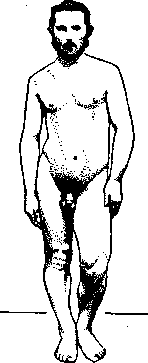
Figure 2. Muscle atrophy of the right
leg in disease of the ischial nerve, leading to the formation of the so-called "Aran-Duchenne hands"; slowly generalizing, muscle atrophy can, in the end, also affect the bulbar musculature; tendon reflexes disappear; disorders of sensitivity, sphincters, and intellect are absent. In the future, most cases treated as Aran-Duchenne muscle atrophy turned out to belong to other disease forms: to syringomyelia, part to lateral amyotrophic sclerosis, to cervical hypertrophic meningitis, to hypertrophic neuritis, to professional amyotrophy, to tuberculosis of the spine, etc. The difference between Aran-Duchenne muscle atrophy and chronic anterior poliomyelitis also turned out to be overly schematized and artificial (see Poliomyelitis). The remaining cases, corresponding to the clinical type of Aran-Duchenne, were subjected to further subdivision, since it turned out that syphilis can give similar forms. Some authors, especially the French, generally deny the existence of progressive non-syphilitic Aran-Duchenne muscle atrophy. Others, based on single observations, continue to describe this form as an independent disease, identical to chronic anterior poliomyelitis (Dejerine) or even independent of it. Therefore, it is understandable that now it is often preferred to use the term "Aran-Duchenne muscle atrophy" not to denote a special disease, but only to denote a special clinical syndrome corresponding to the description of Aran and Duchenne and observed in various diseases of the spinal cord. If this non-familial social progressive muscular atrophy is, therefore, still controversial, then, on the contrary, familial progressive spinal muscular atrophy has been firmly established.
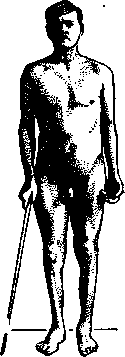
Figure 3. Progressive Muscular Atrophy of Charcot-Marie.
Related articles
Mentioned in
Cite this page
“Muscle Atrophy in Diseases of the Nervous System.” Soviet Medical Encyclopedia. English translation of Bolshaya Meditsinskaya Entsiklopediya, 1st ed. (Moscow, 1928–1936), ed. N. A. Semashko. https://sovietmedicalencyclopedia.pages.dev/article/muscle-atrophy-in-diseases-of-the-nervous-system/