Waste Incineration
Historical document, translated for reference. It reflects medical knowledge of the 1920s–30s and is not medical advice.
Summary
This article from the 1928–1936 Great Medical Encyclopedia describes the principles, technological methods, and sanitary requirements of solid waste incineration. It covers both large central municipal incineration plants with heat recovery and small portable or stationary household and institutional furnaces.
Encyclopedia article (1928–1936)
WASTE INCINERATION, a radical method of neutralizing solid refuse by fire. A distinction is made between waste incineration in small, simple furnaces without utilizing the heat of combustion and ash, and waste incineration in central station plants with the utilization of waste heat for steam generation and obtaining slag for construction purposes. Recently, attempts have been made to extract from refuse: a) fine refuse, which represents a good fertilizer (by passing through trommel screens); b) metal parts (using a magnetic apparatus); c) rags and paper (by suction with strong exhausters); d) other valuables, such as bones, glass, etc. (manually). With modern technological advances, waste incineration is carried out in an environment that is sanitary and flawless for the workers engaged in production; the workers have no contact with the refuse, the entire premises of the station are maintained in exemplary cleanliness, disinfection measures are carried out, enhanced ventilation and dust suction from the premises are provided, and airlocks with showers are installed. Thanks to the complete and perfect combustion of refuse in improved furnaces, garbage incineration plants do not spoil the atmospheric air and can be located even near residential areas. The art of the most economical waste incineration consists in burning any refuse without adding fuel. For this purpose, it is necessary to construct complex furnaces and subject the refuse to preliminary processing in order to rid it of ballast in the form of moisture and inorganic parts that lower its calorific value. If the refuse is very wet (Russian and French refuse), it is subjected to drying before burning in drying apparatus located outside the combustion chamber and heated by waste gases [furnaces of the "Musag" system; Kiel, Cologne, Moscow], or on drying hearths located inside the combustion chambers themselves [furnaces of the "Sepia" system; Tours, Moscow], or in special drying drums located outside the furnaces and heated by gases escaping into the chimney [furnaces of the "Boussange" system; Paris]. If the refuse contains a lot of ash, sand, earth, and other non-combustible substances, the non-combustible fines are screened out before combustion through special trommel screens, thereby increasing the calorific value (Cologne); on the other hand, these fines find application as fertilizer (Paris) or as material for casting paving stones in special furnaces—the Suho-Humboldt method. Collecting street sweepings in yards into separate containers can eliminate the need for screening at the station. In view of the fact that preliminary processing complicates and increases the cost of waste incineration, when refuse is sufficiently combustible, it is burned without any preliminary processing and in furnaces of less complex construction (English refuse). For very moist refuse, the blowing of preheated air into the furnace is used during combustion. Sanitary requirements imposed on furnaces regarding their maintenance: a) dust-free and, where possible, automatic loading of furnaces with refuse without workers coming into contact with it (workers do not see the refuse at all if it is delivered in bodies of the Ochsner system); b) dust-free removal of ash and cinders from the furnace, which is achieved by having the slag fall into a water basin located beneath the furnace and become granulated; c) mechanical stoking of the furnace; d) complete combustion of refuse in the combustion chamber without the release of smoke into the station premises and unburned gases into the chimney; e) mechanization of both the removal of slag from the furnace and its transport to the place of utilization; f) immediate incineration of all refuse arriving at the station during the day (within the first twenty-four hours); g) maintaining the floors and walls of all working premises of the station constantly clean; h) dust suction by powerful vacuum cleaners; i) devices for washing and disinfecting the bodies in which refuse is delivered to the station. All of the above applies to large station furnaces with a daily capacity of 40 tons or more of burned refuse. Portable and stationary domestic furnaces are also built. In such furnaces, refuse is burned with the addition of fuel, and the possibility of unburned gases escaping into the chimney is not excluded. Examples of portable furnaces include the English "Watson" cylindrical system, the "Columbian", and the triangular-section "Triangle". A stationary furnace for hotels
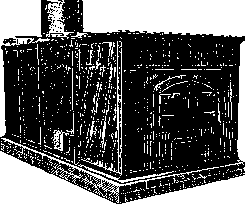
Figure 1. Waste incineration furnace for hotels and restaurants.
and restaurants, etc., is shown in Fig. 1; such furnaces are lined on the inside with firebrick and have a device for blowing air into them by a fan; the furnace is loaded and deslagged manually. The most widespread type of furnace is that of the German "Kori" system. The cost of such furnaces (depending on size) ranges from 1,500 to 2,800 marks. These furnaces are built in 10 different types: Type I for veterinary laboratories, institutes, clinics, and hospitals (for burning dressing materials and small experimental animals). Type Ia for infirmaries and veterinary clinics with an auxiliary combustion chamber. Type II for large hospitals (up to 2,000 beds) in the presence of a chimney at the boiler house; it is built next to the boiler house or the disinfection room. Type III for small and medium-sized slaughterhouses (for burning condemned meat and carcasses). Type IIIa for large slaughterhouses. Type IV for boiler houses. Type X—small gas-heated furnaces for burning dressing materials, small animals, etc. Station furnaces designed for burning very large quantities of refuse are of various systems and designs. Figure 2 shows the Moscow waste incineration station (plan of the 1st and 2nd floors), commissioned in 1926 and built in compliance with all sanitary requirements according to the design of Burche. It is equipped with two furnaces with a daily capacity of 80 tons each: one of the German "Musag" system, the other of the French "Sepia" system. The furnace building has two floors; the design of furnace loading and deslagging complies with all hygienic requirements set forth by labor protection according to the Labor Code, i.e., workers not only do not come into contact with the refuse
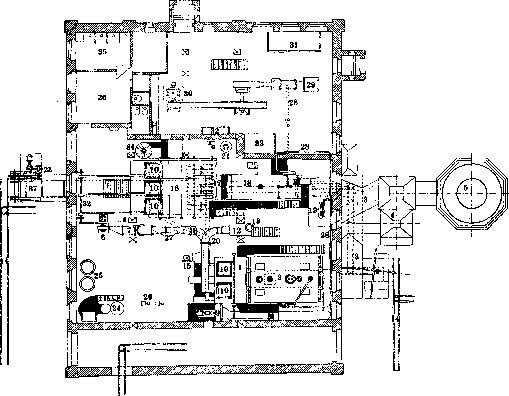
Figure 2. Plan of the waste incineration station in Moscow: 1—furnace of the "Musag" system; 2—boiler of the "Humboldt" system; 3—flue to the chimney; 4 and 12—heat trap; 5—chimney; 6—fan for the furnace; 7—steam air preheater; 8—air duct to the furnace; 9—exhauster device; 10—drying apparatus; 11—pipe from the drying apparatus; 13—pipe for removing vapors of the dried refuse; 14—tramcar tracks; 15—measuring instruments; 16—furnace of the "Sepia" system; 17—flue connecting the furnace to the boiler; 18—boiler of the "Babcock & Wilcox" system; 19—Green's economizer; 20—fan for the "Sepia" furnace; 21—hydraulic accumulator; 22—transmission for the charging device; 23—transmission for slag transport; 24—water purifier of the "Seyfert" system; 25—feed water tanks; 26—pumps for the "Humboldt" boiler; 27—pumps for the "Babcock & Wilcox" boiler; 28—pipeline to the steam engine; 29—steam engine; 30—generator; 31—main switchboard; 32—lighting switchboard; 33—recording measuring instruments; 34—spiral staircase; 35—shower; 36—dressing room; 37—conveyor for lifting slag.
for factories, warehouses, hotels (for large masses of easily combustible objects). Type V - for wet refuse (with a chamber for preliminary drying). Type VI - for markets (for burning vegetable refuse, spoiled fish, fruit); it is attached to an existing chimney. Type VII - for disinfection devices. Type VIII - for cemeteries in large cities where masses of dried flowers and wreaths accumulate. Type IX - is installed in the courtyards of large buildings for burning all kinds of refuse and is attached to the central heating boiler room with the discharge of flue gases into the chimney, but they do not see it either. Proper cleanliness is maintained at all times on both floors; this is facilitated by tile floors and the absence of dust and ash, which do not enter the room thanks to the rational choice of slag removal and loading systems. The station has a inspection checkpoint with clean and dirty changing rooms. Central steam heating is provided from boilers built into the furnaces; ventilation on the lower floor is achieved by blowers that suck out stale air from the premises. On the upper floor on the roof, a lantern is arranged with frames that open using a cord from the floor of the second floor. The transport of garbage to the station is carried out by horse-drawn traction from close distances, and by automobile and electric vehicle traction from medium and long distances. Electric vehicles are charged at the station with current received at an electric station temporarily installed at the site of the third furnace. Electrical energy is generated by a generator connected by a belt drive to a steam engine, which receives steam from boilers built into the incinerators; the boilers are heated by gases escaping from the furnaces without additional fuel. In addition, the laundry is supplied with steam, washing 4 tons of linen in one shift. All machines and lifting mechanisms, such as ventilators, exhausters, cranes for feeding garbage into furnaces, motors for slagging, etc., are driven by electrical energy generated at its own electric station; the latter is also illuminated by its own energy. The station has a laboratory equipped with all instruments and apparatus for chemical and mechanical analysis of garbage, for determining the calorific value of garbage, the composition of slag, etc. Among modern waste incineration plants abroad with the latest equipment, the most noteworthy are the waste incineration plant in Cologne with a daily capacity of 550 tons, put into operation in 1928 and equipped with «Musag» system furnaces, four Paris stations converted in recent years with «Boussingault and Brechot» system furnaces, the Zurich and Birmingham plants equipped with «Heenan and Froude» system furnaces, and the newest American plants equipped with «Nye Odorless» and «Decarie» system furnaces. - In the USSR, waste incineration stations exist besides Moscow also in Leningrad, Baku, Kiev, and Odessa. The use of one or another furnace system depends mainly on the properties of the garbage and its calorific value; each country tries to build furnaces of its own engineers' design without resorting to foreign assistance, and the equipment of the stations is produced in relation to local conditions. These designs take into account the features of local garbage: German garbage, with low moisture content but a high ash content, requires preliminary sifting and can be burned in furnaces without a combustion chamber; Russian or French garbage, which is very wet, requires preliminary drying and burns better in furnaces equipped with drying apparatus and combustion chambers. - In foreign plants, even the most modern ones, due attention is not paid to the sanitary side of the matter; in the cities of the USSR, the main condition is sanitary requirements, and the economic side of the enterprise is put in second place; electric stations are not set up everywhere, and the steam generated in the boilers is either expended on heating the district adjacent to the station (Zurich) or transmitted directly via pipeline for the production needs of neighboring enterprises; in Schöneberg (Berlin), the station is located near the city electric station, and steam from the waste incineration station is transmitted directly to the electric station, and the electric station supplies current to the waste incineration station for all its needs, i.e., for driving electric motors at the station, for charging electric vehicles bringing garbage to the station, and for lighting. The stations of Paris, Cologne, Birmingham, etc., have their own electric stations and supply current: Paris - to the city water-pumping stations, Cologne - to the city, while Birmingham uses current mainly for its own needs - charging 40 electric vehicles bringing garbage to the station. When equipping its own electric station, production is complicated and distracts attention from the direct task, since the presence of stations imposes responsibility for regular and uninterrupted supply of current with an extremely variable composition of garbage-fuel, whereas with the direct delivery of steam to the outside, all production is extremely simplified, and all attention is directed to the better organization of waste incineration production and to ensuring that it takes place under hygienic conditions. - Station furnaces are built for a daily capacity of from 40 to 120 tons in a single apparatus; the temperature in the furnace is from 600° to 800°, and at the end of combustion up to 1,000–1,100°; the temperature of flue gases is from 250° to 350°. Steam generation ranges from 0.4 to 1 kg per 1 kg of garbage; English garbage in some cities yields up to 2.5 kg of steam per 1 kg of garbage. Waste incineration stations are very advisable to set up in large cities; due to the possibility of building them in residential areas, funds are saved on the transport of garbage usually carted to dumps located far beyond the city limits; in addition, large cities have the opportunity to expend significant funds necessary for the construction of such complex structures as waste incineration stations. If we assume the minimum daily capacity of a station furnace to be 40 tons, this approximately corresponds to a population of 80–100 thousand residents on the condition that the furnace operates around the clock; when working in one shift, such a furnace can serve only 30 to 40 thousand residents, depending on the accumulation of garbage; working in one shift is very unprofitable, since valuable fuel must be expended daily for kindling; when working in two shifts, such a fuel expenditure can be avoided. A city population of 40–50 thousand residents is the minimum at which waste incineration in station furnaces of complex design, pursuing mainly hygienic combustion conditions, can still be justified from an economic point of view. However, even in cities with a population of 100–200 thousand residents, waste incineration cannot always be applied due to local conditions. One of the main conditions for the rational application of waste incineration is that the operating costs of the station can be covered by revenues from the utilization of steam and slag, etc.; the second prerequisite for the application of waste incineration is the absence of free land plots outside the city limits for the soil method of disposal (see Garbage). In large cities with a population of 505 thousand residents and more, when the territory is widely scattered and when the expected expansion of the city over the next 25–30 years strongly pushes away the locations of land plots for the soil method of disposal, it is often more advantageous for economic reasons to set up waste incineration stations in order to reduce transport costs. In most cases, the introduction of waste incineration is hindered by economic reasons both in terms of large one-time expenditures and large operating expenses, which are mostly unjustified with the low calorific value of garbage and place a heavy burden on the city budget. The excessive moisture of Russian garbage causes great difficulties during its combustion and increases expenses. Only with the eradication of uncivilized habits of the population, when liquid sewage—which should be poured into sink drains—is also poured into the garbage pail, will waste incineration become profitable in operation for relatively small cities. However, economic considerations must take a back seat in those cities where population density is very high and where, in the interests of sanitary well-being, waste incineration is indispensable as a radical method of improving the city's territory. The cost of waste incineration installations-stations is usually referred to 1 ton of daily capacity; operating expenses are referred to 1 ton of burned garbage. The table gives data on the cost of stations per 1 ton of daily capacity of a number of foreign and Russian installations, indicating the furnace system, the year of their construction, daily capacity, and cost data for burning 1 ton of garbage. Cost of construction per 1 ton of daily capacity and cost of burning per...
Humboldt 12(1916) 1.84 Wiesbaden .... derv 17(1916) 2.20 Frankfurt am Main. Herbertz 465(1916) 3 500 2.90 Milwaukee . . . Heenan & Froude 54(1918) 3.02 Berlin ..... Martini-Vesuvius 50(1923) - 2.50 Leningrad . . . Heenan & Froude 26(1912-15) 3 000 2.00 (pre-war) Moscow..... Muzag 8(1926-27) 2 500 (pre-war) 2.75 (pre-war) Moscow..... Sepia 2 500 (pre-war) 2.53 (pre-war). Since economics in most cases play a large role in the resolution of important sanitary measures, the key to the success of waste incineration lies in such an organization of the enterprise that expenses are covered by income. This can be achieved, first of all, by utilizing heat for steam, which can cover up to 40% of the expenses, and secondly, by setting up a plant at the station to utilize slag, which can be used for construction either directly as a building material or processed at the plant into building bricks; thus, approximately another 30% of expenses can be covered. The remaining 30% of expenses can be covered by the realization of valuables and screenings found in the refuse, for which mechanical sorting departments are arranged at the stations in compliance with all sanitary rules. In addition, savings on transport due to bringing the disposal site closer to the accumulation site can go towards covering the incineration costs. Thus, an exemplary setup of waste incineration consists in the refuse being used entirely without residue and all the refuse arriving at the station being processed into valuables, which already entails the formation of a whole industrial complex, i.e., a waste incineration station in combination with a sorting station for extracting valuables and together with a plant for manufacturing products from slag (Cologne). In addition to these sideline enterprises, it is useful to choose a location for the station such that the steam generated in the furnace boilers is consumed right there in production, for example, to supply steam to a gasworks (Fürth), to baths and laundries for their heat supply (Moscow), to supply hot water to an entire city district (Zurich), or to use the hot gases escaping into the chimney to dry sludge at sewage treatment plants (Frankfurt am Main). The birthplace of waste incineration is England, where the good combustibility of refuse was particularly favorable to the development of this business. Over a 50-year period of gradual development of waste incineration, there are about 500 large waste incineration plants worldwide, half of which are in England. Despite the fact that waste incineration, along with other sanitary-technical measures such as water supply and sewerage, is still a young enterprise, its successes over the past 10 years abroad show that progressive cities interested in providing their populations with cultural and hygienic living conditions do not hesitate at the expense for this cause. All difficulties of a technical nature that hindered the development of waste incineration 20-25 years ago are presently, thanks to improvements in the methods of processing refuse before its incineration, gradually disappearing, thereby clearing the way for the wide introduction of waste incineration. It is important here that after a thorough study of all local producer of 1 t of r e f u s e. conditions and taking into account all technical and economic aspects of the matter, the questions of choosing the location for the station, the choice of furnace system, the system of supervision and utilization of steam, slag, and valuables contained in the refuse are correctly resolved.—The basic provisions for the construction of waste incineration stations were developed by a special commission under the Permanent Bureau of Water Supply and Sanitary-Technical Congresses and published in the proceedings of the 14th Congress.
Related articles
Mentioned in
Cite this page
“Waste Incineration.” Soviet Medical Encyclopedia. English translation of Bolshaya Meditsinskaya Entsiklopediya, 1st ed. (Moscow, 1928–1936), ed. N. A. Semashko. https://sovietmedicalencyclopedia.pages.dev/article/waste-incineration/