REOMETERS
Historical document, translated for reference. It reflects medical knowledge of the 1920s–30s and is not medical advice.
Summary
Reometers are devices for measuring the amount of air or other gas passing through research apparatus. They are widely used in analytical work with chemical warfare agents and in sanitary-hygienic studies of air for harmful impurities in factory premises.
Encyclopedia article (1928–1936)
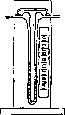
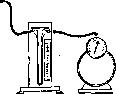
REOMETERS, devices for measuring the amount of air or any other gas passing through research apparatus. R. are widely used in analytical work with chemical warfare agents, as well as in sanitary-hygienic studies of air for harmful impurities in factory premises. In terms of accuracy, a well-calibrated R. is little inferior to gas meters (see). The principle of R. design is based on the fact that gaseous substances, when passing through a tube inside which there is a narrowing of the passage in the form of a diaphragm or capillary, encounter some obstacle in this narrowing, as a result of which a greater gas pressure is obtained in front of the narrowed place in the tube than after exiting the narrowed place. The greater the speed of the gas flow, the greater the pressure difference. If both halves of the tube, in front of and behind the narrowing, are connected to a sensitive bent manometer, then when air is passed through the tube, the level of liquid in one manometer limb will rise, in the other it will fall. Using the difference in levels, and using Torricelli's formula for determining the speed of efflux of liquids and gases V = √(2gh), and taking into account the formula V = k√(p/ρ), which expresses that the speed of efflux is inversely proportional to the square root of the gas density and directly proportional to the square root of the gas pressure, the speed of gas movement in the tube and its volume passing through the tube per unit of time are calculated. Such theoretical calculations are mainly required when designing R., when the diameter of the diaphragm and the dimensions of individual parts of R. are established. A finished R. is usually calibrated against good gas meters. Having determined by gas meters the amount of air or gas passing through the reometer per unit of time at different positions of the manometric liquid, an empirical scale is compiled and it is used in work with R. Various types of reometers. R. with diaphragms are most widespread; they consist (Fig. 1) of a U-shaped glass tube with protective expansions a and b in the left and right limbs to prevent the liquid from being ejected. At the top, both limbs are connected to a horizontal tube, in the middle of which there is a diaphragm c with a narrow hole of a certain diameter. The U-shaped tube is filled with colored liquid: kerosene, water, sulfuric acid, etc. As a general rule, the manometric liquid should not chemically react with the gas passing through the R. When working with air, it is most convenient to use kerosene colored with alkanic or picric acid. The specific gravity of the kerosene must be specific, since a change in the specific gravity of the liquid changes all calculations. A cardboard scale is attached to one of the limbs of the R., on which divisions are marked indicating the amount of air passing through the R. at one or another position of the manometric liquid. When working with R., it is necessary to ensure that in a state of rest, the level of liquid in both limbs of the U-shaped tube exactly corresponds to the zero point of the scale. The practical application of R. is shown in Fig. 2. By connecting the reometer to any apparatus, for example to a Palmer vessel, air is uniformly drawn through the apparatus; the height of the rise of liquid in the R. shows on the scale the volume of air drawn per unit of time. This volume, in precise work, should be reduced to 0° and 760 mm of mercury pressure. R. with diaphragms are used to measure relatively large amounts of air passing through the research apparatus, for example from 5 to 150 or more liters per minute; for small amounts of passing air, for example within 10-100 cm³ per minute, R. equipped with a capillary instead of a diaphragm are used. The most convenient are R. with removable capillary tubes (Fig. 3), because by changing the capillaries, the speed of air passing through the R. can be widely varied. The disadvantage of R. with a capillary is its fragility and the ease with which the narrow passage of the capillary becomes contaminated with dust and condensed moisture. Therefore, when working with R. equipped with a capillary, the air or other gas passing through it should be pre-dried and freed from dust. Calibration of reometers. There is often doubt about the accuracy of R. readings. In such cases, it is necessary to check the correctness of its scale against gas meters as follows: the R. is connected to gas meters, as shown in Fig. 4, and air or another gas is drawn through it, maintaining a certain height of the manometric liquid; every minute the readings of the gas meters are noted; the volume of air (or other gas) drawn in one minute should exactly correspond to the reading of the manometric liquid on the R. scale. It is sufficient to check three or four points on the scale to judge the correctness of the R. readings and to make the appropriate correction to these readings. In order to ensure a constant level of the manometric liquid during calibration work, part of the air entering the R. is diverted through a special tube into vessel A, where it escapes to the outside in the form of bubbles. By changing the height of the liquid column in vessel A, one can establish an arbitrary difference in the levels of the manometric liquid. Instead of gas meters for checking R., calibrated gasometers or large bottles can be used, measuring the amount of water flowing out per unit of time. The speed of water flow is regulated by a screw clamp; the bottle should be equipped with a manometer, and during the entire time of water outflow, the level of liquid in both ends of the manometer should be at the same height, because only under these conditions will the amount of water flowing out exactly correspond to the amount of air entering it per unit of time. A checked R. can serve as a standard for checking other R. In addition to the types of reometers described, there are also reometers of special design, which serve not for measurement but only for regulating the volume of gas or air passing through the research apparatus. These include the Giraud reometer, the Moitessier apparatus, and others. In laboratory practice, they are commonly called gas pressure regulators.
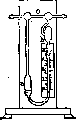
Figure 1. Reometer with diaphragm.
The liquid is colored: kerosene, water, sulfuric acid, etc. As a general rule, the manometric liquid should not chemically react with the gas passing through the R. When working with air, it is most convenient to use kerosene colored with alkanic or picric acid. The specific gravity of the kerosene must be specific, since a change in the specific gravity of the liquid changes all calculations. A cardboard scale is attached to one of the limbs of the R., on which divisions are marked indicating the amount of air passing through the R. at one or another position of the manometric liquid. When working with R., it is necessary to ensure that in a state of rest, the level of liquid in both limbs of the U-shaped tube exactly corresponds to the zero point of the scale. The practical application of R. is shown in Fig. 2. By connecting the reometer to any apparatus, for example to a Palmer vessel, air is uniformly drawn through the apparatus; the height of the rise of liquid in the R. shows on the scale the volume of air drawn per unit of time. This volume, in precise work, should be reduced to 0° and 760 mm of mercury pressure. R. with diaphragms are used to measure relatively large amounts of air passing through the research apparatus, for example from 5 to 150 or more liters per minute; for small amounts of passing air, for example within 10-100 cm³ per minute, R. equipped with a capillary instead of a diaphragm are used. The most convenient are R. with removable capillary tubes (Fig. 3), because by changing the capillaries, the speed of air passing through the R. can be widely varied. The disadvantage of R. with a capillary is its fragility and the ease with which the narrow passage of the capillary becomes contaminated with dust and condensed moisture. Therefore, when working with R. equipped with a capillary, the air or other gas passing through it should be pre-dried and freed from dust. Calibration of reometers. There is often doubt about the accuracy of R. readings. In such cases, it is necessary to check the correctness of its scale against gas meters as follows: the R. is connected to gas meters, as shown in Fig. 4, and air or another gas is drawn through it, maintaining a certain height of the manometric liquid; every minute the readings of the gas meters are noted; the volume of air (or other gas) drawn in one minute should exactly correspond to the reading of the manometric liquid on the R. scale. It is sufficient to check three or four points on the scale to judge the correctness of the R. readings and to make the appropriate correction to these readings. In order to ensure a constant level of the manometric liquid during calibration work, part of the air entering the R. is diverted through a special tube into vessel A, where it escapes to the outside in the form of bubbles. By changing the height of the liquid column in vessel A, one can establish an arbitrary difference in the levels of the manometric liquid. Instead of gas meters for checking R., calibrated gasometers or large bottles can be used, measuring the amount of water flowing out per unit of time. The speed of water flow is regulated by a screw clamp; the bottle should be equipped with a manometer, and during the entire time of water outflow, the level of liquid in both ends of the manometer should be at the same height, because only under these conditions will the amount of water flowing out exactly correspond to the amount of air entering it per unit of time. A checked R. can serve as a standard for checking other R. In addition to the types of reometers described, there are also reometers of special design, which serve not for measurement but only for regulating the volume of gas or air passing through the research apparatus. These include the Giraud reometer, the Moitessier apparatus, and others. In laboratory practice, they are commonly called gas pressure regulators.
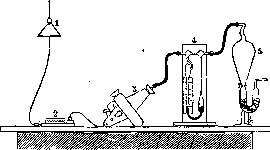
Figure 2. Diagram of reometer application: 1-electrical fittings with plug for obtaining electric current; 2-rheostat; 3-electric pump-fan; 4-reometer; 5-Palmer vessel for dust collection.
uniformly draw through the apparatus air; the height of the rise of liquid in the R. shows on the scale the volume of air drawn per unit of time. This volume, in precise work, should be reduced to 0° and 760 mm of mercury pressure. R. with diaphragms are used to measure relatively large amounts of air passing through the research apparatus, for example from 5 to 150 or more liters per minute; for small amounts of passing air, for example within 10-100 cm³ per minute, R. equipped with a capillary instead of a diaphragm are used. The most convenient are R. with removable capillary tubes (Fig. 3), because by changing the capillaries, the speed of air passing through the R. can be widely varied. The disadvantage of R. with a capillary is its fragility and the ease with which the narrow passage of the capillary becomes contaminated with dust and condensed moisture. Therefore, when working with R. equipped with a capillary, the air or other gas passing through it should be pre-dried and freed from dust. Calibration of reometers. There is often doubt about the accuracy of R. readings. In such cases, it is necessary to check the correctness of its scale against gas meters as follows: the R. is connected to gas meters, as shown in Fig. 4, and air or another gas is drawn through it, maintaining a certain height of the manometric liquid; every minute the readings of the gas meters are noted; the volume of air (or other gas) drawn in one minute should exactly correspond to the reading of the manometric liquid on the R. scale. It is sufficient to check three or four points on the scale to judge the correctness of the R. readings and to make the appropriate correction to these readings. In order to ensure a constant level of the manometric liquid during calibration work, part of the air entering the R. is diverted through a special tube into vessel A, where it escapes to the outside in the form of bubbles. By changing the height of the liquid column in vessel A, one can establish an arbitrary difference in the levels of the manometric liquid. Instead of gas meters for checking R., calibrated gasometers or large bottles can be used, measuring the amount of water flowing out per unit of time. The speed of water flow is regulated by a screw clamp; the bottle should be equipped with a manometer, and during the entire time of water outflow, the level of liquid in both ends of the manometer should be at the same height, because only under these conditions will the amount of water flowing out exactly correspond to the amount of air entering it per unit of time. A checked R. can serve as a standard for checking other R. In addition to the types of reometers described, there are also reometers of special design, which serve not for measurement but only for regulating the volume of gas or air passing through the research apparatus. These include the Giraud reometer, the Moitessier apparatus, and others. In laboratory practice, they are commonly called gas pressure regulators.
passing through the reometer in one minute, should exactly correspond to the reading of the manometric liquid on the R. scale. It is sufficient to check three or four points on the scale to judge the correctness of the R. readings and to make the appropriate correction to these readings. In order to ensure a constant level of the manometric liquid during calibration work, part of the air entering the R. is diverted through a special tube into vessel A, where it escapes to the outside in the form of bubbles. By changing the height of the liquid column in vessel A, one can establish an arbitrary difference in the levels of the manometric liquid. Instead of gas meters for checking R., calibrated gasometers or large bottles can be used, measuring the amount of water flowing out per unit of time. The speed of water flow is regulated by a screw clamp; the bottle should be equipped with a manometer, and during the entire time of water outflow, the level of liquid in both ends of the manometer should be at the same height, because only under these conditions will the amount of water flowing out exactly correspond to the amount of air entering it per unit of time. A checked R. can serve as a standard for checking other R. In addition to the types of reometers described, there are also reometers of special design, which serve not for measurement but only for regulating the volume of gas or air passing through the research apparatus. These include the Giraud reometer, the Moitessier apparatus, and others. In laboratory practice, they are commonly called gas pressure regulators.
Figure 3. Reometer with capillary.
difference in the levels of the manometric liquid. Instead of gas meters for checking R., calibrated gasometers or large bottles can be used, measuring the amount of water flowing out per unit of time. The speed of water flow is regulated by a screw clamp; the bottle should be equipped with a manometer, and during the entire time of water outflow, the level of liquid in both ends of the manometer should be at the same height, because only under these conditions will the amount of water flowing out exactly correspond to the amount of air entering it per unit of time. A checked R. can serve as a standard for checking other R. In addition to the types of reometers described, there are also reometers of special design, which serve not for measurement but only for regulating the volume of gas or air passing through the research apparatus. These include the Giraud reometer, the Moitessier apparatus, and others. In laboratory practice, they are commonly called gas pressure regulators.
Figure 4. Connection of reometer with gas meters.
Instead of gas meters for checking R., calibrated gasometers or large bottles can be used, measuring the amount of water flowing out per unit of time. The speed of water flow is regulated by a screw clamp; the bottle should be equipped with a manometer, and during the entire time of water outflow, the level of liquid in both ends of the manometer should be at the same height, because only under these conditions will the amount of water flowing out exactly correspond to the amount of air entering it per unit of time. A checked R. can serve as a standard for checking other R. In addition to the types of reometers described, there are also reometers of special design, which serve not for measurement but only for regulating the volume of gas or air passing through the research apparatus. These include the Giraud reometer, the Moitessier apparatus, and others. In laboratory practice, they are commonly called gas pressure regulators.
A checked R. can serve as a standard for checking other R. In addition to the types of reometers described, there are also reometers of special design, which serve not for measurement but only for regulating the volume of gas or air passing through the research apparatus. These include the Giraud reometer, the Moitessier apparatus, and others. In laboratory practice, they are commonly called gas pressure regulators.
Related articles
Cite this page
“REOMETERS.” Soviet Medical Encyclopedia. English translation of Bolshaya Meditsinskaya Entsiklopediya, 1st ed. (Moscow, 1928–1936), ed. N. A. Semashko. https://sovietmedicalencyclopedia.pages.dev/article/reometers/