Gas Meters
Historical document, translated for reference. It reflects medical knowledge of the 1920s–30s and is not medical advice.
Summary
This article describes gas meters used in the early 20th century for measuring the volume of exhaled air in gas exchange studies. It details the construction and operation of both wet and dry gas meter types, including their use in the Zuntz-Geppert apparatus and the Douglas method.
Encyclopedia article (1928–1936)
GAS METERS are instruments that measure the volume of gas passing through them. In studies of gas exchange (see), they are used to determine the volume of exhaled air. The requirements for gas meters most often boil down to the following: 1) the lowest possible resistance to the flow of air passing through the gas meter, since otherwise, a change in the nature of the subject's breathing is possible; 2) accuracy of readings with a variable air pressure flow; and 3) in some cases, portability (the ability to be easily carried, e.g., for studying gas exchange while walking).
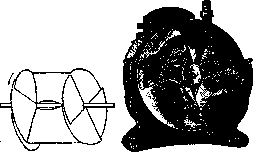
Figure 1.
Figure 2.
Figure 1. Rotating drum of the Zuntz wet gas meter; the shape of the blades is clearly visible, ensuring the timely entry and exit of air from the drum, which rotates the drum. Figure 2. Zuntz wet gas meter from the back; the rear cover is removed; the blades of the rotating drum are visible.
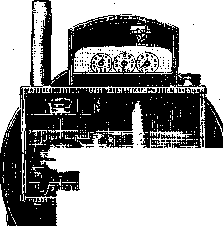
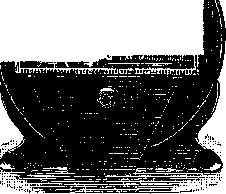
Figure 3. Zuntz wet gas meter from the front. The front wall is removed. The left part of the figure shows a float that shuts off air access in case of an excess or lack of water. In the center of the figure, the end of the horizontal axis is visible; its rotation is transmitted to a gear wheel sitting on a vertical axis. The hands on the dial indicate the volume of air passing through the gas meter (in cubic feet).
The second requirement is especially significant, because when exhaling air directly into a gas meter, its pressure changes all the time, and a measuring mechanism that correctly indicates the volume of air passing through the gas meter with a continuous flow may, due to its inertia, give incorrect readings with variable pressure. Therefore, gas meters must be checked and tested for operation with an intermittent air flow. At the present time, this difficulty is bypassed by having subjects exhale air into special rubber bags with a capacity of 50 to 200 liters and then sucking the air from the bags through the gas meter with a continuous flow at constant pressure (the Douglas method). Gas meters are of two designs: wet and dry. In the body of a wet gas meter, there is a light metal drum with a horizontal axis and curved, complexly arranged blades (see Figures 1 and 2). Air entering the gas meter passes through a tube into this drum from one side and, by displacing water from this part, disturbs its equilibrium and forces it to rotate. The water level is regulated by a hollow ball, visible in the left part of Figure 3. If there is little water in the gas meter, the ball drops and stops the access of air to the apparatus. If there is too much water, it pours out through a hole in the middle of the meter. The axis of the drum is connected by means of a worm gear and a gear wheel to a system of hands (see Figure 3) rotating in front of their dials. Each subsequent hand moves 10 times slower than the previous one. By comparing the readings of the hands before and after passing air through the gas meter and subtracting the first reading from the second, one obtains the volume of air (or other gas) that has passed through the meter. Wet gas meters are used in the Zuntz-Geppert apparatus. Dry gas meters (see Figure 4), used by Zuntz for studying gas exchange while walking, do not contain water. The hands indicating the volume of air that has passed through the gas meter are set in motion by alternately expanding and collapsing bellows. Both systems of gas meters are equipped with devices that allow for taking air samples for gas analysis (see). This is achieved by the fact that the air passing through the gas meter forces
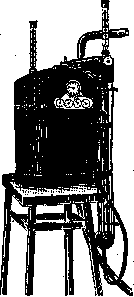
Figure 4. Zuntz dry gas meter. At the top right, the tube through which air enters is visible, as well as the box where various portions of air are mixed. The dial hands show the volume of air in liters, tenths, and hundredths of a liter... The right thermometer indicates the temperature of the air entering the gas meter, the left thermometer the temperature of the exiting air. On the right, a 300 cubic centimeter cylinder is visible for collecting air samples and a mechanism that allows samples to be taken at different speeds.
a cylinder with a thread wound around it to rotate. The water filling the cylinder flows out, and air for analysis is sucked in from the gas meter. A set of cylinders allows for regulating the speed of sample collection. The readings of the gas meter are adjusted according to known formulas based on the laws of Boyle-Mariotte and Gay-Lussac to 0° and to atmospheric pressure (760 mm of mercury).
Related articles
Mentioned in
Cite this page
“Gas Meters.” Soviet Medical Encyclopedia. English translation of Bolshaya Meditsinskaya Entsiklopediya, 1st ed. (Moscow, 1928–1936), ed. N. A. Semashko. https://sovietmedicalencyclopedia.pages.dev/article/gas-meters/