Gas Exchange
Historical document, translated for reference. It reflects medical knowledge of the 1920s–30s and is not medical advice.
Summary
This article defines gas exchange as the fundamental physiological process of oxygen intake and carbon dioxide/water vapor excretion in humans and animals. It details the methodology for measuring this exchange, distinguishing between short-term pulmonary studies and long-term metabolic assessments, while noting the historical contributions of scientists like Lavoisier, Regnault, and Pettenkofer.
Encyclopedia article (1928–1936)
GAS EXCHANGE, i.e., the exchange of gases between the organism of a human or animals and the external environment, being one of the fundamental vital processes, consists in the absorption of oxygen from the outside and the release of carbonic acid and water vapor into the external environment (as well as gases developing as a result of fermentative or putrefactive processes in the intestines, especially, for example, in ruminants, and excreted either directly from the intestines or through the blood via the lungs; see Gas formation in organs). A distinction is made between pulmonary (respiratory) gas exchange, cutaneous (perspiratory) gas exchange, and, finally, total gas exchange as the sum of both. In humans, cutaneous gas exchange, outside of heavy sweating, plays a small role, constituting on average 0.5–1% of total gas exchange; therefore, the study of pulmonary gas exchange alone, being easier to carry out, is widely used and is applied almost exclusively in clinics. By determining the amount of consumed O2 and excreted CO2 and water, the study of gas exchange provides a basis for judging 1) the intensity of the chemical processes underlying the vital activity of the organism and generally having the character of oxidative processes, and 2) which substances and in what quantity undergo oxidation in the organism during the investigated period of time (see Metabolism). In addition, knowledge of the amount of consumed oxygen and the respiratory quotient (see) provides a basis for calculating energy expenditure (indirect calorimetry, see), and consequently, the so-called basal metabolism.
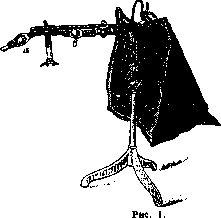
The quantitative study of gas exchange is carried out with the help of so-called respiratory apparatuses, which make it possible to conduct experiments over short periods of time and over long periods, up to a day or more. Short-term experiments, in which usually only pulmonary gas exchange is investigated, cannot, of course, serve as a basis for judging the details of the course of total metabolism, but are quite appropriate where it is a matter of comparative determination of gas exchange in one and the same individual or in different individuals, but under the same conditions. Despite this, the excessive brevity of experiments, for example, 5, 10, 15 minutes, makes their results insufficiently convincing, especially if it is a matter of establishing the influence on gas exchange of factors acting in a non-sharp manner. It should be borne in mind that the mechanism of respiratory movements is an extremely sensitive mechanism, and as soon as the conditions of respiration deviate even slightly from free normal breathing, the rhythm and depth of respiratory movements change immediately, and along with them the partial pressure of O2 and especially CO2 in the alveolar air. In relation to O2 consumption, this is of no importance, and a more significant factor is the increased, or respectively, decreased, work of the respiratory muscles. For CO2, the excretion of which from the body is determined by the established difference in tension in the tissues, blood, and alveolar air, a decrease in the latter value immediately entails an increased transfer of CO2 from the blood into the alveolar air, and from the tissues into the blood. Thus, conditions are created for the excessive, in relation to formation, excretion of CO2 from the body, and only little by little, when the dynamic equilibrium of CO2 tensions in the tissues, blood, and alveolar air is re-established, will the excretion of CO2 again come into correspondence with its formation in the tissues. Speck already observed that with voluntary increased ventilation of the lungs, the respiratory quotient, i.e., the ratio of the volumes of exhaled CO2 and inhaled O2 (q = CO2/O2), becomes greater than 1, and with decreased ventilation—less than the normal minimum value. The return of the respiratory quotient to its initial value occurs the later, the more strongly the ventilation of the lungs is changed; for example, in Loewy's experiments, with an increase in breathing to only 9–10 liters per minute, it took 10–15 minutes, and at 12–15 liters—even 20–25 minutes for the initial value of the respiratory quotient to be established. In short-term experiments, the connection of a person to the respiratory apparatus is carried out either with the help of a mouthpiece (shown in Fig. 1 between valves a and e),
with the nose closed with a clip, or with the help of a mask tightly fitted to the face, under which the nose and mouth fit. The latter method is more preferable, since the former is very burdensome even for a person accustomed to it, but in any case, one has to breathe during experiments against some, albeit small, resistance of the connecting tubes, valves, absorbing media, etc. By virtue of this, the transition from free breathing to breathing into an apparatus is always associated with a change (mostly in the direction of increase) in the usual type of breathing, and time is required for the organism to get used to the new conditions and more or less restore its normal breathing. In addition, fluctuations in the physical and psychic state of the test subject, which are difficult or impossible for the experimenter to account for, can also significantly influence the results of short-term experiments. In view of all the above, it seems rational for the majority, at least, of cases
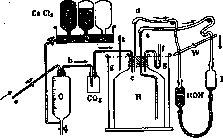
to conduct experiments for no less than 1/2 hour, and only in exceptional cases, and even then when determining only oxygen, is it permissible to limit oneself to minute-long periods. Long-term experiments, in which a person or animal is usually placed in respiratory chambers of greater or lesser capacity, make it possible to determine total gas exchange, and moreover under conditions of completely free normal breathing. The duration of long-term experiments can vary from several hours to several days; however, when investigating gas exchange, as well as total metabolism, the unit of time is considered to be a day. Human life, viewed from the point of view of the intensity of vital processes and the processes of metabolism and energy underlying them, represents a certain wave-like line, the repeating period of which is the day, containing both the time of manifestation of greatest vital activity (day) and the time of rest (night). A well-known expression of this is the repeating daily temperature curve of a person with a maximum in the evening and a minimum in the early morning hours. Daily fluctuations of vital processes can be likened to the pulsatory fluctuations of the blood pressure curve, and just as the latter is composed not only of pulsatory fluctuations, but also of respiratory waves and Traube waves, so the total curve of the intensity of vital processes is composed of daily fluctuations and fluctuations with a longer period, depending on sex, age, and other factors. Since, however, these latter fluctuations extend over periods of life significantly longer than a day, the determination of daily gas exchange gives results that are characteristic (standard) for a whole long period of life. Thus, the daily gas exchange of a 30-year-old man will, under other equal conditions, be characteristic of him at the age of 35 and even 40 years. In addition, as already stated above, the determination of daily gas exchange (together with the analysis of urine collected over the same period of time) provides a basis for judging the actual breakdown of substances and energy expenditure, and at the same time for calculating the need for food. Comparing what has been said about the significance of short-term and long-term experiments on the investigation of gas exchange, it is easy to see that both categories mutually complement each other and each has its own special sphere of application in the general totality of scientific problems of gas exchange. Methodology of gas exchange research. The basic principles of all the diverse modern methodology are given, as R. Tigerstedt rightly emphasizes, in the last quarter of the 18th century in the works of Lavoisier on the respiration of animals and humans. One of these principles was implemented in a very perfect form by the French physicist Regnault and his collaborator Reiset in 1849, another by Pettenkofer and Voit in 1860, with the apparatuses of both authors being designed for daily experiments. The Regnault respiratory apparatus (see Figure 2) consists of a bell 11 (in which the animal is placed), hermetically ground to a base and surrounded by a water jacket dd to maintain the constancy of t°. The animal absorbs O2 from the air of the bell and exhales CO2 into it. The latter is absorbed by caustic potash in vessels KOH and KOH, communicating with each other and connected by a system. Figure 2.
tubes d and e with JR. These vessels are alternately raised and lowered by means of a rocker arm W, whereby air is sucked from B into the rising one, and pushed from the descending one into B. Thus, the air in B is constantly agitated and freed from CO2, and since the animal consumes oxygen at the same time, the air pressure will fall, and moreover, in proportion to the oxygen consumption. For the automatic replenishment of these losses, B is connected to a reservoir O, where oxygen is kept under constant pressure and from where it enters B through a CO2 valve. The amount of oxygen consumed is determined by its loss from O, and the amount of CO2 by the gain in weight of the vessels with KOH, with appropriate corrections based on the data of the air analysis in B at the end of the experiment (the device for taking an air sample from B is not indicated on the diagram). Thus, the Regnault method allows for the direct experimental determination of O2 and CO2 and the indirect determination of water vapor according to the equation A + O2 - CO2 - H2O = B, where A is the weight of the animal before the experiment, B is after the experiment (if the animal took food and drink or passed urine and feces, the corresponding weight values must be introduced into the equation with the appropriate sign). Reiset in 1863 and Hoppe-Seyler in 1894 used the Regnault principle to construct a respiratory apparatus, the former for medium-sized animals (sheep, pigs, etc.), the latter for humans. The results for Hoppe-Seyler were not very satisfactory, as the ventilation proved to be completely insufficient. Starting from the same equation as Regnault, Pettenkofer proposed to carry out an indirect determination of oxygen while directly determining CO2 and H2O in the air drawn through a chamber, which could be of large size, since airtightness was not required. In his apparatus (see Fig. 3) for a human, a metal chamber Z, with a capacity of about 13 cubic meters, had about 6 square meters of floor area, and was equipped with a window and a door with an opening 'a' for air intake. A bed, table, and chair were placed in it, and there was room left for movement. A pump PP1, driven by steam, drew air through the chamber, through a tank filled with pieces of pumice stone moistened with water, and through a large gas meter C, which indicated the total amount of air that had passed through. From the main line 'x', an air current (approx. 1/100-1/200 of the total volume) is diverted by pump M through branch 'n' for analysis, whereby water vapor is absorbed in K by sulfuric acid, and carbon dioxide is absorbed in B by a titrated solution of Ba(OH)2. A meter at the end of the branch shows the volume of air sucked out for analysis. (In reality, the tube 'me' branched into 3 branches, each of which was equipped as indicated in the diagram; consequently, 3 analyses were performed in parallel.) Finally, from the opening 'a' for air entering the chamber, branch N began (also in reality triple), which served for the analysis of the air entering the chamber. The amount of absorbed water was determined by weighing K, and the amount of CO2 by titration. Pettenkofer's own experiments showed the unsuitability of the method for determining oxygen (mainly due to the adsorption of water vapor by the chamber walls), and therefore one had to be limited to the determination of CO2 alone. Due to the possibility of conducting experiments on humans and large animals, the Pettenkofer method became widely used, and many apparatuses were built according to his model, with some researchers obtaining more or less satisfactory results regarding oxygen as well. The Pettenkofer principle was most successfully used by Haldane (1892). His apparatus, intended for small animals, has a small chamber,
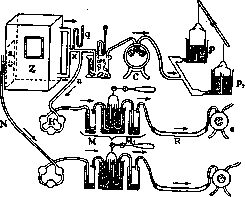
Figure 3.
which is weighed together with the animal before and after the experiment, which eliminates the error in the determination of water vapor; furthermore, the air drawn through the chamber is freed from CO2 and H2O before entering it, and upon exiting is passed through absorbers in toto, and, consequently, the data for the equation are obtained directly from the experiment without a thousandfold increase in analysis errors. The important significance of the most accurate possible determination of oxygen consumed by a human under various conditions served as a stimulus for the construction, already in the current century, of a number of apparatuses (Atwater and Benedict, Shaternikov, Hagemann, Zuntz, etc.), based on the Regnault principle, for long-term experiments on humans and large animals. These apparatuses represent (see Figure 4) a hermetically sealed system with a double-acting pump (D) included in it, which carries out the circulation of air in the system, whereby the air from the chamber (A) passes through a series of absorbers (and coolers) and returns to the chamber freed
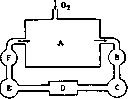
from CO2 and most of the H2O, while the oxygen losses are replenished from reserve (Fig. 4)
reservoirs
or cylinders. The absorption of CO2 either by soda lime (Benedict) or by a solution of caustic alkali (Shaternikov), with an appropriate selection of the air circulation speed and the size of the absorber layer, is extremely perfect, and the average error of the apparatuses for both O2 and CO2 lies within ±1%. By replacing chamber A with a small gasometer (spirometer) and inserting into the system, for example, between A and B, a three-way tube, to the branch of which a person could be connected by means of a mask or mouthpiece, one obtains (Shaternikov, Benedict, Knipping, etc.) an apparatus for short-term experiments. Figure 5 shows a diagram of the Benedict apparatus, and Figure 6 shows a general view of the latest model (Migos) of this apparatus. The apparatus is mounted on a movable table. Pump 'a', driven by motor 'k', sucks air from tube 'h2' through a rubber balloon 'r' and drives it through a series of so-called Williams bottles. The first (b), empty,
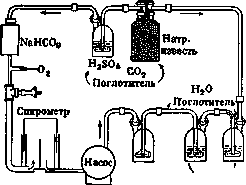
H2SO4
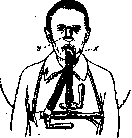
Figure 5. is intended to trap oil carried by the air current from the pump; the next two bottles (c and d) with H2SO4 serve to completely free the air from water vapor. From here, the air goes into bottle 'e' with soda lime and into bottle 'f' with H2SO4 to absorb the water vapor given off by the soda lime. Finally, in bottle 'g' the air is re-humidified and goes into tube 'h1'. The subject under study is connected to tubes 'h1' and 'h2' (see Figure 7), breathing through a mouthpiece 'x', with the nose clamped by a clip 'y'. Oxygen is delivered to the apparatus from cylinder 'u', and its quantity is measured by a gas meter (not shown in the figure). The amount of carbon dioxide is determined by the weight of the bottles
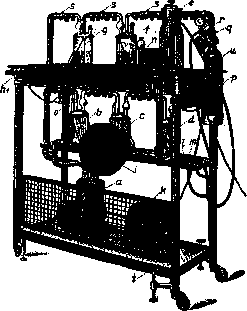
Figure 6. 'e' and 'f' before and after the experiment. To record respiratory movements, a sensitive spirometer is inserted in place of balloon 'r', the readings of which are recorded on a kymograph. A very compact apparatus was designed by Knipping. The entire system consists of a spirometer C, filled with oxygen, a pump D, and a washing bottle E with a solution
of KOH (see Figure 8). The movements of the spirometer bell are recorded on a kymograph. The dimensions of the spirometer are such that the oxygen supply in it is sufficient for 10-15 minutes of the experiment at complete rest of the subject. At the end of the experiment, the subject is disconnected from the apparatus by turning a three-way valve, but the air circulation in the apparatus is continued for complete absorption of CO2, which is then determined volumetrically by displacing it from the alkali with sulfuric acid, without dismantling the apparatus and counting the amount of CO2 by the rise of the spirometer bell. The design of the Knipping absorption device is given in Fig. 9, from which it can be seen that by turning the valve, H2SO4 is transferred from the upper bulb to the lower compartment of the device, where it is located
Figure 7.
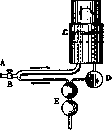
Figure 8.
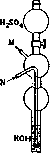
Figure 9.
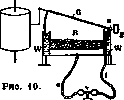
SOLUTION.-All apparatuses with mechanical air circulation do not require any devices for separating the inhaled air from the exhaled air, and during breathing there is no need to overcome any resistance from absorption media, which could affect the mechanism of breathing, which is a significant advantage of these apparatuses. Since oxygen consumption is the main characteristic of gas exchange, in clinics they often limit themselves to just this determination, using the Krogh apparatus. In Fig. 10 a diagram of this apparatus is given: a square-shaped spirometer W has a light bell O, movable around axis a and balanced by a weight d. Below the bottom, the spirometer has a second grating bottom, on which soda lime is loaded. The space R of the spirometer is filled with oxygen from bombs. A person, with the help of a mouthpiece and valves directing the movement of air, is connected to the spirometer by tubes g and e in such a way that they inhale from g and exhale into e. The exhaled air is freed from CO2 in the layer of soda lime, and therefore the bell O will descend in accordance with oxygen consumption. The movement of the bell, and along with it the breathing curve, is recorded on a kymograph. From the difference in the standing levels of G before and after the experiment, oxygen consumption during the experiment time is calculated from a calibration table, i.e., usually for 10 minutes. Breathing in the Krogh apparatus is undoubtedly difficult, and this must be taken into account during such a short experiment. Finally, the study of gas exchange with free movement of the subject is carried out with the help of so-called portable breathing apparatuses. The simplest in construction is the Douglas method. With the help of a mouthpiece and valves a and b (see Figure 1), the subject inhales atmospheric air and exhales into a rubber bag of one or another capacity. In Fig. 11 the equipment of a person is shown. After the experiment, the air is squeezed out of the bag (see Figure 12) through gas meters, thus determining its volume, and by analyzing a part of the air-its percentage composition. If breathing atmospheric air, the analysis of inhaled air is not performed. Tsunts measures the volume of exhaled air by forcing exhaled air through so-called dry gas meters (see). A person with their nose pinched breathes through a mouthpiece and valves, with the exhaled air going into parts fixed on the back in the form of a backpack. An average sample of exhaled air is diverted for analysis.-Finally, the portable apparatus of Sechenov and Shaternikov
shown in Fig. 13 from the front and in Fig. 14 from the back. The subject breathes through mask A, inhaling through B and exhaling through valve C into D, where there is an alkali solution (a humidifier), and through valve F to the outside. In a and O17, i.e., before and after the alkali, there are diversion paths into flat flasks M and N, filled with mercury. During the experiment, mercury is uniformly released drop by drop into receiver h (see Figure 14), located on springs and descending as mercury flows into it I, corresponding to the lowering of the mercury level in M and N. Having determined the amount of CO2 absorbed by the alkali Q, and the percentage of CO2 in the air diverted before the alkali p and after the alkali q, the following equation can be derived,
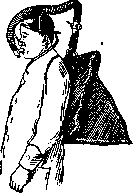
Figure 11.

Figure 12.
taking as x the unknown volume of exhaled air 100-? x.p Too" <э= (« - Q)q 100 Y- Having established the numerical value for x, from the first term of the equation the total amount of exhaled CO2 is found. If the volume of exhaled air and its percentage composition are known, then according to the nitrogen content in it, as shown by Tsunts, the volume of inhaled air can be calculated, and knowing its composition-the amount of oxygen consumed. Let the volume of exhaled air=V, percentage N in it=80, and in atmospheric (inhaled)-79. Since N does not participate in breathing, the volume of inhaled air x is calculated by the proportion x:V=80:79. Knowing the volume of inhaled air and the percentage of oxygen in it, the volume of oxygen that entered the lungs is calculated, and from the volume of exhaled air and the percentage of oxygen in it-the volume of oxygen that left the lungs. The difference gives oxygen consumption.
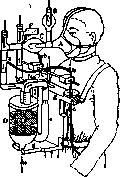
Figure 13.
The intensity of gas exchange is in close connection with the chemical processes underlying the vital activity of the cellular elements of the tissues and organs of our body. Therefore, a greater suppression of this vital activity causes a corresponding decrease in gas exchange, making it in the limit minimal. This minimal gas exchange, determined in a person on an empty stomach and in the strictest rest, is called the "basal metabolism", i.e., that necessary for maintaining the basic functions of the body. This value, being obviously conditional, is nevertheless quite constant for the same individual. The basal metabolism is influenced, on the one hand, by body weight, its length, its surface, age and sex, and on the other hand by various endogenous factors, for example, the state of the endocrine apparatus. Thus, in hyperthyroidism the basal metabolism is elevated, in hypothyroidism it is lowered. This influence on the basal metabolism of internal factors gives it the value of a clinical method. In the following table, data on basal gas exchange by Magnus-Levy and Falk, on the one hand, and Benedict, on the other, are given for men weighing 60-70 kg per 1 kg and 1 min.
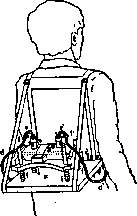
Figure 14.
Authors Magnus-Levy Benedict . . Oxygen consumed in cubic cm Carbon dioxide excreted in cubic cm 3,6 -3.38-3.7 -4.09 2.7 -2.9 2.86-3.49 Age fluctuations of basal metabolism (according to Magnus-Levy and Falk). Subjects Age Weight in kg Boy 15 years 43.7 Man 24 years 43.2 Old man 71 years 47.8 Girl 13 years 31.0 Woman 39 years 31.6 Old woman 75 years 30.3 Height in cm 152 148 164 138 134 about 140 O2 consumption per 1 kg and 1 min. in cubic cm 4.97(110%) 4.5 3 (100%) 3.42 (75%) 5.54 (112%) 4.96 (100%) 4.25 (86%) With the same weight and same body surface, adults of different sexes show approximately the same basal metabolism. During sexual development, metabolism in boys is higher than in girls (probably due to greater mobility of the former). Menstruation does not affect basal metabolism, pregnancy either does not affect or increases it by 3-4%. A significant decrease in ambient temperature increases gas exchange, but in this case, especially when cold is already felt, there can be no talk of basal metabolism (involuntary trembling, etc.). In everyday life, basal metabolism is always associated with a work addition, larger or smaller depending on the work performed by the body. Thus, Johansson excreted 20.7 g CO2 per hour in "absolute" rest, 24.8 g in "bed" rest, and 33.1 g in "room" rest, i.e., sitting and engaged in light reading. Light muscular activity, e.g., walking quietly on level ground, doubles basal metabolism, with moderate work it increases 3-4 times, and with strong work-6-7 times and more. Food intake also increases basal metabolism, but not to the same extent as muscular work. In this case, not only the activity of the digestive glands and the movements of the digestive tract play a role, but also the composition of food, so-called specific dynamic action (Rubner) of food substances (see Metabolism), inherent to the greatest degree in protein food. According to Bohr, the average values of gas exchange for an adult man weighing 70 kg at room temperature and on an empty stomach are as follows: oxygen is consumed 720 g per day, CO2 is excreted-840 g, and water through the lungs-450 g. According to Rubner, an adult person at average temperature and humidity of the air loses through pulmonary respiration per hour: with calm breathing-17, with deep breathing-^10, with loud reading-28, with singing-34 g of water.
Related articles
Mentioned in
Cite this page
“Gas Exchange.” Soviet Medical Encyclopedia. English translation of Bolshaya Meditsinskaya Entsiklopediya, 1st ed. (Moscow, 1928–1936), ed. N. A. Semashko. https://sovietmedicalencyclopedia.pages.dev/article/gas-exchange/