D'Arsonvalization
Historical document, translated for reference. It reflects medical knowledge of the 1920s–30s and is not medical advice.
Summary
D'Arsonvalization is the therapeutic application of high-frequency, high-voltage d'Arsonval currents. The method produces various physiological effects and therapeutic benefits depending on the application technique, with indications including high blood pressure, gout, diabetes, anemia, and functional neuroses.
Encyclopedia article (1928–1936)
D'ARSONVALIZATION, the therapeutic application of d'Arsonval currents of high frequency and high voltage. Depending on the method of application, various physiological phenomena occur and various therapeutic effects are observed, and from this follow indications for each of the methods of d'A. General d'A. is applied through a large solenoid (the most common method) or with an Apostoli condenser bed. When using the large solenoid, which is inserted into the d'Arsonval apparatus in place of the small one (connection - see Figure 1), the patient is placed inside this solenoid. During the passage of high-frequency currents through the solenoid, induced eddy currents of Foucael develop in the subject placed inside it in a variable electromagnetic field, closing in the body; in this case, the electrified person does not experience any sensations. The condenser bed in general has a similar action to the solenoid, but when
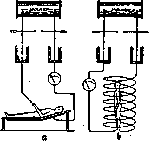
Figure 1. Diagram of the connection of the Apostoli condenser bed (a) and the large solenoid (b) into the therapeutic circuit of the d'Arsonval apparatus.
the condenser bed is used, the subject is directly subjected to the action of the high-frequency alternating current by contact with one pole of the therapeutic circuit of the d'Arsonval apparatus. To this day, regarding the physiological and therapeutic action of general d'A. through the condenser bed and the large solenoid, there is no unified view; there are a number of opinions, ranging from the complete denial of any independent therapeutic effect for these methods (German authors) to the complete affirmation of these effects (French authors). An increase in body temperature during the session, increased gas exchange, increased nitrogen excretion in the urine, enhanced emigration of leukocytes, changes in blood pressure in both humans and animals - some authors confirm this, others deny it or consider it doubtful. Obviously, such disagreement in the assessment of the action of general d'A. is due to the extraordinary diversity of apparatuses produced by various firms in various countries, and consequently to the different physical conditions of experiments and observations. In recent times, many consider it almost indisputable that general d'A. has an effect on vegetative innervation and, in particular, on the vegetative endings of the skin, and consequently reflexively on the entire organism; with regard to blood pressure, clinical observations force one to accept the selective action of general d'A. on disturbed blood pressure. In patients with elevated pressure, a number of authors observed its immediate decrease after the session with a tendency to further decrease under the influence of subsequent sessions; in some cases, an increase in pressure was noted where it was lowered; with normal blood pressure, a slight, rapidly passing effect of general d.A. is observed. Indications for it are - elevated arterial pressure in arteriosclerosis, especially in the stage preceding it, gout, diabetes, anemic conditions and functional neuroses accompanied by insomnia, headaches. Sessions lasting from 15 to 20 minutes are performed 3 to 6 times a week; after 20-25 sessions, a break of 2-3 weeks is usually recommended. d'Arsonval current (see Figure 2), a high-frequency alternating electric current named after its author (to obtain the current, an installation is used, schematically shown in Figure 3). It is necessary to distinguish, when using the d'Arsonval current, its direct action as a high-frequency current from secondary phenomena. In d'arsonvalization, neither iontophoresis, nor cataphoresis, nor electrolysis is observed; neither muscle nor nerve irritation is observed, but a strong thermal effect is observed. The frequency of the alternating current ab Cy^- ]r-- Figure 2. Curve of d'Arsonval high-frequency currents: a-spark; b-pause (200-500 times greater than the period of the spark). or the number of periods per second is much greater than 100,000, the current strength reaches tenths of an ampere (at an electrode causing an outflow of 0.001 A). The effective voltage is many thousands of volts.

5< sh -{patient V Figure 3. Diagram of the d'Arsonval apparatus with solenoid and resonator. 1-first oscillatory circuit; 2-second oscillatory circuit; 3-therapeutic circuit. frequency into the apparatus is introduced an oscillatory circuit, for which each pole of the secondary coil of the inductor is connected to the inner coating of one of two Leyden jars (L, L) - some modern apparatuses have, instead of fragile jars, oil capacitors,-and in this circuit parallel to the jars is installed a microdischarger (P), serving as a source of high-frequency oscillations due to the discharges of the capacitors in the spark gap of the microdischarger. In this way, in the discharger, the spark that appears when the voltage of the capacitors is sufficient closes the circuit of the first high-frequency oscillatory circuit. The microdischarger usually consists of two metal points or balls facing each other, with one of them being movable toward and away from the other fixed one. From the outer coatings of the capacitor (jars), which receive through the electric field the high frequency of the primary circuit, a second circuit is taken - the therapeutic oscillatory cir
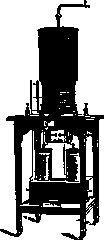
Figure 4. Table for the d'Arsonval apparatus, with a resonator on it; below - two Leyden jars and a microdischarger.
cuit. Consequently, the glass of the jars insulates the patient from the high voltage of the inductor. Between two poles extending from the outer coatings of the Leyden jars, a solenoid (S) is connected, closing the therapeutic oscillatory circuit. From one end of the solenoid and one of its turns, the therapeutic current is taken, with the greater number of solenoid turns included in the circuit, the greater the current strength in it due to the greater self-induction in the solenoid. To further increase the voltage of the current tapped from the solenoid, the solenoid in the d'Arsonval apparatus is replaced by an Udener resonator or a Tesla transformer, from which the current is used, reaching voltages of 100,000 or more.
Related articles
Mentioned in
Cite this page
“D'Arsonvalization.” Soviet Medical Encyclopedia. English translation of Bolshaya Meditsinskaya Entsiklopediya, 1st ed. (Moscow, 1928–1936), ed. N. A. Semashko. https://sovietmedicalencyclopedia.pages.dev/article/d-arsonvalization/