Electrotherapy
Historical document, translated for reference. It reflects medical knowledge of the 1920s–30s and is not medical advice.
Summary
Electrotherapy is the application of electricity as a therapeutic factor. This article describes the historical development and various methods of electrotherapy used in the 1920s-1930s, including galvanization, faradization, sinusoidal currents, high-frequency currents, and static electricity.
Encyclopedia article (1928–1936)
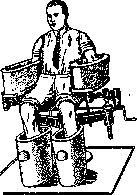
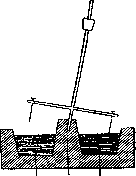
Electrotherapy, the application of electricity as a therapeutic factor. The beneficial effect of electricity was noted already in ancient times: bathing in ponds where electric fish were found. The invention of the electrostatic machine, Galvani's hydroelectric experiments (1789), and Faraday's discoveries (1831) gave further impetus to the development of E. The further development of electrical engineering, and more recently radio engineering, has further expanded the field of application of electricity in medicine. For E. at present, they use: 1) direct current, 2) alternating current, and 3) static electricity. The application of direct current is called galvanization (see). General and local galvanization are distinguished. General galvanization is used in the form of so-called hydroelectric baths (fig. 1) and 4-chamber baths according to Schnee (fig. 2). In the first case, the patient is placed in a bath (faience or marble), one pole of the current source is placed at the head end, the other at the foot end. The current strength is 200-500 µA for a session duration of 10-30-40 minutes. In this case, the current is closed through the water. The patient, connected in parallel, receives only a small part of the current, the strength of which cannot be measured with this method. Eulenburg modified the technique; one pole is placed in the bath,
Figure 2.
Four-chamber bath. the other is applied directly to the patient (on the back or arms). However, due to the danger of grounding, these baths are now very rarely used. The 4-chamber baths according to Schnee and 5-chamber baths have found much greater application. They consist of 4 (or 5) small (faience or porcelain) basins for the upper and lower limbs (and pelvic girdle). The basins are filled with warm water, into which carbon electrodes are immersed, connected to the poles of the current source. A special switch is used to change polarity. Session 30-60 min. Current strength from 10 to 60 µA (by patient's sensation). Number of sessions - 15-30. Indications for general galvanization in the form of 4-chamber baths are polyneuritis and polyarthritis of various etiologies, acroparesthesias and angioneuroses. In local galvanization, current is passed through a limited area of the body. The electrodes should be positioned so that most of the current passes through the affected area. To cause muscle contraction, interrupted galvanization is used, which consists in the alternating closing and opening of the current. If the interruptions are made at strictly defined times, the galvanization is called rhythmic. Interrupted galvanization is carried out using a special electrode attached to a handle with an interrupter (fig. 3). For rhythmic galvanization, metronomes (fig. 4) are used, which automatically turn the current on and off. The technique of the procedures is as follows: the passive electrode with an area of 300-400 cm2 is placed on the chest or back of the patient, while the active electrode with a diameter of 17-2 ohms is placed on the motor point of the nerve or muscle (under the motor point is meant the place from which irritation of the corresponding muscle or nerve is caused with minimal current strength). Interrupted current is also used in the form of the so-called Leduc current, named after its author (Leduc), who first developed this method and proposed a special interrupter for this purpose. The latter is a disk consisting of 4 metal segments separated from each other by ebonite spacers (fig. 5). The disk is set in motion by a motor. As the disk rotates, two carbon brushes slide along the sectors. The current is closed at the moment when both brushes touch the same segment. The duration of current closures and openings and the number of interruptions are regulated by changing the distance between the brushes and the speed of the
Figure 3. Handle-interrupter.
motor rotation. Usually the number of interruptions is 100 per second, with a current strength of 1-4 µA, with the ratio of current flow time to pause being 9:1. The voltage of the current source is 30-40 V. Leduc currents have a local anesthetic effect, and when passed through the brain, they can cause general anesthesia. This current has not found wide application in therapeutic practice. Alternating currents used in electrotherapy include: 1) alternating currents of low frequency (faradic and sinusoidal currents) and 2) alternating currents of high frequency. Faradic current is obtained using an induction coil (see Dubois-Reymond apparatus), powered by a battery of 4-12 V. The current induced in the outer coil when breaking
Figure 4. Metronome-interrupter.
the current in the inner coil is called the breaking current - it always has a higher voltage than the closing current, i.e., the current induced in the outer coil when breaking the current in the inner. The electrode that is positive with the breaking current is conventionally called the positive pole of the coil, and the one that is negative is considered the negative pole of the coil. When passing faradic current through the body, only the breaking current can be considered practically effective (fig. 6). Faradic current strongly affects both sensory and motor nerves. A single breaking induction shock, like the closing of direct current, causes contraction of a muscle or group of muscles. If irritations follow each other at high frequency, tetanic contraction of the muscle occurs. The frequency of irritation depends on the number of current interruptions in the primary coil. The latter is regulated by a special screw. In coils used for medical purposes, the number of interruptions ranges from 20 to 60 per second. Prolonged and frequent faradization, causing continuous muscle contraction, leads to fatigue, and subsequently to atrophy of the latter. On the contrary, rhythmic muscle contractions lead to improved nutrition and subsequent hypertrophy. General and local faradization are distinguished. General faradization is used in the form of so-called bergonization (see). Local faradization is now mainly used in the form of rhythmic procedures, for which a metronome-interruptioner is inserted into the secondary circuit. The methodology and technique of local faradization are the same as for galvanization. Faradization is sometimes used in combination with galvanization (see Galvano-faradization). Sinusoidal current is called a periodic alternating current. Its graphical curve is represented in the form of a sinusoid (fig. 7). The source of sinusoidal current are alternating current dynamos of city lighting installations with a voltage of 110-120V. For therapy, the voltage needs to be reduced
Figure 6. Curve
of faradic current. Figure 7. Graphical curve of sinusoidal current. to 60-50 V using a step-down transformer. This current, due to its unfavorable effect on the cardiovascular system, especially when the number of periods is around 50, is very rarely used. High-frequency alternating currents have found wide application in medicine. In some cases, high-voltage currents (tens and hundreds of thousands of volts) but of small strength (hundredths of an ampere) are used (see d'Arsonvalization), while in other cases the voltage is only hundreds of volts, but the current strength reaches several amperes (see Diathermy). In recent years, the therapeutic effect of a high-frequency electric field has also been used (see Ultrashort waves). The therapeutic application of static electricity is called franklinization. As a source of static electricity, machines of the Holz-Wimshurst type are mainly used. The working parts in them are glass or ebonite disks (from one to six pairs), rotated by a motor in opposite directions (fig. 8). On the outer sides of the disks, strips of foil (up to 36 in number), so-called sections, are pasted at equal distances from each other, against which two metal rods are installed perpendicular to each other along the diameter of both disks. Soft metal brushes are attached to both ends of the latter. As the disks rotate, the brushes slide along the metal sections, in which electricity is induced, which is then collected by needle combs onto metal balls (with a diameter of
Figure 8. Static machine.



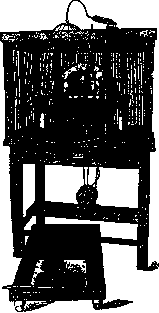
in centimeters), called conductors. On one of the conductors, positive electricity accumulates, and on the other, negative electricity. The voltage provided by static machines reaches 25,000-100,000 V. To increase capacity, the machines are equipped with two Leyden jars. Static machines of the "Mercedes" type are also used, consisting of 3 disks—a stationary middle one and 2 outer ones rotating in the same direction. To protect the disks from dust and moisture, the machine is placed in a special cabinet with glass walls. Since even slight air humidity significantly reduces the machine's voltage, electric light bulbs or sulfuric acid are usually placed in the cabinet. The machine's disks become covered with fine metal dust from wearing sections and brushes, for which reason they require fairly frequent and thorough cleaning. The patient is subjected to the effects of static electricity (general Franklinization) or individual areas (local Franklinization). General Franklinization is performed as follows. On a wooden platform with legs made of well-insulating material (ebonite, glass), a metal plate is fixed, connected to one of the machine's conductors. Figure 9. Electrodes for local Franklinization. A chair is placed on the platform, with the patient sitting so that both legs are on the metal plate. Above the patient's head, a metal disk equipped with points and connected to the second conductor of the machine is placed, which moves in a vertical direction. The patient experiences a sensation of a light breeze. The session duration is 15-20 minutes. Sessions are daily or every other day. The course of treatment consists of 15-20 procedures. Local Franklinization is carried out using special electrodes (Fig. 9), in the form of a brush or a ball. The electrode, connected to one of the conductors, is brought close to the patient's body. With a brush electrode, the discharge of electricity from the points gives a sensation of a fairly strong breeze. With a spherical electrode, a spark jumps between the body and the electrode, the length of which depends on the distance between the body and the electrode and the magnitude of the voltage provided by the machine. Local Franklinization has a pronounced analgesic effect. Electrotherapy is indicated for a number of nervous diseases. Thus, in peripheral paralysis of the facial nerve, galvanization, ionogalvanization with iodine ion, diathermy, and rhythmic faradization or galvanization often give favorable results, and at times are the only method of therapeutic effect on the affected nerve. (When using rhythmic electrification, one must be very careful, and at the first signs of contracture, it is better to discontinue electrotherapy or use it in the form of ionogalvanization with iodine or diathermy.) In lesions of the nerves of the upper or lower limbs, galvanization, iodine-ionogalvanization, rhythmic faradization, or interrupted galvanization are used, and in cases where it is necessary to cause simultaneous contraction of many muscles, it is advisable to use bergonization. Electrotherapy is also widely used in neuralgias: galvanization, ionogalvanization with iodine and aconitine ions, diathermy, and local d'arsonvalization (preferably in the form of a small spark). The scope of application of electrotherapy in diseases of the central nervous system is very limited: diathermy and galvanization of affected segments of the spinal cord, and rhythmic faradization or galvanization of affected muscles in poliomyelitis; transverse ionogalvanization with iodine of the spinal cord area in tabes dorsalis; diathermy of the head in encephalitis; ionogalvanization according to the method of Bourguignon with calcium ions in vascular lesions of the brain and with iodine ions in sclerosis of cerebral vessels; general diathermy in progressive paralysis. General Franklinization, d'arsonvalization, and bergonization are indicated for functional diseases of the nervous system. Electrotherapy gives good results in some diseases of the autonomic nervous system: 4-chamber baths in acroparesthesias and diathermy in intermittent claudication. Electrotherapy in diseases of the cardiovascular system. In insufficiency of cardiac activity, galvano-ionotherapy with calcium chloride is used. In chronic insufficiency of blood flow to the heart, a course of general bergonization can be conducted. For painful sensations in the heart area, sometimes associated with spasm of the coronary vessels, local d'arsonvalization is indicated. In spasm of the coronary vessels with no sharply expressed degenerative changes in them, diathermy of medium strength (0.8-1.2 A) for 15-20 minutes gives successful results. Sometimes a favorable effect is observed when using general d'arsonvalization in the form of a cage in patients suffering from hypertension (of non-renal origin) with unpleasant subjective sensations. In local circulatory disorders in the area of the limbs, chamber baths with galvanic current are used. Local d'arsonvalization gives successful results in the treatment of varicose veins and hemorrhoidal piles.
Related articles
Mentioned in
Cite this page
“Electrotherapy.” Soviet Medical Encyclopedia. English translation of Bolshaya Meditsinskaya Entsiklopediya, 1st ed. (Moscow, 1928–1936), ed. N. A. Semashko. https://sovietmedicalencyclopedia.pages.dev/article/electrotherapy/