Galvanocautery
Historical document, translated for reference. It reflects medical knowledge of the 1920s–30s and is not medical advice.
Summary
Galvanocautery is a method of cauterizing tissues using heated metal loops or electrodes by electric current. The technique is used for destroying tumors, stopping bleeding, and creating tissue reactions.
Encyclopedia article (1928–1936)
Galvanocautery, or galvanothermy, is a method of cauterizing tissues by means of heated metal loops or electrodes of various shapes, called galvanocauters. The degree of heating of the conductor through which the current passes depends on the strength (quantity) of the current, the cross-section of the conductor, and the electrical conductivity of its material. Since the tips of galvanocauters are usually made of iridium platinum (sometimes steel wire is used for them), the resistance of such cauteries as current conductors is small, and therefore a galvanic battery with as wide electrode surfaces as possible and low internal resistance can be used to heat them; the current strength from such batteries can reach 20-25 A at 2-4 V voltage. An accumulator battery of sufficient capacity and discharge current can also serve for the purposes of galvanocautery. When industrial lighting current is available, it is more convenient to use it as a source for galvanocautery (in this case, it is better to call it electrocautery). Having a current source and devices for its regulation, one should also have special handles for holding the cauters (see Figure 1). The selection of cauters for work (see Figures 2 and 3) in each individual case depends on the size of the object of action, its location (nose, pharynx, uterus, rectum, etc.). The wires for connecting the handle to the regulating device (multistat or column) should be of thick cross-section to avoid heating by the strong current, and they should also be sufficiently flexible; special wires consisting of a large number of very thin and flexible copper fibers are usually used; their insulation is usually double silk. In cases of cauterizing large surfaces, it is more convenient to use a special tip-cauterizer, the porcelain head of which is wound with platinum wire - after passing a sufficient current, the wire and porcelain are heated to white heat and are ready for use. Where it is necessary to remove a pedunculated tumor that can be caught with a loop (polyps), a ligature tube with a correspondingly sized loop is used (more often a piece of musical steel string without bends is taken for the loop, otherwise it will easily break during heating). The loop should fit tightly to the tissues everywhere and even slightly compress them, to cause preliminary mild anemia at the cauterization site; it should be heated only to dark red heat. As the size of the loop decreases, the current strength should be correspondingly reduced. After placing the loop at the site of tumor removal, the current is closed by pressing a button in the handle, the loop is heated, and with a slow movement, the neoplasm is removed, which with appropriate skill can be done almost without blood loss. For cauterizations aimed at stopping bleeding, the cautery is removed slowly, otherwise the formed crust may be torn off - it is better, after the crust has formed and the current is turned off, without touching the cautery, to quickly heat it again for a short time and thus burn off the clots adhering to it, after which it can be easily removed with a rotary motion.
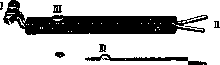
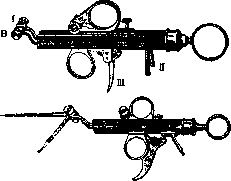
Figure 1. A-simple handle: B-with a galvanocauter inserted into it; C-universal handle with rings for 1, 2 and 3 fingers and a trigger (///) for closing the current during work; D-universal handle with a galvanocauter fixed in it. I-clamps for fixing the galvanocauter; II-tips for fixing the wires; III-button, by pressing which the heating current in the galvanocauter is closed.
size loop (more often a piece of musical steel string without bends is taken for the loop, otherwise it will easily break during heating). The loop should fit tightly to the tissues everywhere and even slightly compress them, to cause preliminary mild anemia at the cauterization site; it should be heated only to dark red heat. As the size of the loop decreases, the current strength should be correspondingly reduced. After placing the loop at the site of tumor removal, the current is closed by pressing a button in the handle, the loop is heated, and with a slow movement, the neoplasm is removed, which with appropriate skill can be done almost without blood loss. For cauterizations aimed at stopping bleeding, the cautery is removed slowly, otherwise the formed crust may be torn off - it is better, after the crust has formed and the current is turned off, without touching the cautery, to quickly heat it again for a short time and thus burn off the clots adhering to it, after which it can be easily removed with a rotary motion.
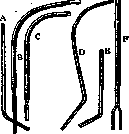
Figure 2. Cauterizers: A-for the nose; B-for the larynx; C-for the pharynx; D-for the nasopharynx; E-for the ear; F-for the skin.
After preparing the current source, its regulator, wires, handle, and corresponding sterile electrocauters, it is necessary to pre-test the heating to obtain the desired degree. At the same time, it is necessary to note the degree of movement of the rheostat slider to achieve the desired heating degree in the air, in order to bring it to the same degree in the tissues. Gradual, careful regulation by the rheostat ensures the preservation of the cautery, which can melt from a strong current unsuitable for it. Indications for electrocautery: 1) cases where it is necessary to destroy newly formed tissues in a small area: nodes, fibroid tumors, papillary growths of mucous membranes, etc.; 2) cases where inflammation, scarring and subsequent shrinkage are desirable after cauterization; 3) cases where
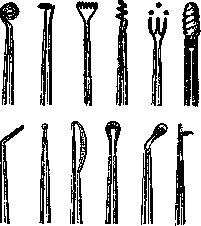
Figure 3.
it is necessary to split tissue adhesions, for example, membrane formations in the larynx, etc.; 4) polyps in the nose, larynx, fauces, ear, uterus, etc.; 5) cases where it is necessary to achieve blood clotting in small areas to stop capillary bleeding; 6) cases where it is necessary to apply strong irritation as a counter-irritant (cauterizing the spine along the nerves) or as a means of causing a sharp local reaction (in torpid ulcers). The advantage of electrocautery over Paquelin's cautery is that an electrocautery of any shape can be introduced into a cavity and applied even to a small point in a cold state, and only after precise positioning can cauterization be begun by closing the current; the temperature can be very easily regulated. It should be noted that recently, where a diathermy apparatus is available, the so-called cold cauterization with diathermy current using special cauters adapted for this purpose is increasingly being used for the same purposes as electrocautery. Lit.-see lit. to the article Galvanization. M. Anikin.
Related articles
Mentioned in
Cite this page
“Galvanocautery.” Soviet Medical Encyclopedia. English translation of Bolshaya Meditsinskaya Entsiklopediya, 1st ed. (Moscow, 1928–1936), ed. N. A. Semashko. https://sovietmedicalencyclopedia.pages.dev/article/galvanocautery/