Electrosurgery
Historical document, translated for reference. It reflects medical knowledge of the 1920s–30s and is not medical advice.
Summary
This article from the 1928–1936 Soviet medical encyclopedia describes the principles and applications of electrosurgery, a technique using high-frequency alternating current to cut and coagulate tissues. It details various instruments, methods of tissue action, and the procedure's advantages over traditional surgery.
Encyclopedia article (1928–1936)
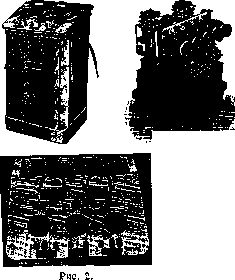
ELECTROSURGERY, the cutting and destruction of tissues by means of high-frequency alternating current. The terms E. and electric surgical apparatus were introduced in 1928 (Kaiser). The basis of E. is the use of heat, the source of which is electrical energy (Joule). The possibility of serious and widespread application in operations was obtained with the construction of special apparatus with a current interruption frequency of at least 100,000 Hz. Electrosurgical apparatus is already manufactured in our country, and the apparatus produced in recent years of Soviet manufacture are made on the Siemens type (Fig. 1). In Germany there are apparatus of the "Sanitas" firm (Fig. 2) and Siemens-Reiniger-Wecke, in America the Bovie apparatus are known (Fig. 3). An indispensable part of the apparatus is: an inactive electrode made of various metals, of considerable area, necessarily well fixed to the patient's body; active electrodes in the form of needles, like little knives, loop-shaped, spherical, roller, plate-shaped, cylindrical; electrode holders in the form of handles of various designs, in most cases with interrupters on them. In the Bovie apparatus, when using handles without an interrupter, a foot interrupter is necessary. All this sterilizes perfectly, including the cables-conductors to the active electrode. In the apparatus there are two sections—one for the electroscalpel, the other for electrocoagulation. Of the large number of methods of action on tissues, the most common are the following: electrotomy, acotomy—the sharp and smooth cutting of tissues by means of a knife-shaped or needle electrode. It is achieved by rapidly moving the electrode over the surface of the tissue being cut in a strictly perpendicular position of the electrode to the tissues. Coagulotomy—the cutting of tissues with their whitening along the path of the electrode (crust, "welding"); achieved by slowly moving a needle or knife-shaped electrode and with a more powerful current. Coagulation—deep welding of tissues; achieved by means of an active electrode with a wide cross-section, with its close contact to the tissues and with the passage of a strong current. Carbonization—charring of tissues; achieved by means of the aforementioned electrodes, but on the condition of their not close contact with the surface of the tissues. The air gap between the electrode and the tissues, as a dielectric, allows a stream of sparks to pass, charring the tissues. Electrocory—disinfection of the wound surface with the killing of bacteria and their germs; achieved by means of a blade-shaped electrode made of flexible metal on the condition of its movement over the wound surface in the manner of a broom or brush movements. Fulguration—cauterization of tissues by a spark like lightning coming from a spherical electrode at very high voltage and at a distance of several cm from the surface of the cauterized tissue. The most frequent applications are acotomy, coagulotomy, coagulation, and electrocory. By acting with the electroscalpel, capillary bleeding from tissues is completely avoided, asepsis is complete at the time of cutting, and the destruction of cells by the action of heat in the sphere of action of the electroscalpel is relatively insignificant when used correctly. The latter condition, as a rule, gives primary wound healing. When applying the electroscalpel in the removal of malignant tumors, we theoretically, due to the absence of pressure on the cut tissues, do not squeeze malignant cells contained in them from the lymphatic pathways and fissures into the lymph stream, and by killing them with the action of heat, we reduce the possibility of recurrence. The application of electrocoagulation makes it possible to stop bleeding from arterioles and arteries of small caliber. However, coagulation cannot be applied near large arterial and nerve trunks for fear of damaging them. In contrast to burning, charring of tissues (by the Packard apparatus), coagulation does not give repeated bleeding and secondary infection. When applying electrocoagulation in the depths of tissues (muscular, hepatic), sharp reactive phenomena do not occur, as happens around necrotic areas for other reasons. Electrocoagulation allows the removal of significant parts of parenchymatous organs (liver) without resorting to suturing. In operations on malignant tumors, when the latter have reached such a stage of growth or are located anatomically so that they cannot be removed by ordinary surgical methods, the electroscalpel and electrocoagulation allow their destruction. In the postoperative period in patients with the application of electrosurgical methods, pain sensations are significantly reduced. When applying electrosurgical methods, one must be guided by the specific electrical conductivity of individual tissues. In electrocoagulation, it is important to consider the time of its action on the tissues and to be familiar with the development of temperature at various depths of the coagulated tissue. During electrosurgical operations, explosions are possible under ether anesthesia, especially if the operation has to be performed on the head. The field of application of E.: the fight against bleeding, operations on parenchymatous organs, thyroid gland, amputation, resection, infected wounds, bladder, prostate, hemorrhoids, fistulas, parasitic cysts, benign tumors, a number of skin diseases and especially the fight against malignant tumors, in particular brain tumors. In combination with radiation therapy, E. significantly expands and improves the possibilities of fighting in especially neglected cases of neoplasms.



Related articles
Mentioned in
Cite this page
“Electrosurgery.” Soviet Medical Encyclopedia. English translation of Bolshaya Meditsinskaya Entsiklopediya, 1st ed. (Moscow, 1928–1936), ed. N. A. Semashko. https://sovietmedicalencyclopedia.pages.dev/article/electrosurgery/