Paquelin Apparatus
Historical document, translated for reference. It reflects medical knowledge of the 1920s–30s and is not medical advice.
Summary
The Paquelin apparatus, also known as thermocautery, is a surgical instrument introduced by French surgeon Claude Andre Paquelin in the late 19th century. It uses a platinum tip heated by burning gasoline to cauterize tissue, with applications in removing tumors, treating ulcers, stopping bleeding, and various surgical procedures.
Encyclopedia article (1928–1936)
PAQUELIN APPARATUS (syn. thermocautery) was introduced into medicine by French surgeon Paquelin (Claude Andre Paquelin) in the late 19th century. The action of the apparatus is based on the application of metal (iron) heated to white heat (the idea of treating with iron heated to white heat dates back to deep antiquity). The apparatus consists of a platinum tip that screws onto a handle, through which vaporizing gasoline is forced by means of a rubber bulb; the combustion of the latter heats the platinum tip to red or white heat. For different purposes, tips of various shapes are used: spherical, knife-shaped, pointed (Figure 1), etc. As a rule, a small gasoline vessel is used, which is connected by rubber tubes with the compression bulb and with the handle of the apparatus (Figure 2). When using the apparatus, first the platinum tip is heated over the flame of an alcohol or gas burner until red hot, and then air is forced into the gasoline vessel. The evaporating gasoline passes through the handle into the platinum tip, burns there, heating the tip, and the apparatus is ready for use.

Fig
The therapeutic application of the apparatus is used for burning out various new growths, small tumors, hemorrhoidal nodules, and for cauterizing and burning out septic ulcers and wounds. The P. a. is widely used for neuralgias. In abdominal surgery, the apparatus is used for cauterizing the vermiform appendix during appendectomy, for incising the wall of the stomach or intestine when creating an anastomosis in order to make this act of the operation more aseptic and for the purpose of stopping bleeding from the intestinal wall (formation of a thrombus). The hemostatic effect of cauterization has been known for a long time.
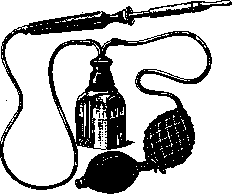
Figure 2.
new growths, small tumors, hemorrhoidal nodules, for cauterizing and burning out septic ulcers and wounds. The P. a. is widely used for neuralgias. In abdominal surgery, the apparatus is used for cauterizing the vermiform appendix during appendectomy, for incising the wall of the stomach or intestine when creating an anastomosis in order to make this act of the operation more aseptic and for the purpose of stopping bleeding from the intestinal wall (formation of a thrombus). The hemostatic effect of cauterization has been known for a long time.
Related articles
Mentioned in
Cite this page
“Paquelin Apparatus.” Soviet Medical Encyclopedia. English translation of Bolshaya Meditsinskaya Entsiklopediya, 1st ed. (Moscow, 1928–1936), ed. N. A. Semashko. https://sovietmedicalencyclopedia.pages.dev/article/paquelin-apparatus/