Diathermy
Historical document, translated for reference. It reflects medical knowledge of the 1920s–30s and is not medical advice.
Summary
An overview of diathermy, a high-frequency current treatment method used primarily for its thermal effects, detailing the technical and therapeutic circuits, electrode types, and administration techniques from a 1930s perspective.
Encyclopedia article (1928–1936)
DIATHERMY, a method of treatment using high-frequency currents, in which their thermal effect is predominantly utilized. The property of high-frequency currents to generate heat when passing through tissues was noted by d'Arsonval and, following him, by other investigators. However, due significance was not initially attached to this, and such heat generation was viewed rather as an undesirable phenomenon. Only Zeyneck and Nagelschmidt simultaneously, in 1908, began to use high-frequency currents with the aim of utilizing their thermal effect. There is no fundamental difference between the currents obtained from diathermy apparatus and d'Arsonval currents; both types are oscillatory and damped, but while in d'Arsonval currents individual oscillatory discharges follow one another at certain intervals of time that are sufficiently long, in diathermy apparatus this time interval is very small, i.e., practically it can be disregarded (Fig. 1). The primary alternating current of 120-220 volts, 50 periods per 1 sec., in the apparatus for diathermy enters a transformer (T), which consists of 2 types of wire, one thicker and shorter, the other thinner and longer, wound on a closed core of laminated soft iron. Due to induction, a high voltage appears in the thinner wire, which in diathermy apparatus reaches 1,500-2,000 volts. The secondary winding of the transformer is connected to a capacitor (C) by a small self-induction coil (L) and spark gaps (F). The latter consist of two copper plates with a diameter of 15 cm, ground as smoothly as possible. Small tungsten disks are soldered to one side of them. A mica disk 0.1 mm thick is placed between the plates; thus, the spark gap is kept constant at all times, equal to 0.1 mm. In order to obtain strong oscillatory currents, the number of discharge sparks is increased, i.e., instead of two plates, 4 and 6 are installed. Thanks to the heat-resistant tungsten, the spark gaps do not need special cooling. Thus, the primary, or, as it is also called, technical circuit of diathermy consists of a source of alternating current of 110-220 volts and 50 periods, a transformer, a capacitor, a spark gap, and a small self-induction coil (Fig. 2 and 2a). Electrical oscillations of the technical circuit are not communicated to the patient due to the danger of connecting the patient to the street
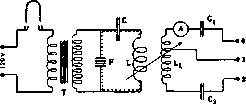
Figure 2. T - transformer; F - spark gap; C, C1, C2 - capacitors; L - primary spiral of the solenoid; L1 - secondary spiral of the solenoid; A - ammeter; 0, 1, 2 - electrodes for therapeutic purposes.
To avoid this, a second circuit is created in the apparatus—the therapeutic circuit, consisting of a small coil (L1), two capacitors (C1, C2), and a thermal ammeter (A). The ends of the coil are connected to both capacitors and approach the external terminals (0, 1, 2) via the ammeter. The coil of the therapeutic circuit is made movable. The operation of the apparatus reduces to the following: when the current in the technical circuit is switched on, oscillatory discharges appear, and an alternating magnetic field is formed around the coil (L). When, by means of a handle, the coil (L1) of the therapeutic circuit is pushed onto the coil of the technical circuit, it thereby enters the alternating magnetic field, by virtue of which a high-frequency oscillatory current is excited in it, which is transmitted to the patient. The strength of the current in the therapeutic circuit will be greater the more magnetic lines intersect the movable coil, and therefore the maximum current strength will be when the movable coil is entirely pushed onto the stationary one. In the opposite case, the current strength will decrease. Thus, the regulation of current strength reduces to moving one coil relative to the other. In all diathermy apparatus, both coils are located inside the apparatus, and regulation is carried out using a handle located outside. All apparatus for diathermy currently produced, giving damped oscillations, are built on this principle. Individual firms make changes only in the placement of individual parts of the equipment or in the design of individual parts. Modern large apparatus are built for the simultaneous service of two patients (Fig. 3). Recently, apparatus have been proposed in which spark gaps are replaced by cathode tubes. Thanks to them, undamped oscillations are obtained, which contributes to more uniform heating of the tissues. With them, the faradic irritation that can occur with damped oscillations is also absent. Cathode tubes are used with an oscillatory power of 500 watts, and the burning life of the tube Figure 2a. Wiring diagram for diathermy: 1 - mains; 2 - alcohol; 3 - thermal current; 4 - self-induction; 5 - switch; 6 - capacitors; 7 - high voltage transformer; A - ammeter.

Figure 3.
through well-insulated wires, the current is communicated to the patient using foil electrodes 0.1-0.2 mm thick. The dimensions of the electrodes depend on the surface area on which it is desired to act, and can range from several square centimeters to 500-600. In addition to flat ones, electrodes in the form of metal cylinders or olives are also used, which serve for introduction into cavities (rectum, vagina; Fig. 4). The electrodes offer very negligible resistance to the high-frequency current—they do not heat up themselves and therefore are not sterilized by the current. In view of this, those of them intended for cavities require careful boiling. Electrodes applied to the skin are sufficient to wash with alcohol. Using the above-indicated
Figure 4.

Figure 5. Local application of diathermy.
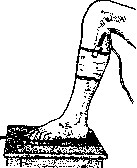
electrodes, diathermy can be applied either locally (to the diseased organ) or to the entire organism as a whole (Fig. 5-8). Since high-frequency currents do not cause electrolysis phenomena, there is no need for fabric pads here, and now everyone uses exclusively bare metal plates. Lead is most convenient for this purpose as the most flexible and cheapest. There is no need to fear poisoning, since with alternating currents of high frequency, the penetration of ions into the body from the outside is impossible. It is most expedient to make electrodes from sheets 1 and 1/2 mm thick; thinner ones are very fragile. Before use, electrodes should be carefully smoothed out. It is extremely important that the electrodes evenly and tightly adhere to the skin over the entire surface in order to avoid
burns. In diathermy, burns do not occur through electrolytic decomposition of tissues, as with direct current, but are caused either by sparks or by local current concentration due to tighter contact of the electrode at individual, very limited points and loose contact in the surrounding ones. It must be remembered that the current is also concentrated at the edges of the electrodes. Electrodes are secured with bandages, dressings, or bags of sand (on the abdomen, chest). Various tissues of the organism offer unequal resistance to high-frequency alternating currents. With appropriate arrangement of the electrodes, they can be introduced in series or in parallel. In the first case, the tissue that offers greater resistance to the current will heat up more; in the second, the one that offers lesser resistance, since almost all the current will pass through the body with lesser resistance. The total amount of heat generated in the body obeys the Joule-Lenz law (Q = 0.24 I2 r t, where 0.24 is the proportionality coefficient, I is the current strength, r is the tissue resistance, and t is the time). Current density per unit surface is of great importance for conducting therapy correctly. The smaller the surface of the electrode,
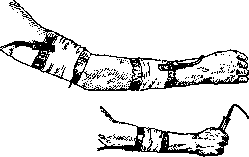
Figure 6. Local application of diathermy.
Figure 7. General diathermy according to Kowarschik.
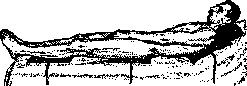
the greater the current density will be. Sometimes, for the sake of observing this condition, one of the poles has to be connected to two electrodes. General diathermy enjoys significant application,
Figure 8. Condenser bed for general diathermy.

differing from local diathermy only in the arrangement and size of the electrodes. Two techniques are most common: 1) the stripped patient lies on three wide plates located under the calves, seat, and back at the level of the shoulder blades. In both cases, the middle electrode is connected to one pole, and the other two to the other; 2) the patient puts his feet on one wide plate, sits on the other, and puts his forearms and hands on the third (Bordier). The duration of a session in both general and local diathermy should be significant: for local from 20 to 40 minutes, for general from 30 minutes to
hours. Shorter sessions are useless, and only at the beginning, especially in critical cases, should one be limited to 5-10 minutes. The sessions are repeated every other day or daily, and some authors in certain cases insist on two (Bergonie; in cases of excessively low body temperature) and even three (Stewart; in lobar pneumonia) applications per day, lasting an hour each. After 30-40 electropunctures it is advisable to take breaks of 4-6 weeks. As for dosage, unfortunately, there are still no criteria; on the one hand, the ammeter readings for a number of reasons do not characterize the degree of heating of the tissues, and on the other hand, methods for measuring the temperature of the electrified tissues are still completely undeveloped—attempts are only now being made to approach this issue. However, in practice, one still needs to be guided by something: it was necessary to work out certain limits roughly empirically, guided by the ammeter readings and (very importantly!) the patient's sensations. For local applications, currents from 0.5 to 1.5 A are used, at most up to 2 A; for general applications, from 1.5 to 3 A. The patient should be questioned more often and warned that he should feel nothing except a uniform, easily tolerable sensation of warmth. Any other sensation (pain, tingling, burning, a feeling of pressure or numbness, etc.) makes it necessary either to reduce the current or even turn it off completely, remove the electrodes, carefully inspect the skin surface to make sure how evenly the electrodes adhere, whether there are signs of local current concentrations, whether there are burns, etc. The patient must be strictly instructed that he must report any unpleasant sensation to the person administering the treatment. The physiological effects of the current can be observed chiefly during general diathermy; most of the data obtained in this respect relate specifically to general, and not to local diathermy, except, however, for the increase in the temperature of the tissues penetrated by the current, which is indisputably established even with local applications. Thus, Roucayrol states that in his observations the temperature of the prostate gland rose to 48°. M. V. Egorov, during gynecological electro-therapies, observed an increase of 7.75° in the vagina; this limit should generally not be exceeded. Thermoelectric couples are usually used for temperature measurements. The general body temperature may also rise, even with local applications, by 1-1.5°. The physiological effect of diathermy is based mainly on the thermal effect that it causes in the tissues. Whether only heat acts or whether there is also an influence of high-frequency current remains not entirely clear to this day. The bactericidal effect of diathermy has been proven by various authors in vitro, but this effect has not been confirmed by all in vivo. Diathermy causes hyperemia at the site of its action, an increase in leukocytosis, and an increase in other defense mechanisms of the body. The general body temperature can rise by several degrees. Blood pressure decreases under the influence of diathermy, and this decrease is more pronounced in individuals with high blood pressure than with normal blood pressure. Pulse and respiration become more frequent. The secretory activity of the glands is enhanced, metabolism, both general and local, is intensified under the influence of diathermy, and oxidation processes occur faster and more completely. The processes of assimilation and disassimilation proceed more energetically. Diathermy possesses significant analgesic and antispasmodic action. Indications. Diathermy is widely and successfully used in diseases of the joints (polyarthritis rheumatica, urica, gonorrhoica, traumatic joint injuries, etc.); it promotes the resorption and removal through the general bloodstream of pathological products deposited in the joints or in the tissues surrounding the joint. Under its influence, pain diminishes or disappears altogether. Furthermore, diathermy is indicated for diseases of tendons and their sheaths, for bursitis, and for myositis, especially of rheumatic or traumatic origin. The pain-relieving effect of diathermy in neuralgias of various etiologies often manifests itself after the very first session. In these cases, a large current strength should not be given; the patient should experience only a light, pleasant sensation of warmth. In infantile paralysis in the subacute stage, diathermy (along with other physical therapy procedures), thanks to its heat, promotes more rapid resorption of exudate in the spinal cord, enhances metabolic processes in the paralyzed limbs, and thereby contributes to a more rapid restoration of their function. Among diseases of the cardiovascular system, diathermy is indicated for angina pectoris. Mild warming of the heart region helps to reduce pain sensations, decrease the number of attacks, and improve the general well-being of patients. Diathermy is able to lower high blood pressure for a long and persistent period. Diathermy yields good results in endarteriitis obliterans. In this disease, it is advisable to combine diathermy with illumination by a voltaic arc through red glass, as well as with the action of an alternating air shower. Diathermy yields satisfactory results in local circulatory disorders accompanied by both an increase and a decrease in vascular tone, which is explained on the one hand by its antispasmodic action, and on the other hand by the intensification of blood circulation caused by it, a decrease in congestive phenomena, and an improvement in local metabolic processes. Among lung diseases, diathermy is successfully used for bronchial asthma. In this case, the electrodes are applied to the chest. Satisfactory results in bronchial asthma are sometimes also obtained by warming the spleen. The use of diathermy in lobar pneumonia, proposed by American authors, deserves attention. Good results are also obtained in dry and serous pleurisy. Diathermy can have a regulating effect on gastric secretion and is used in states of both hypersecretion and hyposecretion. In intestinal diseases, diathermy is indicated for their spastic states. In acute appendicitis, diathermy is contraindicated. Furthermore, it often yields good results for pain due to adhesions and scar tissue in the abdominal cavity after surgery or as a result of inflammatory processes. The use of diathermy in enterocolitis results in a reduction of pain, improvement of stool, appetite, and general condition. Diathermy is often used with good results in cholecystitis. Treatment with diathermy of various diseases of the genitourinary organs (prostatitis, chronic epididymitis, vesiculitis, especially of a gonorrheal nature) yields satisfactory results. The same can be noted for certain diseases of the female genital sphere of both gonorrheal and general inflammatory nature. With the help of special electrodes, diathermy is also used for certain diseases of the eyes, ears, nose, and larynx. Good results are obtained chiefly in rheumatic and gouty conjunctivitis, rheumatic and gonorrheal iritis and iridocyclitis, and in rheumatic, tuberculous, and syphilitic diseases of the vitreous body. In chronic laryngitis, diathermy acts in a pain-relieving and resorptive manner. Diathermy is indicated for chronic otitis, and for sclerotic, fibrous, and scar processes in the middle ear. Diathermy should be used with particular caution in the presence of a tendency to hemorrhages (e.g., pulmonary), in diseases of the stomach and intestines when there is a suspicion of ulcers or another process that could cause bleeding. In women, the use of diathermy on the pelvic organs during pregnancy and menstruation is contraindicated. Diathermy is further contraindicated in acute diseases proceeding with an elevated temperature, as well as in processes that may end in suppuration (acute inflammation of the pleura, appendix, peri- and parametrium, etc.), and in malignant tumors. Literature: Arandarenko, P., Diathermy, Leningrad, 1925 (literature); Brushtein, S., Manual of Physical Methods of Treatment, Leningrad, 1927; Brushtein, S. and Zalkindson, E., Diathermy, Moscow-Leningrad, 1929 (literature); Kotovich, I., Method of Diathermy Treatment, Moscow, 1911; Stiebock, L., Diathermy, Kharkov, 1927; Physiotherapy of the Practical Physician, edited by S. Vermel, Moscow, 1928; Bordier, H., Diathermie et diathermotherapie, Paris, 1928; Cumberbatch, E., Diathermy, London, 1921; Kowarschik, J., Die Diathermie, Berlin-Vienna, 1928.
Related articles
Mentioned in
Cite this page
“Diathermy.” Soviet Medical Encyclopedia. English translation of Bolshaya Meditsinskaya Entsiklopediya, 1st ed. (Moscow, 1928–1936), ed. N. A. Semashko. https://sovietmedicalencyclopedia.pages.dev/article/diathermy/