Buck's Alternator
Historical document, translated for reference. It reflects medical knowledge of the 1920s–30s and is not medical advice.
Summary
Buck's alternator is a device used in diathermy that consists of a pulsator and the alternator proper. It allows for more uniform heating of tissue areas by rhythmically interrupting the current and changing its direction.
Encyclopedia article (1928–1936)
Buck's Alternator (Visco), is used in diathermy and consists of a pulsator and the proper Alternator (see Figure 1). Buck noticed in 1921 that the best results in diathermy are obtained when using a strong current; however, such a current causes a series of unpleasant sensations (which can be avoided by rhythmically interrupting the current). At the same time, due to the rapid dissipation of heat by the heated tissues, one can significantly increase the strength of the current at the moment of its closure, and thereby also the thermal effect. The pulsator serves for rhythmic interruptions, being an integral part of the Alternator. It consists of a motor that drives a special lever that closes and opens the circuit that powers the apparatus, since interruptions in the diathermy current are associated with danger to the patient. By means of a rheostat, the number of motor revolutions can be regulated, and with the help of a special screw, the duration of the closing and opening phases can be adjusted. The Alternator serves
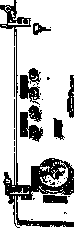
Figure I. for more uniform heating of one area with two pairs of electrodes, or of two different areas. When heating one area with two pairs of electrodes without the Alternator, the peripheral parts will heat up the most (see Figure 2a), since this is the shortest path for the current; with the Alternator, however, the central part will heat up better (see Figure 2b), since, due to two movable levers connected to the pulsator motor, the circuit is rhythmically closed first in one direction, then in the other.
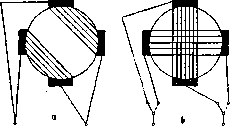
The change in the direction of the current coincides with the moment of current interruption by the pulsator.
Related articles
Cite this page
“Buck's Alternator.” Soviet Medical Encyclopedia. English translation of Bolshaya Meditsinskaya Entsiklopediya, 1st ed. (Moscow, 1928–1936), ed. N. A. Semashko. https://sovietmedicalencyclopedia.pages.dev/article/bucks-alternator/