Bergonization
Historical document, translated for reference. It reflects medical knowledge of the 1920s–30s and is not medical advice.
Summary
Bergonization is a specific type of rhythmic faradization developed by Bergonie for therapeutic muscle stimulation. It involves carefully controlled electrical currents to produce painless muscle contractions, with applications for metabolic disorders, obesity, and conditions associated with arthritism, atony, and asthenia.
Encyclopedia article (1928–1936)
BERGONIZATION, a special type of rhythmic faradization, developed and introduced into practice by Bergonie. This method is the most difficult of all electrotherapeutic procedures; every electrotherapist must study this method in all practical details, conducting several sessions on themselves. The main conditions for painless contractions are the appropriate form of current. After prolonged research, Bergonie settled on the faradic current, since with a properly designed coil, this current produces less painful contractions than all other types of currents. In the latest models of his apparatus, Bergonie replaced the faradic coil with a magnetic dynamo machine, specially designed and giving a current of the same character as the coil—with sharp waves. In order for the muscles to receive a period of contraction absolutely equal to the period of rest, an interrupter-distorter (of the metronome type) or a rotating motor is installed in the secondary circuit. The latter is inconvenient because it requires more maintenance. The duration of each period of closure and opening should, on average, equal 1/2 second, thus the metronome should give 120 interruptions-distortions per minute. The distortion of the faradic current in B. is by no means for straightening its direction, but for the uniform distribution of opening and closing waves, since opening waves give stronger contractions than closing waves. The strength of the current is regulated by 12 resistors (1-general and 11-partial) installed on the distribution board (of Russian design by N. I. Korotnev and French firm Geff): 2-for the arms, 2-for the back, 2-for the buttocks, 2-for the thighs, 2-for the calves, and 1-for the abdomen. Electrodes for B. are of two types: fixed (back, buttocks, arms, and thighs)—made of sheets of copper or tinned iron, and variable (abdomen, dorsal surfaces of the hands and feet)—made of flexible sheets of copper or tin. On the patient, electrodes are fixed with sandbags placed on top, which simultaneously increase the work of the muscles, presenting a certain resistance to them during contractions. When adjusting the strength of the current, it is necessary to constantly monitor the subjective sensations of the patient. Duration of sessions: initially—every other day for 15-20 minutes, and by the end of treatment, it can be increased to two sessions per day, one hour each.-Technique of B.: a completely undressed patient lies in a chair (see illustration), covered with a sheet moistened in hot water. In view of the absence of electrolysis phenomena, with faradization, bare metal electrodes can also be used. But usually, for hygienic purposes, padding is placed underneath. On top, individual electrodes with sandbags securing them are applied. For greater convenience in accounting for the total load, the average weight of each bag is taken as 3-4 kg. Regarding the polarity of the electrodes, there are no direct instructions, but N. I. Korotnev prefers to arrange them not on the right and left sides of the chair, but along cross-sections, or along the posterior and

® "@ ®"
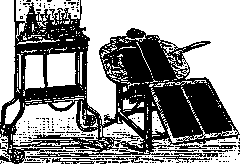
anterior surfaces. When adjusting the strength of the current, one must achieve completely uniform contractions of all muscles, if, of course, there is no local pathological process, for example, joint suffering making movements in this area painful. Local skin defects are quickly eliminated by applying collodium to the affected area of skin.'-Management of the distribution board is as follows. Before the session, all resistors are fully inserted. First, the resistance of the partial resistors is reduced, and then the main resistor is very carefully withdrawn. As soon as contractions of one or another group of muscles appear, the resistance of the corresponding partial resistor is increased and the general one is withdrawn again. In this way, completely uniform contractions of all electrifiable muscles can be achieved. The load during the session is increased in parallel with the increase in the strength of the current, since a very strong current is tolerated much more easily with a sufficiently large load; at the end of the session, as the current strength decreases, the load is gradually reduced.-The physiological action of B. is as follows: increase in metabolism, gas exchange, enhancement of blood circulation and sweating. On the nervous system, B. has a calming effect, simultaneously improving mood, vigor, and performance. Accordingly, the indications for B. are all diseases associated with metabolic disorders, in conditions of arthritism, atony, and asthenia. The main indication is obesity, regardless of etiology.
Related articles
Mentioned in
Cite this page
“Bergonization.” Soviet Medical Encyclopedia. English translation of Bolshaya Meditsinskaya Entsiklopediya, 1st ed. (Moscow, 1928–1936), ed. N. A. Semashko. https://sovietmedicalencyclopedia.pages.dev/article/bergonization/