Electivity
Historical document, translated for reference. It reflects medical knowledge of the 1920s–30s and is not medical advice.
Summary
Electivity refers to the selective relationship of structural elements to various agents, revealing specific properties of these elements. This property is widely used in histological and cytological techniques for differentiating tissue elements or cellular components.
Encyclopedia article (1928–1936)
Electivity, the selective relationship of structural elements to various agents with the manifestation of certain specific properties of these elements. Electivity may be based on chemical affinity for certain agents. Its basis may lie in anatomical and physiological prerequisites (the fine structure of tissue, its adsorption properties, tissue reaction, etc.). In histological and cytological methodology, this property of selective action is widely used for the differentiation of tissue elements or individual components of the cell. Thanks to the selective relationship of different structural elements to various chemical substances, it is possible to clearly identify them from among other structures. An example of such electivity is the selective staining of cell nuclei by means of the nucleal reaction, the selective staining of amyloid by means of congo red, the selective impregnation of axis cylinders with silver, etc. In pharmacology, one speaks of the selective action of certain medicinal substances. Electivity is implied when referring to the neurotropic or dermatotropic action of certain agents, which determines the localization of these agents and the development of corresponding clinical-anatomical phenomena. Electivity is not something stable and fluctuates within wide limits, since the physicochemical and functional-anatomical (for example, age-related) features of tissues and organs constantly undergo significant fluctuations.
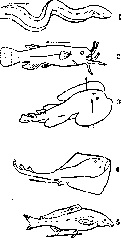
Figure 1. Schematic representation of electric fish with indication of the direction of electric current upon discharge: 1-Gymnotus electricus; 2-Malopterurus; 3-Torpedo; 4-Raja; 5-Mormyrus.
Related articles
Mentioned in
Cite this page
“Electivity.” Soviet Medical Encyclopedia. English translation of Bolshaya Meditsinskaya Entsiklopediya, 1st ed. (Moscow, 1928–1936), ed. N. A. Semashko. https://sovietmedicalencyclopedia.pages.dev/article/electivity/