Calorimetry
Historical document, translated for reference. It reflects medical knowledge of the 1920s–30s and is not medical advice.
Summary
This article from the 1928–1936 Soviet Great Medical Encyclopedia describes the principles and methods of calorimetry, including the mixing method, the Bunsen ice calorimeter, and the Benedict oxygen calorimeter. It details the apparatus used for measuring heat released or absorbed during physical and chemical processes.
Encyclopedia article (1928–1936)
CALORIMETRY (from Latin calor—heat and Greek metron—measure), the quantitative determination of heat released or absorbed during various kinds of physical or chemical processes. Since the development of thermochemistry, the amount of heat released or absorbed during the interaction of both individual elements and various chemical compounds has been determined to clarify the course and direction of various reactions. Thus, calorimetric determinations are beginning to play a role in solving many theoretical questions and are finding more and more application. Industrial technology also resorts to this method for evaluating various kinds of combustible materials. Calorimetric determinations are conducted mainly by the method of mixing, developed by Regnault and modified by Berthelot and others. The essence of the method is that the released heat warms a certain volume of water or some other liquid, and the change in the temperature of the liquid is determined with the greatest possible accuracy. Knowing 1) the heat capacity of the liquid, 2) the amount of heat spent on heating the various parts of the apparatus, and 3) the amount of heat lost or
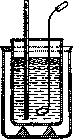
Figure 1.
acquired through radiation, one has all the necessary data for calculating the sought amount of heat. The apparatus serving this purpose consists of the following parts: the calorimeter in the proper sense, a bath, a stirrer, and a thermometer. Calorimeters can be platinum, brass, or glass. Platinum ones have a great advantage over others because most chemical compounds do not act upon platinum, and also because platinum has a low heat capacity and high thermal conductivity, which contributes to the rapid equalization of temperature throughout the calorimeter. In addition, the white color of platinum protects the calorimeter from heat loss through radiation. All this makes the platinum calorimeter the most convenient and suitable for all kinds of thermochemical determinations, but the high price of platinum makes it not very accessible. For many determinations, one can use glass calorimeters, consisting of either two large chemical beakers or a Dewar vessel (Figure 1). In many cases, brass calorimeters are used, with the heat capacity of brass being taken as equal to 0.095. The most commonly used is the calorimeter of the old type, the so-called Berthelot type (Figure 2). The calorimetric vessel itself is surrounded by two air gaps and then an external water jacket. The outer vessel is covered on the outside with felt, and the inner one has silvered and carefully polished walls. A necessary part of such a calorimeter is a stirrer for mixing the liquid during the experiment, by which uniform distribution of heat and the correctness of the temperature reading are achieved. The Berthelot stirrer (Figure 3) is very convenient, consisting of blades attached to two rods. It can be connected to a special mechanism driven by an electric motor. Besides these common types of calorimeters, others are used for precise measurements; among them, it is worth noting: 1. The Bunsen ice calorimeter; this is one of the so-called isothermal calorimeters, i.e., one whose temperature remains constant throughout the entire experiment. The heat released during
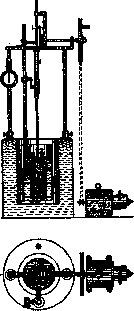
Figure 2.
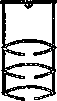
Figure 3.
the reaction goes to melting the ice surrounding the calorimetric vessel. The change in volume occurring during the melting of ice or the freezing of water is measur
ed by the position of the mercury column, which closes the external space and moves in the capillary, and serves as a measure of the released heat (Figure 4). The Bunsen apparatus consists of a wide glass tube with thick walls (b), passing in the lower part into a thinner tube (c); a steel frame (z) is attached to the latter, in which a capillary tube (d) is fixed on a stopper. A thin-walled tube (a), closed with a stopper, is fused into tube b. Tube b is filled to the top from level (e) with boiled water and ice. The latter forms a solid cylinder around tube a. Below level e is
mercury, which also fills tube c and capillary d up to a certain mark. The entire apparatus, except for the capillary, is immersed in snow. To form the ice cylinder around the tube, alcohol cooled to -10° is sucked through it, or ether with solid CO2 is used. Usually, by experimental means, one finds the constant, i.e., the amount of heat necessary to move the mercury column in the tube by one division, and after that, the determination of heat under one condition or another presents no difficulties. 2. The adiabatic calorimeter of Holman and Richards (1905) is based on the fact that the temperature of its

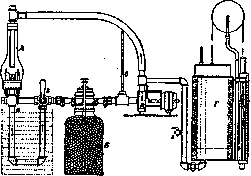
Figure 5.
external shell is artificially changed in the same way as the temperature in the calorimetric vessel. Such a device almost completely eliminates the heat exchange of the calorimeter with the surrounding environment. 3. The Benedict oxygen calorimeter allows for the determination of the amount of O2 consumed during the combustion of one substance or another. It consists of a combustion chamber A (Figure 5), which is a lamp glass fitted with the help of a special gasket onto a brass tube. Two nickel rods are inserted into the gasket, on which terminals for electric wires are attached on the side. The brass tube is connected to a four-way valve a, which is connected at its lower end to a cooler, and by one of its side branches to a three-way
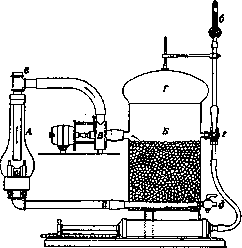
Figure 6.
valve b; after valve b, a vessel B filled with soda lime is inserted into the system, then a thermometer b and a fan V, which blows air through a rubber tube into the combustion chamber. This rubber tube is connected to a three-way valve inserted with the help of a rubber stopper into the upper opening of the chamber. Air from the chamber can pass either through the cooler, the three-way valve, and the absorber for CO2, or, bypassing the cooler, directly into the absorber. Above pump V there is a three-way valve, which connects to tube z, leading to spirometer G. The substance is burned in a nickel crucible, fixed with the help of special clamps on the bottom of chamber A. The CO2 formed during combustion is absorbed in vessel B, and the cooler allows the system to be brought to the initial temperature. Oxygen from the spirometer passes into the system in the same amount as it was consumed during the combustion of the substance; consequently, by the loss of O2 in the spirometer, the amount of consumed O2 is determined. Multiplying this amount by the corresponding coefficient K, one finds the number of calories released during combustion. This coefficient has been determined for many substances, for example, for starch it is equal to 5.06, for protein - 4.60, for sugar - 5.04, etc., and denotes the amount of calories corresponding to 1 liter of oxygen. - The Benedict calorimeter also exists in a simplified form (Figure 6). In this apparatus, the spirometer and cooler are absent
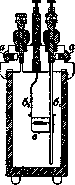
Figure 7.
Soda lime is placed in a metal cylinder B, closed with a rubber cap G. When O2 is absorbed, the rubber cap moves away from the needle touching its top, and to return it to its original position, a certain amount of gas must be forced into the system from the pump. The pump is calibrated, and the volume of air displaced from it to bring the system back to the original pressure equals the amount of O2 consumed. With the help of these two devices, the amount of heat released during the combustion of feeds, food substances for humans, excreta, etc., is determined. Calorimeters can be adapted for different purposes: for example, the determination of heat capacity is carried out in the Regnault apparatus, adapted for this purpose; the heat of combustion in the Mahler, Croker bomb and the Berthelot bomb. The latter is the most convenient and most widespread. This bomb consists of a steel vessel with thick walls capable of withstanding a pressure of 200-300 atmospheres (Fig. 7). A screw cap is screwed onto this cylinder from above. Originally, the Berthelot bomb was lined with platinum lining, which made the entire apparatus extremely expensive. Mahler replaced platinum with enamel, and Croker with special steel, as a result of which the calorimetric bomb became a common apparatus in scientific and technical laboratories. In the cover there is a screw cock with a channel inside, which serves for filling the bomb with O2 and for releasing gases. The substance to be burned (usually pressed into a cake shape) is placed in a platinum or quartz cup (c). Between electrodes b1 and b2 is fixed a spiral of thin iron wire of strictly defined weight. From a cylinder with compressed O2, O2 is introduced into the bomb so that the pressure in the bomb reaches 25 atmospheres; then the valve is screwed in and the bomb is lowered into the calorimeter. Observing the calorimeter thermometer, readings are taken at equal small intervals of time until the temperature stabilizes, after which the bomb electrodes are connected to a battery circuit with a voltage of about 10 volts. The spiral heats up, burns, and ignites the substance under investigation. For calculations, it is necessary to know the water equivalent of the bomb, which is determined by various methods: 1) it is calculated if the weight of all materials entering the bomb is exactly known, 2) a certain amount of substance whose heat of combustion is known is burned in it, etc. The Berthelot bomb was later somewhat modified and adapted for the elementary analysis of organic substances. For this purpose, instead of one valve, two are made in it (Fig. 7a). Both of these valves close the side holes into which screws usually enter from the outside. After the substance is burned, the bomb is removed from the calorimeter and connected on one side with absorbers for CO2 and water (e, f, and i), and on the other side with aspirators a and columns b for passing air through the apparatus and washing it from CO2 and H2O (Fig. 8). The side screws d of the bomb are removed at this time and replaced by two screwed-in metal tubes. The thermometers used for calorimetric determinations must be very sensitive and accurate. Usually a Beckmann thermometer with a movable scale is used. The latter is divided into hundredths of a degree, so that with a magnifying glass one can easily read 0.005°. For each calorimetric thermometer, the weight of mercury in it, the weight of glass in the bulb, and the weight of the scale are always given. In precise measurements, it is necessary to take into account how much heat was spent on heating that part of the thermomet
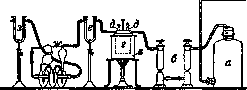
Figure 8.
which is immersed in the calorimeter. It is most convenient to take thermometer readings using a horizontally mounted telescope. Since the mercury column in very thin capillaries moves in jumps, it is useful to tap the thermometer when taking readings. For very precise measurements, it is necessary to introduce a correction for the temperature of the mercury column above the surface of the liquid being measured. This is done according to the formula ΔT = -(t₁ - t₂) × (l/L), where t₁ is the observed temperature of the liquid, t₂ is the temperature of the surrounding environment, and l is the length of the mercury column above the liquid being measured. For the accuracy of calorimetric determinations, it is extremely important that the calorimeter be located in a room well-suited for this purpose. The room should be spacious, not face the sunny side, and heating should be arranged in such a way that cold and warm air currents allow the temperature to become more or less constant. The difference in temperature between the environment and the calorimeter should not be large (not more than 3-4°). Of course, even under such conditions, heat exchange occurs between the calorimeter and the external environment, and to eliminate error in this respect, various correction methods exist. The most common correction is made according to the Regnault-Pfaundler method. Its basis is the assumption that the cooling of the calorimeter at each moment is directly proportional to the difference between its temperature and the temperature of the environment, which is considered constant throughout the experiment. Of all the apparatus described above, the most common for determining the heat of combustion is the Berthelot bomb, which is used in determining the heat of combustion of food substances. Numerous determinations of the heats of combustion of pure preparations of proteins, fats, and carbohydrates have made it possible to obtain average figures for these substances. Table of heats of combustion of various proteins, fats, carbohydrates, and other substances. Number Number Names of sub- Names of sub- stances cal- stances cal- ories ories Elastin..... Palmitic acid Albumin of milk..... Stearic acid Syntonin..... Glycerin Hemoglobin..... Dextrose Milk casein Levulose..... Galactose Milk casein Cane sugar..... Milk sugar. Vealatin..... Maltose Albumin of egg..... Starch Beef..... Glycogen Cow's meat..... Dextrin Fibrin of blood..... Cellulose Pepsin..... Urea Chondrin..... Glycocol Animal fats Hippuric acid 9.23x3 Cream..... Linseed oil Uric acid..... Olive oil Alcohol..... Average numbers: for carbohydrates-4.1 large calories, for fat:-9.45 large calories and for protein-5.65 large calories. For practical purposes it is extremely important to have average figures for the heats of combustion of these three basic substances, since, knowing them and knowing the weight of food substances, one can calculate the amount of energy produced by the organism without determining the heat of combustion of urine and feces. In practice, one has to use not the figures found by burning the substance in a calorimeter, but corrected ones. Since fats and carbohydrates burn in the body to simplest substances (water and carbon dioxide), for them only a correction for digestibility is introduced. For protein, however, it is also necessary to take into account that during its breakdown in the body, substances are formed that can themselves burn, such as urea. The digestibility of carbohydrates is considered to be 98%, fat-95% and protein-92%; the correction for the caloric value of protein breakdown products is considered to be 1.3 large calories per 1 g of protein. Thus, the corrected figures for carbohydrates are 4.1×98%=4 large calories, for fat 9.45×95%=9 large calories and for protein (5.65-1.3) ×92%=4 large calories. These are the data of American researchers.-The most common figures, however, are those found by Rubner in experiments on dogs when feeding them carbohydrates, fats, and proteins. According to Rubner: 1 g of carbohydrates gives 4.1 large calories, 1 g of fat 9.3 large calories and 1 g of protein 4.1 large calories. The Berthelot bomb, after it was adapted for elementary organic analysis, gained even greater prevalence and significance. The possibility of determining simultaneously the thermal value of a substance and its elementary composition makes this method extremely valuable and convenient for many studies of general metabolism and energy in animals and humans, when it is necessary not only to know the caloric value of food substances but also to establish the balance of certain elements in the body, for example nitrogen or carbon (see Metabolism). Biocalorimetry. Besides measuring the heat formed during the combustion of one or another chemical compound or a whole complex of chemical compounds, both in food substances and in combustible material used for fuel, there is a special branch of C., so-called biocalorimetry, which studies the processes of heat formation in the bodies of animals and humans. The first attempt to measure the heat produced by an animal dates back to 1777, but the doctrine of energy exchange developed brilliantly mainly in 1883-1885. The determination of the heat of combustion of food substances and excretory products first paved the way for so-called indirect C., i.e., the calculation of the heat produced by the organism by various methods. Among them, one can mention the calculation of the caloric value 1) from the food consumed, 2) from the O2 consumed or CO2 excreted and from the respiratory coefficient (see Gas exchange) etc. When calculating the amount of heat from one O2 , it is assumed that 1 g of oxygen with mixed food corresponds to 3.33 large calories; therefore, by multiplying the amount of O2 (in grams) consumed during the experiment, one obtains the total number of calories for that period of time. The following table by Zuntz, modified by Lusk, allows one to calculate the heat produced according to the respiratory coefficient, oxygen and CO2. Number of calories Number of calories per 1 l O2 per 1 l CO2 6.694 0.70 0.75 0.80 0.85 0.90 0.95 1.00 Consequently, knowing from experiments on gas exchange the respiratory coefficient (RQ) and the number of liters of O2 consumed or CO2 excreted, from the table one finds the thermal value of 1 l O2 or 1 l CO2 and by multiplying this value by the total number of liters, one finds the number of calories excreted during the experiment.-Besides these methods of calculation, there is the graphical method of Michaelis, which allows one to determine the number of calories corresponding to 1 l of oxygen and the percentage of calories corresponding to protein broken down in the body, or, as is customary to express it, the percentage of protein calories, if the total amount of calories excreted by the body is considered as 100. In Fig. 9, along the abscissa are plotted the values of the respiratory coefficient (RQ), while along the ordinate is the ratio of urinary nitrogen to oxygen (N/O) consumed during the same period of time. The figure shows how to use it on an example when N/O = 0.090, and RQ = 0.824. From the corresponding points of the ordinate and abscissa, dotted lines are drawn until they meet at point p. From point p, a line is drawn parallel to the oblique lines of the triangle, and on the right side of the triangle the number of calories corresponding to 1 l O2 is found. One can also find the % of protein calories if the horizontal line from point p is extended left beyond the ordinate N/O: on the line parallel to the ordinate, the percentage of protein calories is found.
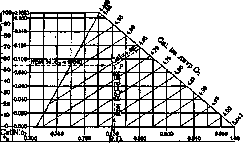
Fig. 9.
Through indirect calorimetry, the forms of thermoregulation, the isodynamic nature of food substances, and the influence of food substances on heat production (specific-dynamic action), as well as the effect of body weight on energy consumption, etc., have been studied. The introduction of methods of biological calorimetry into science made it possible to support the experimental data of indirect calorimetry. There are many instruments for measuring the amount of heat released by animals, but far from all of them have played a significant role in scientific research. This is explained mainly by errors in the construction of the apparatus. First of all, attention should be paid to the so-called air calorimeters. In 1884, several such calorimeters appeared simultaneously, built by different scientists. Geigel used the air calorimeter built by Kunkel for the human hand; it consisted of a vessel with double walls, having the shape of a hand. The amount of heat released was measured by the change in the level of liquid in a tube connected to the air space enclosed between the walls of the apparatus. In the same year 1884, d'Arsonval and Richet published descriptions of their calorimeters. Both of these calorimeters were built according to Kunkel's system. Richet's siphon calorimeter consists of two hollow brass hemispheres, which fit tightly against each other, forming an enclosure for animals inside. The upper hemisphere has a tube that connects to a special device used for measuring heat. This device consists of a bottle into which three tubes enter: one, reaching to the bottom, is connected by a rubber tube to the calorimeter, another goes to a calibrated burette, and the third, straight one, reaching to the liquid, serves for measuring pressure. When the air in the calorimeter is heated by the animal, it expands, passes into the bottle, and forces water to flow out into the burette. The amount of water flowing out is used to judge the change in air volume, and consequently, the amount of heat released. This calorimeter could be used
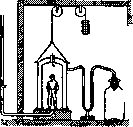
Figure 10.
only for short-term experiments, as it had no ventilation. The method of d'Arsonval is more commonly used. He used two identical cylinders with double walls, which were covered with lids also with double walls. The internal space between the walls of the cylinders themselves and their lids was connected by rubber tubes to a manometer filled with liquid. The change in pressure due to heating or cooling of the air was determined by the manometer and thus the amount of heat released or consumed was recorded. One of the cylinders remained empty, while the other contained an animal. The first gave a change in pressure due to changes in ambient temperature and barometric pressure, while the second also showed heating and expansion of the air from the animal. Later, d'Arsonval used two bells, which were fixed on the beam of a balance and immersed in liquid. A writing apparatus was fixed on one of the beams, making a record on a rotating drum. In addition, d'Arsonval built a large air calorimeter for humans, shown in Fig. 10. It is ventilated through a tube in which gas burns. Fresh air enters through a tube located above the subject's head. Heat is measured by the readings of a manometer, which on one side is connected to the air between the double walls, and on the other side to a hermetically sealed flask. The calorimeter of Haldane, White, and Washburn also deserves attention. It is arranged as follows. Two apparatuses are placed side by side, and the air between the double walls is connected to a sensitive manometer. An animal is in one apparatus, and in the other H2 burns, and its flame is regulated in such a way that the manometer remains at zero. Ventilation is the same in both parts of the apparatus. The incoming air passes through H2SO4 to remove water vapor. The amount of H2 is determined by the weight gain of the absorber with H2SO4, through which the air exiting the 'hydrogen' apparatus passes. The amount of heat released by the animal is calculated from the amount of H2 burned. This apparatus can also be adapted for respiratory
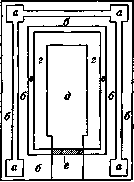
Figure 11.
experiments. Rubner's large air calorimeter is adapted for determining the heat produced, as well as the CO2 and H2O released, and makes it possible to indirectly calculate the amount of O2 consumed. If this calorimeter is compared with the apparatuses described above, it should be called a calorimeter immersed in water. The following scheme gives an idea of the construction of the calorimeter (Figure 11): d - compartment for the subject, e - door of this compartment. The space between the double walls of this compartment (g) contains a volume of air, the change in pressure of which serves as a measure of the heat released. The entire calorimeter is enclosed in a second lining, surrounding space v. The entire system is fixed and immersed in a water bath b. Here there is also a special apparatus consisting of four or five hollow bodies (a), connected to each other by tubes. This apparatus shows fluctuations in water temperature and air pressure.
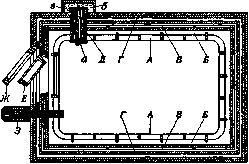
Figure 12.
The most perfected of the respiratory calorimeters can be considered the calorimeter of Atwater and Benedict. It consists of a room for the subject with double walls. The inner walls are copper, the outer ones are zinc. In one of the walls there is a window of such a size that it also serves as a door. In the other wall there is a hatch with two shutters: one from the chamber, the other external. This hatch is used for introducing food into the chamber and for removing excreta during the experiment. This calorimeter can be called a calorimeter with constant temperature, as the heat released by a person is absorbed by the flow of water passing through the system of tubes present in the apparatus. In order to achieve constant temperature in the chamber, the temperature of the incoming water and its flow rate are regulated accordingly. Figures 12 and 13 give a schematic representation of the calorimeter. The calorimeter room itself has double walls, which for protection against heat loss are additionally covered with two or three wooden cases between which there are layers of air. In the wooden cases, opposite the chamber door, there are openings closed by glass doors hinged on pivots (23, Ж). Near the door there are two openings for the incoming and outgoing water tubes. Mercury thermometers are inserted into these tubes, allowing 10ft to read the temperature of the incoming and outgoing water (Fig. 12 Г). In the original construction, the apparatus had three air layers, later it was made with two. To verify that the inner copper wall and the outer zinc wall have the same temperature, thermocouples are used, one half of which is connected to the copper wall and the other to the zinc wall. Wires from the thermocouples are led to a sensitive d'Arsonval galvanometer; in case of equal temperatures of both walls, the galvanometer needle shows no deviation. In order to determine the amount of heat released during Pressure equalization

Intake of O2

Absorber Absorber NgO I------1 Absorber I------1 NgO h,so. [-| co, |-| h,so* |- Figure 13. To determine the heat of an experiment, one needs to know the volume of water that has passed through the calorimeter and the temperature difference in the inlet and outlet tubes. Multiplying these two values gives the amount of calories released. The water meter in the calorimeter works automatically. When it fills up, an electric current is closed, the experimenter hears a bell and notes the time. Knowing the volume of the meter and how many times it fills during the experiment, it is easy to determine the total amount of water that has passed. Depending on the size of the apparatus, experiments can be conducted at rest and during work. Since such apparatus are used for long-term, daily, and longer experiments, they have all the necessary facilities for the subject's life: table, chair, bed, and in cases of studying physical work, appropriate equipment for it. Such respiratory calorimeters are made not only for humans but also for small and large animals (for rabbits, dogs, cows, etc.). These apparatus, like Rubner's calorimeter, at the same time serve as calorimeters and respiratory apparatus, as they have all the equipment for studying gas exchange (see).- In addition to air calorimeters, water calorimeters were formerly used, but due to their inertia and too slow temperature equalization, these calorimeters are now completely out of use. There is also a whole series of respiratory calorimeters for small animals. Among them should be mentioned the apparatus of Bohr and Hasselbalch, as well as the microcalorimeter of Meyerhof. The first apparatus is constructed as follows: two hollow cylinders of sheet copper are connected to each other on one side with iron wire and on the other with copper wire, so that they form a thermoelement. In one cylinder is placed a developing chicken egg, in the other-a resistance coil, through which an electric current can be sent. If the developing embryo gives off heat that heats the junction point in the first cylinder, then a thermal current is produced, which causes deflection of a galvanometer introduced into the circuit. If, however, a current is passed through the coil, then the junction point in the other cylinder is heated and a thermal current of the opposite direction is produced. One can always select such a resistance and current strength that the current arising in the first cylinder will be compensated and the galvanometer will remain at rest. Knowing the current strength and the value of the coil's resistance, one can calculate the amount of heat produced. This apparatus is connected with all the equipment necessary for studying gas exchange and thus serves as a respiratory calorimeter.-On the same principle is built the apparatus of Tangl for animals weighing 250 g, as well as the apparatus of Nuyons for small animals. Tangl's apparatus consists of a calorimeter placed in a thermostat and adapted to work at various temperatures, a galvanometer for observing the thermal current, and all the equipment for studying gas exchange.-Meyerhof's microcalorimeter is not anything new, but only a modification of previously existing apparatus. Microcalorimeters make it possible to study fermentation processes, bacterial growth, embryo development, etc. There are many modifications of microcalorimeters. Thus, Rubner used vessels with a capacity of 300 cm3 with triple walls and two vacuums. He took two completely identical vessels, in one he placed the test material and the liquid in which this material was studied, in the other-only liquid, placed both vessels in the same thermostat and observed the temperature of both vessels. From the temperature difference in these vessels, he could determine the amount of heat formed during the experiment, if the water value of the calorimeter was known to him. In this way, he determined the heat of fermentation of various sugars, the amount of heat given off by living yeast and yeast killed by toluene, etc. Meyerhof observed metabolic and energy processes in the erythrocytes of birds and humans, sea urchin eggs, etc. Korosy determined the amount of calories formed by the evaporation of ether, and Bohr and Hasselbalch in microcalorimetry also used the compensation method. Thus, calorimetry in general and biocalorimetry in particular have greatly advanced the study of metabolism and energy. It should be noted that all methods currently existing in biocalorimetry have certainly played their role in studying various life processes occurring in the body, but the greatest role has been played by those methods that allow for long-term observation, as for example in the large respiratory calorimeters of Rubner and Benedict, where the possibility of random fluctuations is excluded, and consequently also random errors. The described methods have extremely great significance, as they make it possible to study energy exchange processes in the body. The chemical energy entering our body with food can be expressed in thermal units, i.e., the amount of heat from the combustion of food substances. In the expenditure of energy, heat represents the main part. The mechanical energy expended on external work is measured in kilogram-meters, which can also be expressed in thermal equivalents, since it is known that 1 large calorie equals 427 kg/m. Atwater and Benedict in their numerous experiments with the respiratory calorimeter determined the heat balance per day in humans. The example given here shows how this balance is determined.-The subject, 22 years old, weighing 76 kg, receives 97.7 g of protein, 85.6 g of fat, and 278 g of carbohydrates in food. The heat of combustion of all these substances is determined by burning in a Berthelot bomb and gives a total of 2,519 calories. Based on metabolism experiments, it was established that the body had also expended 6.4 g of protein and 5 g of fat. Therefore, the heat intake will be as follows: with food-2,519 cal.; 6.4 g of protein correspond to 36 cal.; 5.0 g of fat-47 cal.; total-2,602 cal. The heat expenditure consists of the heat given off by the body in the calorimeter and the heat of combustion of urine and feces. The heat given off in the calorimeter-2,397 cal.; heat of combustion of urine-135 cal.; heat of feces-110 cal.; total-2,642 cal. From this example it can be seen that the difference between the amount of heat taken in by the body and given off by it lies within the limits of experimental error.-The following table, obtained from research by several authors, gives an idea of how closely the values calculated from metabolism experiments and those found in the calorimeter coincide. Authors Total number of days Calories (calculated) Calories (found) Difference In % Rubner .... Laulanie . . . Atwater and Benedict . . . Benedict and Milner . . . Benedict . . . Armsby and Fries ..... 45 7 24 53 17,406 1,865 95,075 102,078 17,350 1,859 95,689 101,356 -0.32 -0.31 -0.05 +0.65 -0.73 +0.41 These results give experimental proof of the applicability of the law of conservation of energy to the animal organism.
Related articles
Mentioned in
Cite this page
“Calorimetry.” Soviet Medical Encyclopedia. English translation of Bolshaya Meditsinskaya Entsiklopediya, 1st ed. (Moscow, 1928–1936), ed. N. A. Semashko. https://sovietmedicalencyclopedia.pages.dev/article/calorimetry/