Blood Gases
Historical document, translated for reference. It reflects medical knowledge of the 1920s–30s and is not medical advice.
Summary
This article from the 1928–1936 Soviet Great Medical Encyclopedia details the physiological role of blood gases, including oxygen, carbon dioxide, and others. It explains the physical and chemical principles of gas dissolution in blood, the concept of absorption coefficients, and the historical development of methods for extracting gases from blood.
Encyclopedia article (1928–1936)
BLOOD GASES. Blood, representing the internal environment of the organism, is also a mediator between the cellular elements of the body and the external environment in the matter of gas exchange, delivering oxygen to the former from the outside and transporting carbon dioxide, formed in the tissues, to the external environment. Furthermore, flowing through the vessels of the lungs and intestines, blood is to one degree or another saturated with gases present in these cavity organs: nitrogen and argon in the lungs, hydrogen and methane in the intestines. Finally, there are indications that carbon monoxide (CO) is always contained in the blood, albeit in negligible quantities. In blood, as in any liquid containing various substances in solution, gases can exist in a state of 1) simple physical dissolution, 2) weak chemical bonding, and 3) strong chemical combination. Simple physical dissolution (absorption) takes place when a liquid comes into contact with a gas that is chemically indifferent to it. If the liquid is not agitated with the gas, then the dissolution of the gas always occurs slowly and the amount of gas in the liquid increases gradually. Eventually, a moment arrives when further dissolution ceases, and from this moment the amount of gas in the liquid remains constant. What is called the saturation of a liquid with a gas has occurred. According to the kinetic theory of gases, a gas consists of separate, perfectly elastic particles possessing rapid rectilinear motion, colliding with each other, rebounding from one another, and thus constantly changing the direction of their motion. However, the total sum of motion, due to the perfect elasticity of the particles, remains unchanged, and the particles are evenly distributed throughout the entire volume occupied by the gas. The pressure of the gas on the walls of the vessel containing it is determined by the impacts of the gas particles against these walls, and it is clear that the more gas particles there are in a given volume, i.e., the more compressed the gas is, the greater its pressure on the walls will be. This is expressed in the well-known Mariotte's Law, according to which, with an unchanging amount of gas, its volume and pressure are in an inverse proportional relationship, i.e., p*v=const., where p is pressure and v is the volume of the gas. If now one of the surfaces bounding the gas is the surface of an indifferent liquid, then the gas particles, striking it, will push apart the liquid particles and penetrate deep into it. With constant gas pressure above the liquid, the number of its particles penetrating into the liquid per unit of time will remain constant. Simultaneously with this, however, a process of the reverse order arises, since the gas particles that have penetrated into the liquid continue their motion there, and some of them approach the surface of the liquid and exit it again into the gaseous medium. This process must obviously become more and more intense as the number of gas particles that have entered the liquid increases, and finally, a moment arrives when, in the same unit of time, the number of gas particles entering the liquid and exiting it becomes equal. This state of dynamic equilibrium, at which the amount of gas in the liquid remains constant, represents the state of saturation of the liquid with the gas at a given pressure and a given temperature. According to the Henry-Dalton Law, if a mixture of gases chemically indifferent to the liquid is in contact with it, then each of the gases in the mixture is absorbed by the liquid in accordance with its partial pressure (by the latter is understood that part of the total pressure of the mixture which falls to the share of each gas individually; e.g., with a total atmospheric pressure of 760 mm and a content of 21% oxygen and 79% nitrogen, the partial pressure of the 1st would be (760*21)/100 = 159.6 mm, and of the 2nd (760*79)/100 = 600.4 mm). Considering partial pressure as a force driving the gas into the liquid, the force causing the gas to exit the liquid should be considered as a force equivalent to the partial pressure, but of the opposite direction. This force is designated as the "tension of the gas in the liquid." At established equilibrium, the tension of the gas in the liquid is equal to the partial pressure of the gas above the liquid, which makes it possible to quantitatively determine the tension of the gas in the liquid. Experiments have shown that one and the same liquid absorbs various gases indifferent to it under identical conditions of temperature and pressure in different quantities, and on the other hand, one and the same gas, also under identical conditions of temperature and pressure, dissolves in different liquids in different quantities. In view of this, Bunsen introduced the concept of the absorption coefficient. The absorption coefficient of any liquid with respect to any gas is called that volume of gas, measured at 0° and 760 mm of pressure, which dissolves in 1 cubic cm of liquid upon its saturation with the gas under a pressure equal to 760 mm. Its magnitude depends on the nature of the liquid and the gas and on the temperature, but does not depend on the pressure. With an increase in temperature, the absorption coefficient falls in a peculiar way in each individual case (and therefore is determined empirically for each gas), but at the boiling point of the liquid it is always equal to zero, since under this condition a layer of vapor forms above the surface of the liquid, in which the partial pressure of the gas = 0. Furthermore, the absorption coefficient generally falls if solid bodies are dissolved in the liquid, whereby bodies with a lower molecular weight lower it more, and vice versa. Below are the absorption coefficients of oxygen, nitrogen, and carbon dioxide for water and blood according to Bohr (see table on p. 199). Knowing the partial pressure of the gas during saturation and the absorption coefficient, one can calculate the amount of gas dissolved in the liquid using the formula: q = (a*v*p)/760, where q is the amount of cubic cm of gas at 0° and 760 mm, a is the absorption coefficient of this gas, v is the volume of the liquid participating in the absorption, and p is the partial pressure of the gas. The described case of simple physical dissolution is a case of the greatest mobility of gas in a liquid, when the content and tension of the gas in the liquid change in exact accordance with the fluctuations of the partial pressure of the gas. The dissolved gas can, therefore, be extracted from the liquid either by placing the latter in a vacuum, which is constantly renewed, or by passing a stream of another indifferent gas through the liquid, or, finally, by bringing it to a boil. The direct opposite is the case of strong chemical combination, e.g., during the absorption of CO2 by a NaOH solution, when it is a matter of a purely chemical process, in which the quantitative ratios are constant and are determined by the chemical formula of the process. The gas absorbed in this process is bound so strongly that it is almost not released either into a vacuum or upon boiling the liquid, and its tension in the liquid remains close to zero right up to the saturation of chemical affinity. Complete release of gas from a liquid is practically possible only through the combined action of physical agents (vacuum or boiling) and appropriate chemical reagents that decompose the formed compound. An intermediate place between physical absorption and strong chemical combination is occupied by the case of weak chemical bonding, when the gas also enters into a chemical compound (in equivalent ratios), which, however, easily undergoes dissociation, i.e., decomposition. Upon heating the liquid or lowering the pressure, a portion of the bound gas immediately becomes free, thanks to which an extremely gradual transition from complete saturation to complete dissociation becomes possible. A very characteristic property of the weak chemical bonding of gas in a liquid is the sharply expressed dependence of gas absorption on pressure in the low ranges of the latter, whereby even then more gas is absorbed than would be the case if simple physical dissolution were taking place. With an increase in pressure, the amount of absorbed gas increases rapidly at first, and then more and more slowly (see below the curves of oxygen and carbonic acid absorption by blood). From what has been said, it follows that gas found in a liquid in a dissociating compound can be extracted from the liquid by the same methods as gas simply dissolved in it. Proof of the presence of gases in the blood was first given by Boyle in 1636 by means of pumping them out of the blood with an air pump. In 1674, John Mayow found that oxygen is part of the composition of blood gases, and Humphry Davy in 1799 proved the presence of carbon dioxide in them. However, the investigation of the quantitative composition of blood gases was unsatisfactory even in the works of Magnus (1845), and only in 1859 did Sechenov, working in Ludwig's laboratory, first propose and implement a method for the complete extraction of gases from blood using a renewable Torricellian vacuum. All subsequent numerous modifications of mercury pumps for extracting gas from blood are based on Sechenov's principle. Fig. 1 shows a diagram of Pfluger's modification. A glass bulb A, with a capacity of 250-300 cubic cm, with stopcocks a and b, serves as a receiver for the blood. Stopcock a has a passage along the longitudinal axis that opens to the outside.
This passage can lead either to the receiver (position 1) or downwards to the outside (position 2). By means of a mercury pump (E and F), all air is pumped out of A. Having weighed A, the branch of the stopcock a is connected to the artery or vein of the animal, and with the stopcock in position 2, all connecting passages and stopcock a are filled with blood, allowing a small amount of blood to flow out of it, and then the stopcock is turned to position 1 and the desired amount of blood is let into A. After this, the stopcock is turned to position 2, it is carefully cleaned, and A is weighed again. The difference in weight will give the amount of blood taken. Receiver A is connected by a ground-glass joint to receiver B for the foam formed during the release of blood gases from the blood, and the latter is connected to tube C, the bends of which are filled with pieces of pumice,
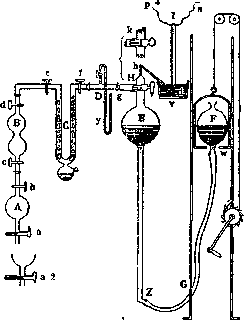
Figure 1. Scheme of a mercury pump for the extraction of blood gases (built on the principle of I. M. Sechenov and modified by Pflüger). Explanation of operation is in the text.
moistened with sulfuric acid (excess acid collects in the lower bulb of the tube); C serves to absorb water vapor and, through tube D, which carries a small barometer y (for measuring the degree of vacuum), is connected to the process d of stopcock H of bulb E. E and F are connected to each other by a rubber hose and are the mercury pump itself. Through F, both bulbs are filled with mercury slightly more than half full, and then, by raising F, the air is displaced from E by the mercury through the stopcock (position k) and the outlet tube hi, which is lowered into a bath (v) with mercury. When this entire system is filled with mercury, the stopcock is turned to position H and, by lowering F, air is sucked into E from all other parts of the apparatus (A, B, C, and D), displaced again through r, and this procedure is repeated until the barometer y indicates zero pressure in the apparatus. Then, having disconnected A from the apparatus, it is weighed, blood is drawn into it, and it is reattached to the apparatus, which is again evacuated with stopcock b closed, and after this, b is opened and by repeated evacuation all blood gases are collected through r into eudiometer I for analysis. It is very important that the blood from the blood vessel immediately enters an airless space and is quickly freed from blood gases, because otherwise the amount of oxygen turns out to be somewhat underestimated, and the amount of carbon dioxide overestimated. Later designs of pumps for blood gases by Toepler-Hagen or Bohr (Toepler-Hagen, Bohr) provide greater convenience and greater speed of operation. Sechenov, Pflüger, Zuntz, Bohr, and others showed that with the help of a renewable vacuum, all gases are obtained from whole blood without residue, while from plasma or serum, a portion of carbonic acid is obtained only upon the addition of a stronger acid (phosphoric or tartaric). The following table shows the average figures for the percentage content of oxygen and carbon dioxide in the arterial and venous blood of various animals. Animals Dog. Horse Ram. Rabbit Chicken Duck. . Oxygen Carbon Dioxide Arter. Ven. Arter. Ven. blood 20.7 blood 13.2 blood 39.4 blood 47.2 14.0 6.7 39.4 55.9 10.7 5.4 45.1 55.5 13.2 34.0 10.7 4.1 48.1 57.5 14.9 7.1 45.6 55.7 From the table, it is evident that the blood of herbivores and birds contains less oxygen and more carbon dioxide than the blood of omnivores (dogs). It should be noted, however, that even in the same species, e.g., dogs, extremely large fluctuations are observed. Pflüger, for example, gives 13.6-25.4% for oxygen in the arterial blood of a dog. These individual and species fluctuations may depend on the different Hb content in the blood and on the different "oxygen capacity" of hemoglobin. As for human blood gases, the first direct determination of them in arterial blood using a pump was performed by Sechenov: he found 21.6% O2, 40.3% CO2, and 1.6% N. Later authors either determined with a pump the amount of oxygen bound by human blood after shaking it with atmospheric air (Loewy), or conducted the determination of blood gases by the Haldane-Barcroft method, described below. In general, the obtained numbers
40 60
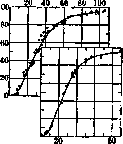
Figure 2. Oxygen saturation curve of human blood at different partial pressures of the latter (according to Barcroft). The blood is in interaction with CO2 at a tension of 40 mm. The abscissa axis shows O2 pressures, and the ordinate axis shows the degree of oxygen saturation of the blood. are close to Sechenov's numbers, and as average figures at the present time, 20% O2, 43% CO2, and approx. 1% N are accepted for human arterial blood, and for venous blood - 12% O2, 50% CO2, and approx. 1% N. The possibility of complete extraction of blood gases into a vacuum showed that the gases are in the blood either in a state of simple solution or in weak chemical combination. If, however, one performs a calculation using absorption coefficients for water as an indifferent liquid, then only the amount of nitrogen obtained from the blood satisfies this calculation more or less, while the amount of O2 and CO2 significantly exceeds possible dissolution. Pumping out plasma (resp. serum) and corpuscles (blood cells) separately showed that oxygen in plasma is only dissolved, while the main mass of it is chemically bound to red blood cells, namely their hemoglobin (see); carbonic acid is chemically bound both in the plasma (about 2/3) and with the corpuscles (about 1/3). Figure 3. Oxygen saturation curves of a hemoglobin solution at temperatures of 38° (I), 32° (II), 26° (III), and 14° (IV) (according to Barcroft). Figure 4. Oxygen saturation curves of dog blood at various O2 and CO2 tensions and at t° 38° (according to Bohr). Chemical binding of O2 and CO2 in the blood gave Haldane (1900) the basis for developing a chemical method for determining the amount of blood gases bound chemically. The Haldane principle (displacement of chemically bound oxygen with a solution of K3Fe(CN)6, and CO2 with a 20% solution of tartaric acid) is widely used at the present time in the Barcroft modification, which makes it possible to operate with small amounts of blood: 1.0-0.1 cubic cm (for details, see the article Barcroft apparatus). For a detailed clarification of the conditions of chemical binding of gases by a liquid, it is not enough to investigate the release of gases from it, but it is necessary to study the conditions of gas entry into the liquid, i.e., its absorption, as by observing the absorption of gases at different partial pressures, it is easy, firstly, to draw a conclusion - whether there is only simple dissolution present, i.e., proportional to pressure, and, secondly, to clarify the scale of chemical absorption depending on the partial pressure of the gas, t°, and various substances dissolved in the liquid. Similar "absorptiometric" studies of whole blood and its individual components were carried out on a large scale by Sechenov, Zuntz, Hüfner, Bohr, Haldane, Barcroft, and others. The results of these studies are briefly illustrated by figures 2-6. Figure 2 gives the oxygen saturation curve of human blood at different partial pressures and with simultaneous interaction of the blood with CO2 at a tension of 40 mm (according to Barcroft). The curves relate to two different subjects and are calculated from individual determinations indicated by dots. Figure 3 presents the oxygen saturation curves of an Hb solution at different t° according to Barcroft, namely I-at 38°, II-32°, III-26°, and IV-14°. Figure 4 presents the oxygen saturation curves of dog blood at various O2 and CO2 tensions and at t° 38° according to Bohr. The abscissa indicates the partial pressure of O2, the ordinate indicates the percentage of oxygen saturation, and the curves themselves indicate the CO2 tension. Figure 5, demonstrating the influence of electrolytes on oxygen absorption, shows the oxygen saturation curves of a dialyzed and non-dialyzed Hb solution according to Barcroft. The curves are constructed from individual observations indicated by circles, and curve I relates to the dialyzed solution, and curve II to the non-dialyzed one. Finally, Fig. 6 illustrates the binding of carbon dioxide by blood at body temperature, according to Haldane. (Regarding the exchange of gases between blood and pulmonary air, blood and tissues - see Respiration.)
Related articles
Mentioned in
Cite this page
“Blood Gases.” Soviet Medical Encyclopedia. English translation of Bolshaya Meditsinskaya Entsiklopediya, 1st ed. (Moscow, 1928–1936), ed. N. A. Semashko. https://sovietmedicalencyclopedia.pages.dev/article/blood-gases/