Dwarfism
Historical document, translated for reference. It reflects medical knowledge of the 1920s–30s and is not medical advice.
Summary
Dwarfism is growth that does not reach the lower limit of normal (130 cm for men and 121 cm for women, according to Martin). Various mechanisms can lead to growth retardation, including endocrine disorders, external conditions, infections, and intrauterine damage.
Encyclopedia article (1928–1936)
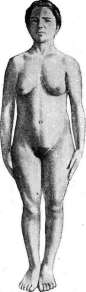
Dwarfism (synonyms: nanism, microsomia, nanosomia), growth that does not reach the lower limit of normal (130 cm for men and 121 cm for women, according to Martin).- Diverse mechanisms can lead to growth retardation. A number of endocrine glands have a significant influence on growth (thyroid gland, anterior pituitary, thymus, adrenal cortex, pineal gland, etc.), but it is not yet possible to say with certainty to which clinical types of dwarfism this influence applies. Only thyroid and pituitary nanism can be clinically differentiated. But other causes as well: unfavorable external conditions, famine, infections, intoxications (tuberculosis, syphilis), diseases of the brain in childhood (hydrocephalus, microcephalus), etc., and finally intrauterine damage can cause a sharp delay in growth. The delay can affect the entire skeleton or its individual parts. In the latter case, sharply disproportionate forms of dwarfism arise. Usually, however, dwarfs retain childlike body proportions except for the miniature type, or primary nanism, where body proportions are normal. Therefore, proportional and disproportionate forms of dwarfism are distinguished. This feature is the basis of schemes that facilitate the recognition of various types of dwarfism. Hansemann distinguishes proportional dwarfism [primary nanism (nanosomia primordialis; fig. 1), infantile, endocrine] and disproportionate [chondrodystrophic (fig. 2), rachitic (fig. 4)]. Primary nanism is characterized by the fact that at birth, height and weight are significantly below normal, development is normal but greatly slowed. Gas exchange, cardiovascular system, endocrine glands, psyche-unchanged. Ossification occurs on time. Such dwarfs represent a miniature type of normal human.-In infantile dwarfism, there is retardation not only of growth but also of development, remaining at a child level. Such patients are born normal, but then due to poor external living conditions, abnormalities of the circulatory and respiratory organs, diseases of the brain, chronic malaria, etc., a delay in growth and development occurs ('dystrophic infantilism'). The cause may also lie in the genotype. In infantile dwarfs, childlike body proportions are often retained, ossification is delayed. The sex organs are also retarded in development. Secondary sexual characteristics are absent. The other endocrine glands remain at a child level of development. The heart and blood vessels are hypoplastic. The psyche is also infantile, i.e. corresponds
sh 10,
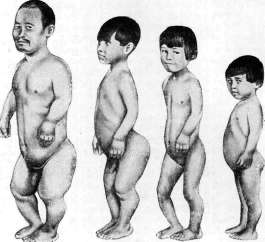
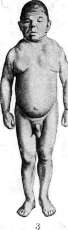
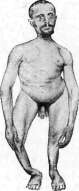
Figure 1. Pure dwarfism, a 24-year-old girl (observation by Slonimskaya). Figure 2. Family of chondrodystrophics - father and three children (from Molchanov). Figure 3. Dwarf, 35 years old, with congenital myxedema (from Tsondek). Figure 4. Rachitic dwarfism (from Bauer). Figure 5. 16-year-old dwarf, senile facial expression (from Bauer). Figure 6. Pituitary dwarfs (brother and sister-16 and 17 years old).
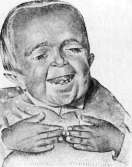
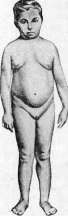
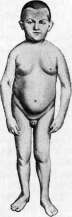
To the article Dwarfism. the level of development at which the patients stopped. The degree of infantilism depends on the time the retarding development factor begins to act. Sometimes by the time of puberty, infantile dwarfs begin to grow and develop rapidly. Therapy lies in eliminating the retarding development factor.-In congenital myxedema (see), in addition to its general signs (changes in skin, chilliness, reduced gas exchange, etc.), there is a sharp delay in growth (in severe cases below 100 cm) (fig. 3). Epiphyseal sutures remain open for a very long time, ossification nuclei appear extremely late. The sex organs are hypoplastic. In most cases, the psyche is markedly retarded in development and in severe cases reaches the state of idiocy. All these signs of thyroid deficiency quickly pass after treatment with thyroidin, which in doubtful cases can facilitate diagnosis. In endemic cretinism, disorders of growth and psyche often correspond to the same disorders in sporadic cases. Treatment with thyroidin gives improvement, but far from always.-With damage to the anterior pituitary in a growing organism, a sharp delay in growth and sexual development occurs (fig. 6). Ossification nuclei are absent for a long time. Epiphyseal sutures close late. Proportions remain childlike. At the same time, premature aging is noted (fig. 5). The skin is wrinkled and lacks a fatty layer (geroderma). There may be fat deposits on the pubis, abdomen, and chest. On the X-ray, the size of the Turkish saddle is often small or it is deformed, and sometimes enlarged due to the presence of a tumor. Brain symptoms are usually absent. The psyche is not particularly affected and corresponds to the age. In some cases, treatment with preparations of the anterior pituitary caused increased growth. With premature sexual development, growth retardation may occur due to rapid ossification and closure of epiphyseal sutures. Initially, such children grow rapidly, but then growth stops, and they lag behind their peers.-Many authors point to dwarfism due to damage to the adrenal cortex, but sufficient evidence for this is still lacking. Combined forms of endocrine dwarfism also occur due to damage to the pituitary and thyroid glands. In chondrodystrophy, there is a sharp delay in growth in cartilaginous bones, beginning already in utero. The extremities are very short with a normal trunk length (micromelia). Internal organs, metabolism, endocrine system-within normal limits. The psyche is completely normal, and many chondrodystrophic dwarfs have increased mental abilities.-In rickets (see), there is also a relative shortening of the extremities; but, unlike the previous form, the bones are not so much shortened as curved. At the same time, there are also other signs of rickets. The psyche, internal organs and endocrine system are normal.
I. Barenblat. From a biological point of view, dwarfism is a sign of great heterogeneity. On the one hand, here there are various forms caused by external factors, on the other hand-forms depending on anomalies of genotypic structure. The latter group undoubtedly includes primary dwarfism (nanosomia) both with preservation of adult proportions and with infantile proportions (ateliosis), and achondroplasia (see). But it is very likely that some other forms of dwarfism, whose genetics is still little studied, will have to be included in this same group. However, neither primary dwarfism nor achondroplasia can be considered as definite, strictly delimited nosological units; what is currently known about the heredity of these anomalies forces one to consider them as artificial composite groups uniting a number of similar phenotypes, but not homogeneous in their genotype. Thus, achondroplasia (since pelvic deformation in women does not prevent childbirth) is known in a number of families as a dominant anomaly; apparently independent are also milder, also dominant disorders-chondrohypoplasia and brachydactyly; but from I
sh"t-vestna and recessive
..,,[,.,. naia achondroplasia, p
i A A i A 61l~„ which proved
Ml
T~ fl by analysis of healthy
I I I ' I and sisters (not many IV j o o j o j patients in this group served as even for
Scheme 1. Dominant type of inheritance (by Schell). water to assume a dihybrid recessive heredity), as well as the frequency of blood relationship of parents in this group. Mutations, in many ways similar to human achondroplasia, are also known in animals (Ancon recessive breed of sheep with crooked legs and short back, dominant leg structure in dachshunds).-Primary dwarfism is also heterogeneous. Some cases are inherited by a recessive type (scheme 2): the trait is found in several brothers and sisters, children of healthy parents (according to Weinberg, about */* of the offspring are affected, which corresponds to monohybrid recessive heredity). However, here one cannot think only of one gene; thus, there is a known case where 2 dwarf parents had offspring of normal growth; which means the parents were carriers of heterogeneous hereditary factors of dwarfism. In addition, there are families in which dwarfism was transmitted directly from parents to children through a number of generations as a dominant trait (scheme 1).Thus, the genetic study of the entire group of dwarfism reveals its internal heterogeneity and cannot yet be considered completed, just as the study of normal growth factors is not yet completed (according to Davenport-a series of unambiguous, growth-retarding dominant genes).- The races of pygmies, both in humans and in some feral domestic animals (for example, the dwarfing of horses on Sable Island in Nova Scotia, according to Saint John), apparently formed in a complex way as a result of natural selection of short-statured individuals. It is possible that in some similar cases the dwarfing of a breed appears phenotypically as a result of the direct influence of unfavorable environmental conditions that directly retard the development of the individual.
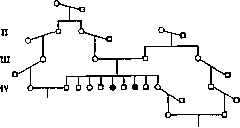
Scheme 2. Recessive type of inheritance (by Hanhrt'y).
s- Davidenkov.
Related articles
Mentioned in
Cite this page
“Dwarfism.” Soviet Medical Encyclopedia. English translation of Bolshaya Meditsinskaya Entsiklopediya, 1st ed. (Moscow, 1928–1936), ed. N. A. Semashko. https://sovietmedicalencyclopedia.pages.dev/article/dwarfism/