Gas Cell
Historical document, translated for reference. It reflects medical knowledge of the 1920s–30s and is not medical advice.
Summary
This article from the 1928–1936 Great Medical Encyclopedia describes the gas cell, an apparatus for electrometric measurement of hydrogen ion concentration based on Nernst's theory of concentration cells. It details the principles of electrode potential, solution pressure, concentration cells, and the specific application of the hydrogen electrode.
Encyclopedia article (1928–1936)
GAS CELL, an apparatus for the electrometric measurement of hydrogen ion concentration. The gas cell is based on the theory of the galvanic cell proposed by Nernst and represents a special case of so-called "concentration cells." - Principle of the concentration cell. When a solid body is immersed in water, its molecules dissolve until a saturated solution is obtained. In the latter, the osmotic pressure of the dissolved molecules exactly balances the tendency of the solid body to pass into solution, i.e., its "solution tension." A solution having a greater concentration is supersaturated, and the dissolved molecules precipitate from it onto the surface of the solid body. Metals are distinguished by the feature that their atoms pass into solution in the form of positively charged ions, leaving a negative charge on the metal surface. The significant potential difference arising as a result of this between the metal (metal electrode) and the solution rapidly halts the further dissolution of metal ions and is the sole sign of their partial, infinitesimally small dissolution. The greater the magnitude of this so-called "electrolytic solution tension," the stronger the electrical charge and the higher the electrical potential acquired by the metal in solution. It has the smallest magnitude in noble metals and rapidly increases in the Volta series. If increasing quantities of a salt of a given metal are introduced into a solution, the osmotic pressure of its ions will weaken the tendency of the metallic cations to pass into solution, and consequently will also decrease the electrical potential acquired by the metal electrode. When the concentration of metallic cations exactly balances the electrolytic solution tension of the metal, the latter turns out to be completely devoid of charge. At an even greater concentration, dissolved metal ions begin to precipitate onto the electrode, imparting a positive charge to it. According to Nernst, the electrode potential is equal to -- In -, where R is the gas constant, T is the absolute temperature, n is the valence, c is the concentration of metal ions, C is a constant characterizing the solution tension of the given metal, and In is the natural logarithm. If the same metal in a salt solution of a different concentration is taken as the second electrode, and a liquid contact is established between both solutions and a metallic connection between both electrodes, then in such a case a concentration element, or concentration cell, is obtained. Its EMF (electromotive force) is equal to the difference in potentials of both electrodes: E = RT/n ln c1/c2 (1). It can easily be calculated if the concentrations c1 and c2 of both solutions are known; conversely, by measuring the EMF and knowing the concentration of a given ion in one solution, its concentration in any other solution can be calculated. This is precisely the principle of using concentration cells for the electrometric measurement of the ionic concentration of a studied solution. Hydrogen electrode. A necessary condition for such an application of a concentration cell is the presence of a corresponding so-called reversible electrode, consisting of the same material as the studied ion and being in equilibrium with its aqueous solution. This condition is directly feasible for only a few ions. For a number of others, it is possible to approach it by using certain artificial techniques. They are based on the circumstance that substances having a high solution tension, when mixed with noble, electrolytically inactive metals, yield the same electrode potential as in pure form. Taking advantage of this important property, in recent years it has been possible to develop an electrometric method for measuring the concentration of alkali and alkaline-earth cations. Preparing electrodes from these metals is impossible in view of their extreme instability with respect to water. However, in combination with mercury, in the form of amalgams, they yield corresponding concentration cells and make it possible to determine the ionic concentration of such cations as Na, K, and Ca, for the measurement of which no precise method has existed until now. Despite the considerable experimental difficulties of this method, its application opens up interesting prospects for biological research. The same principle was applied even earlier for the electrometric measurement of hydrogen ion concentration. The task of preparing a hydrogen electrode is successfully resolved thanks to the fact that platinum, having adsorbed hydrogen on its surface, behaves like a hydrogen electrode possessing metallic electrical conductivity. Therefore, platinum (or another noble metal, e.g., palladium), coated with platinum black to enhance adsorption, is placed in a hydrogen atmosphere. By immersing two such electrodes in two solutions containing different concentrations of H-ions, a "hydrogen cell" is obtained, the EMF of which depends on the concentration of hydrogen ions in both solutions (or rather, on their ratio). The role of the electrode is played in this case, in essence, by the corresponding gas, which is why such a concentration cell is called a "gas cell." Various gas cells are possible. However, among them, only the hydrogen cell has acquired great practical significance, representing the main and most precise method for measuring the concentration of hydrogen ions, and consequently also the reaction of the studied solution (see Active reaction and hydrogen ions).
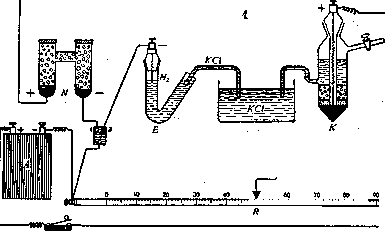
E is the hydrogen electrode; K is the calomel electrode; C is the capillary electrometer; N is the standard cell; A is the accumulator; R is the slidewire. In the 1st position of the switches, the standard cell (N) is switched on, with the help of which the EMF of the accumulator (A) is checked. In the 2nd position, the EMF of the cell consisting of the hydrogen (E) and calomel (K) electrodes, connected by a saturated KCl solution, is measured. Structure of the hydrogen cell. According to equation (1), the EMF of the hydrogen cell is E = RT/n ln [H]1/[H]2. Passing from natural logarithms to decimal ones and substituting the numerical values of R and T (for 18°), we find (in volts): E = 0.058 (log [H]2 - log [H]1). It is currently accepted to express the concentration of hydrogen ions by its negative decimal logarithm, which has been named the hydrogen exponent, pH (= -log [H]). Introducing it into our formula, we get: E = 0.058 (pH1 - pH2).
[This paragraph is an unrecoverable OCR artifact containing fragmented letters and layout symbols, retained for structural completeness.]

[This paragraph is an unrecoverable OCR artifact containing fragmented letters and layout symbols, retained for structural completeness.]
(2). A difference in the value of the hydrogen exponent by one unit (i.e., a tenfold change in the concentration of hydrogen ions) thus corresponds to a potential difference of approximately 58 millivolts. By making measurements with an accuracy of up to half a millivolt, it is possible to determine down to 0.01 pH. The hydrogen chain is composed of two halves, two hydrogen electrodes immersed in different solutions; they act as sort of "half-elements" that together produce a concentration galvanic cell. In order to use equation (2) to determine the hydrogen exponent in the solution under study, the latter must have a known, strictly defined value in the second solution. For this purpose, one can use the so-called "normal hydrogen electrode," i.e., a hydrogen electrode immersed in a normal solution of a strong acid. In this case, the concentration [H+] is approximately equal to unity, pH(0) = 0, and the calculation of the desired pH takes a very simple form (for 18°): (3), where E is expressed in millivolts. Although calculations using a normal hydrogen electrode are simple, in practice it turns out to be more convenient to use another electrode as the second constant half-element. Therefore, at present, a calomel electrode is used, which is a highly precise and constant device that does not have to be prepared anew before each experiment, but can be kept indefinitely. It consists of a mercury electrode in contact with a saturated solution of calomel (HgCl) in potassium chloride (see figure 1, K). Thus, in practice, only one half-element—only the electrode immersed in the solution under study—is a hydrogen electrode. However, knowing the potential difference between the calomel and normal hydrogen electrodes, it is easy to introduce the corresponding correction to the measured value and perform all further calculations just as accurately as when using the complete hydrogen chain described above. For other temperatures, as well as depending on the barometric pressure (upon which the pressure of the hydrogen atmosphere around the platinum electrode depends), it is necessary to introduce appropriate corrections. Of great importance is also the method of connecting the two half-elements that make up the gas cell. H=58 At the point of contact of two different solutions, due to the unequally rapid diffusion of ions of opposite sign, a so-called diffusion potential difference arises, which is added to the electrode potential difference underlying our measurement. It can be almost completely eliminated by using a saturated KCl solution to connect both liquids (K and Cl ions have approximately the same mobility; this salt therefore does not produce a diffusion potential difference). To give such "electrolytic contacts" sufficient strength, the KCl solution is often prepared in the form of a solid gel with agar-agar. The remaining parts of the electrometric setup serve to measure the potential difference between the hydrogen and calomel electrodes. The measurement is carried out according to the compensation method using a Wheatstone bridge (see figure 1, R). Types of electrodes. Many different designs of the hydrogen electrode have been proposed. First of all, mention should be made of the "pear-shaped electrode," which has a convenient system of ground glass stopcocks for passing hydrogen through the solution (see figure 2). Passing a current of hydrogen is unacceptable in cases where the test liquid contains significant amounts of CO2. The latter would be removed by the current of passing gas, which would significantly shift the reaction to the alkaline side (as indeed occurred during the first attempts at electrometric measurement of blood reaction). One has to limit oneself to the smallest possible volume of hydrogen, in which the partial pressure of CO2 corresponding to its content in the solution is quickly established. An electrode of this type (suitable for measuring blood pH) is the so-called "U-shaped electrode" (see figure 3). Schade proposed a "subcutaneous electrode" for measuring the reaction of tissue fluid in living tissue (see figure 4); the electrode is inserted by a subcutaneous injection. In many cases, it is necessary to measure extremely small quantities (down to a single drop) of the test liquid. For this purpose, various microelectrodes have been proposed, an example of which is the Lehmann microelectrode (see figure 5) or its modification according to Radzymovska (see figure 6). --- Quinhydrone electrode. Recently, a special type of hydrogen electrode has become quite widespread—the so-called quinhydrone electrode introduced by Bilmann. Quinhydrone is a compound (in an equimolar proportion) of quinone (C6H4O2) and hydroquinone (C6H4(OH)2). In solution, both of these substances are in equilibrium according to the equation: C6H4(OH)2 ⇄ C6H4O2 + H2. Thanks to this reaction, there is no need to pass hydrogen: when a small amount of quinhydrone is added to the solution, the electrodes behave as if they were in equilibrium with a certain (extremely low) pressure of gaseous hydrogen. It is possible to construct a concentration cell from two quinhydrone electrodes (one of which is immersed in a solution of known pH, the other in the measured one) or from a combination of a quinhydrone electrode with a constant calomel one. An example of a quinhydrone electrode for small quantities of liquid is the Mislowitzer syringe electrode (see figure 7). In the quinhydrone electrode, the potential is established so quickly that a blood sample taken using such a syringe can be measured before it has time to clot. At an alkaline reaction, as well as at a very acidic one (pH < 2.5), quinhydrone electrodes are inapplicable.
Related articles
Cite this page
“Gas Cell.” Soviet Medical Encyclopedia. English translation of Bolshaya Meditsinskaya Entsiklopediya, 1st ed. (Moscow, 1928–1936), ed. N. A. Semashko. https://sovietmedicalencyclopedia.pages.dev/article/gas-chain/