Galvanic Cells
Historical document, translated for reference. It reflects medical knowledge of the 1920s–30s and is not medical advice.
Summary
This article explains the fundamental principles of galvanic cells as described in the 1930s. It details the Voltaic contact potential difference and the mechanism by which chemical reactions between metals and liquids generate a continuous electric current.
Encyclopedia article (1928–1936)
GALVANIC CELLS, a combination of metals and liquids that allows for the generation of a constant (galvanic) electric current due to chemical reactions occurring between the metals and the liquids. The theory of galvanic cells is based on the following two rules, first discovered by Volta. If there are two metals: A and B (see Figure 1), then by touching metal A to metal B, a specific potential difference, a voltage difference (the so-called Volta contact potential difference), is obtained between them, and if the potential of A is equal to a and the potential of B is b, then a potential jump of b - a is obtained at C. If individual metals are connected, a potential difference will always be established between any two successive metals, and if such a circuit is closed, there will be no flow of electricity through the circuit, since the total sum of all electromotive forces in the circuit will be equal to zero. This is easy to see if two metals are connected in a ring (see Figure 2); then it is clear that there will be jumps equal to b - a between A and B at points C and D, and electricity will not move. The second rule is that if two metals are connected by means of a current-conducting liquid, the liquid will equalize the potential difference of the metals that arises upon the contact of the two metals. Suppose there is a round zinc plate Z0 having a potential V (see Figure 3),
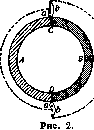
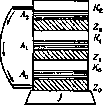
Figure 3.
let us place it on an insulator J. If a disk of cloth A0 soaked in weak sulfuric acid is placed on Z0, and a copper disk K0 is placed on top of it, then the latter will receive a potential V, since the conducting liquid located between the metals equalizes their potentials. The next zinc disk Z1 will receive a potential V+a, thanks to the contact potential difference of copper and zinc, which is equal to a. The copper disk K1, separated from Z1 by a layer of sulfuric acid soaking the cloth A1, will have the same potential. A disk of zinc Z2, placed on the copper K1, will have a potential V+2a. The copper disk K2, separated by sulfuric acid from Z2, will have the same potential. If one has n pairs of zinc-sulfuric acid-copper, then the last pair will receive a potential V+na, and, consequently, the copper of the last pair Kn will have a potential V+na, and the zinc of the first pair Z1 will have a potential V. By connecting
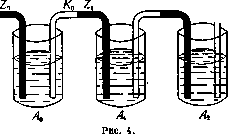
Kn and Z0, we will obtain a current flowing in the external circuit from copper to zinc. The positive pole of the battery is located where a copper disk follows a cloth disk, and the negative pole is where a zinc disk follows a cloth disk. The indicated device bears the name of a Voltaic pile (or battery), provides a continuous transfer of electricity from one end of the battery to the other, and is a source of constant current. The current, however, weakens over time, which depends on chemical phenomena in the individual groups consisting of zinc - sulfuric acid - copper.
This phenomenon bears the name of battery polarization. A battery of a convenient type is presented in Fig. 4, where K, Z, and A represent the copper and zinc parts and the acid.
Related articles
Mentioned in
Cite this page
“Galvanic Cells.” Soviet Medical Encyclopedia. English translation of Bolshaya Meditsinskaya Entsiklopediya, 1st ed. (Moscow, 1928–1936), ed. N. A. Semashko. https://sovietmedicalencyclopedia.pages.dev/article/galvanic-cells/