Weston Standard Cell
Historical document, translated for reference. It reflects medical knowledge of the 1920s–30s and is not medical advice.
Summary
The Weston standard cell is a galvanic cell used as an international standard for electromotive force. It is valued for its remarkable stability and consistent voltage of 1.0190 volts, which led to it replacing the Clark cell.
Encyclopedia article (1928–1936)
WESTON STANDARD CELL (Weston, more correctly Weston), a galvanic cell, widely used, serving as an international standard for electromotive force.
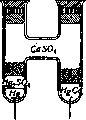
The electrodes are usually sealed into an H-shaped glass vessel, in one part of which is placed mercury, covered on top with a layer of Hg2SO4. In the other part is cadmium amalgam (about 10% cadmium and 90% mercury). The vessel is filled from above with a solution of cadmium sulfate in water. Some designers make this solution saturated, with an excess of cadmium sulfate crystals present; others saturate the solution at 4°C, so that at room temperature it turns out to be unsaturated. The most valuable property of the Weston cell is the remarkable constancy of its electromotive force, which practically does not change at all with ordinary fluctuations in temperature and maintains a value of 1.0190 volts. Thanks to this property, this cell has completely replaced the other standard cell used previously, the Clark cell.
Related articles
Cite this page
“Weston Standard Cell.” Soviet Medical Encyclopedia. English translation of Bolshaya Meditsinskaya Entsiklopediya, 1st ed. (Moscow, 1928–1936), ed. N. A. Semashko. https://sovietmedicalencyclopedia.pages.dev/article/weston-normal-element/