Gas Production
Historical document, translated for reference. It reflects medical knowledge of the 1920s–30s and is not medical advice.
Summary
Gas production involves obtaining illuminating gas through the dry distillation of carbon-containing substances like coal, oil, and wood. This article details the manufacturing process, health hazards for workers, and measures to improve working conditions in gas plants during the 1920s-1930s.
Encyclopedia article (1928–1936)
Gas production consists of obtaining illuminating gas through the dry distillation of carbon-containing substances (coal, oil, wood). English engineer Murdoch (Murdoch) was the first to successfully apply gas obtained from the dry distillation of coal for lighting purposes in the 18th century. Gas production became widespread in the mid-19th century. The first plant in Russia was built in 1835 for outdoor lighting purposes. The main moments of the production process are as follows: dry distillation of coal is carried out in special gas furnaces consisting of a generator and a system of retorts (retort department) (see Figure 1). The resulting gas mixture is purified from cyanide, naphthalene, tar, and ammonia in the apparatus department, and purification from hydrogen sulfide takes place in the dry purification department. The purified gas, through a system of meters and regulators where the gas is measured and its pressure is regulated, is directed into gas holders-gasholders, which are a special type of very large bells floating in water basins. At present, illuminating gas is usually mixed with 25-30% water gas to increase its calorific value. Water gas is obtained by heating coke in special generators in the presence of air blown by blowers and passing water vapor through the heated coke. This produces a mixture of hydrogen and carbon monoxide in almost equal volumes (H2O + C = CO + H2). The calorific value of water gas is increased by carburation with petroleum vapors to enrich it with heavy hydrocarbons. In composition, it differs significantly from coal gas, especially in terms of CO content, as seen in the following table: Composition of coal gas and water gas (in percent). Coal gas Water gas Heavy hydrocarbons ..... Carbon monoxide . Carbon dioxide . . 46 33 Hydrogen ..... Heavy hydrocarbons ..... Carbon monoxide . Carbon dioxide . . . 36 16 From the point of view of professional hygiene, the work in the retort department, dry purification department, and water gas department is of greatest importance. In addition, auxiliary work commonly practiced in all gas plants should be noted; repair of gas meters and repair of the network.
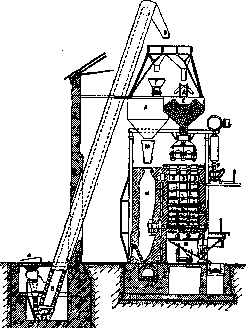
Figure 1. Cross-section of a gas furnace with vertical retorts: A-receiving funnel of the elevator; B-buckets that raise coal to the top of the retort building; C-upper opening of the elevator; D-cart moving along the entire retort building; E-conveyor; F-bunkers; G-funnel-hoppers installed above the retort openings; 333-vertical retorts; H-generator; I-coke bunkers; J-funnel for loading coke into the generator; K-cart on which coke falls when opening the lower retort cover; L-hydraulic seal, through which the gas passes before entering the collecting pipe.
The central moments of work in the retort department are loading the retorts with coal and unloading them from coke. Professional hazards of work in the retort department depend to a large extent on the nature of the technical equipment of this department. The work is most difficult and harmful in horizontal furnaces, especially if loading and unloading are done manually. In addition to inhaling large doses of CO, the worker is subjected to the strongest effects of high temperature, and both of these harmful effects are aggravated due to extremely intense muscular strain during the loading and unloading of retorts. With horizontal retorts, the distillation process lasts no more than 4-6 hours, and the moments of loading and unloading are repeated periodically 4-6 times during the day. Mechanization of loading and unloading processes significantly reduces muscular strain during work, but does not fundamentally solve the problem of improving this production. A significant step forward both hygienically and technically are vertical retorts with mechanical loading and unloading. Muscular strain as a harmful factor here almost no longer plays a serious role, but the effect of radiant heat and high temperature, up to 50-60°, especially during unloading of retorts, and contamination of the air in the retort department with harmful gases, among which carbon monoxide is in first place, remains. At the Moscow gas plant, where a system of vertical retorts is used, the following data on the content of harmful gases in the air of the retort department were obtained in 1923. During loading-0.6-0.8 mg CO and 0.32 mg heavy hydrocarbons per 1 liter of air, during unloading-1.17-1.33 mg CO per 1 liter of air. Under normal conditions, CO content in different parts of the department ranged from 0.21 to 0.37 mg. The most difficult work from a hygienic point of view is the unloading work, as here the unloaded hot coke is extinguished with water and large amounts of CO are formed, as in the production of water gas. The indicated amounts of CO in the air significantly exceed permissible concentrations and can serve as an etiological factor not only for chronic but also for acute CO poisoning. Of other departments from a professional-hygienic point of view, the dry purification department is important, in which gas is purified from sulfur compounds. Purification from other harmful impurities (cyanide, naphthalene, tar, ammonia) takes place in hermetically sealed apparatus, so the penetration of harmful gases into workrooms, although it occurs, is in very small concentrations. In the dry purification department, workers have to inhale large doses of CO and sulfur compounds. Purification is carried out in closed boxes filled with bog ore (iron hydrate oxide), through which sulfur gas and water gas pass all the time. Every two weeks the ore is unloaded, as it loses its ability to retain sulfur compounds that contaminate the illuminating gas. The unloaded ore, combining with oxygen from the air, is regenerated (oxidized) and again acquires the ability to purify gas. To accelerate regeneration, it is moistened with water and turned over (loosened) with a shovel in a thin layer. During these processes, the air in the rooms is contaminated with CO, H2S, cyanide compounds, etc. At the Moscow gas plant, in the purification department, 0.37-0.45 mg CO per 1 liter of air was detected.


The morbidity of gas plant workers. According to German data (Lewin and others), the morbidity of gas plant workers is almost twice as high as in other industries. According to data from one small gas plant, the highest morbidity is found among workers in the retort department (11.9-number of sick days for retort workers, while for other production workers-9.6). An examination of 439 workers at the Moscow gas plant in 1923 revealed cases of: diseases of the nervous system (neuroses, neuritis)-42.8%, circulatory system (myocarditis, heart defects)-17.8%, respiratory organs (bronchitis, chronic emphysema, chronic pleurisy)-19%. The most significant place
i
is thus occupied by diseases of the nervous system, which is undoubtedly connected with the selective effect of CO on nerve cells.-Measures to improve gas production lie mainly in the technical improvement of production processes. Improvement of the most difficult working conditions in the retort department will be achieved by transitioning to vertical continuous-action retorts with automatic loading and unloading (see Figure 2) or chamber furnaces. The harmful moment-extinguishing coke-should be moved to a special room, preferably special underground towers. The unloading of bog ore and turning it over to accelerate regeneration can be eliminated by introducing air directly into the purification boxes, which will achieve regeneration of the ore without unloading it. In addition, it is necessary to maintain the hermeticity of the apparatus in all departments to prevent gas leakage into workrooms. Among sanitary-technical measures, a rational supply and exhaust ventilation system should be given first place in all departments of gas production. - Legislative measures for labor protection in gas production in the USSR: all workers engaged in the production of coal gas and water gas, repair of gas meters and the network, enjoy a reduced six-hour working day, additional two-week vacations and additional nutrition (milk, fats). Adolescents and women are not admitted to work in the retort department. Gas plant workers undergo an annual medical examination.
Related articles
Mentioned in
Cite this page
“Gas Production.” Soviet Medical Encyclopedia. English translation of Bolshaya Meditsinskaya Entsiklopediya, 1st ed. (Moscow, 1928–1936), ed. N. A. Semashko. https://sovietmedicalencyclopedia.pages.dev/article/gas-production/