Horner's Syndrome
Historical document, translated for reference. It reflects medical knowledge of the 1920s–30s and is not medical advice.
Summary
This article defines Horner's syndrome as a set of symptoms resulting from cervical sympathetic nerve lesions. It also contains a significant, unrelated section detailing the occupational health hazards, sanitation, and accident statistics of the Soviet coal mining industry in the 1920s.
Encyclopedia article (1928–1936)
HORNER'S SYNDROME (Horner) includes a number of signs indicating a lesion of the cervical sympathetic nerve: vasodilation on the corresponding half of the face and head with an increase in skin temperature, enophthalmos (recession of the eyeball), and narrowing of the pupil and the palpebral fissure. The occurrence of Horner's syndrome can be caused by very different reasons: compression of the sympathetic nerve trunk, tumors in the neck region, aortic aneurysm, cervical ribs, injuries affecting the cervical sympathetic nerve, and surgical operations (Chipault's operation).
4. Poisonous gases in the atmosphere of underground workings, a) Carbon dioxide. In underground workings, the amount of CO2 permitted by USSR legislation is no more than 0.5%. In underground workings, CO2 accumulates, in addition to the breathing of workers, from the burning of lamps, the rotting of timber supports, and other oxidative processes, and also enters from the pores of coal and rock. In the mines of the Donets Basin, such an amount of CO2 was found in only 27-30% of all air samples taken for analysis. b) Carbon monoxide. The main source of CO formation in underground workings is blasting operations and mine fires. Poisoning of underground workers by carbon monoxide with fatal cases is noted annually. In 480 air samples taken in 1926-1927 in the extraction and preparatory workings of the Donets Basin mines, CO was found from 0.01 to 0.643 mg per 1 liter. c) Hydrogen sulfide ("eye-eater"). The source of its formation is the decomposition of organic substances containing sulfur, the action of water on gypsum, iron pyrites, etc. Out of 90 surveyed mines of the Donets Basin, 15 mines constantly emitted H2S. Sulfur dioxide is released from coal and, combining with water, forms so-called caustic waters, causing skin irritation, furunculosis, and rapid deterioration of clothing and metal objects. In various regions of the Donets Basin, such waters account for 8% to 91% of the total inflow of mine waters. d) Mine gas (methane). Although it apparently does not constitute an industrial hazard in itself, due to its ability to form explosive gas in a certain mixture with air, it is an extremely dangerous factor. With a methane content of 2% in the air, USSR legislation requires the immediate cessation of work. e) Nitrogen oxides are formed during blasting operations and are not completely removed by ventilation of the work areas. Complaints from rock cleaners about headaches are apparently the result of chronic poisoning by nitrogen oxides. f) Products of incomplete combustion of lighting materials are also an industrial hazard of underground work, especially for coal hewers, because due to poor ventilation, incomplete combustion occurs; moreover, the safety mesh of the lamp becomes clogged with soot, which further contributes to a reduction in the access of oxygen to the flame. The combination of all the described industrial hazards of underground work creates very difficult working conditions. It is quite natural that after 10, maximum 15 years of work in such an environment, a healthy worker usually becomes an invalid. This is confirmed by data from a survey of coal hewers in the Donets Basin in 1925, according to which 2/3 of all coal hewers work in underground jobs, including at the coal face, for no more than 15 years. In the age group from 20 to 40 years, 63.8% were found to be ill. Among occupational diseases, the survey particularly highlighted: heart diseases ("miner's bull heart"), emphysema, rheumatism, and partly eye diseases (40.6% of all diseases). A survey of the state of the cardiovascular system of coal miners in the Donets Basin (9,610 people), conducted by Kavalerov, indicates that with an increase in the length of underground service, the number of workers with enlarged heart sizes and altered blood vessels progressively increases. Among those who had worked for only up to 5 years, an increase in heart size was found in 13.9% (under the age of 35) and pathological changes in arteries in 15%. The morbidity of miners in the Donets Basin (pre-war data) is more than twice the morbidity of miners in Westphalia and peasants in the Donets Basin: per 1,000 people, the morbidity of the former is 1,400, and of the latter 610. Among disabled coal miners in the Donets Basin receiving benefits in 1911-12, pulmonary emphysema was found in 76.6%, chronic bronchitis in 41.3%, rheumatism in 33.4%, heart disease in 32.6%, and arteriosclerosis in 21%. The question of the prevalence of pneumoconiosis and nystagmus among miners in the USSR has been little studied; but it must be assumed that pneumoconiosis is also widespread among miners. Out of 158 autopsies of miners in the Donets Basin performed by Kavalerov, pneumoconiosis was noted in 96 cases, i.e., in 64% of all autopsied. Nystagmus (see), considered an occupational disease of miners, is apparently not as widespread in the USSR as in the West. Out of 42 disabled miners in the Donets Basin, it was found in only four. Ankylostomiasis (see Ankylostoma), also usually considered an occupational disease of miners, was not found by the Skryabin expedition, which surveyed miners in the Donets Basin in 1925, but other diverse parasitic worms were found in almost 30.8% of underground workers (mainly Trichocephalus trichiurus - 22.8%). All that has been said above refers mainly to the Donets Basin, which provides 90% of all coal in the USSR, due to which the specific weight of other coal basins is practically negligible. In general terms, regarding the mines of other basins, it can be said that the physical and chemical working environment in them is easier and better, mainly because the air temperature in underground workings is lower than in the Donbas mines. And there is not the dustiness that exists in the Donbas mines. But due to the fact that these mines mostly have natural ventilation, the pollution of their air with carbon dioxide, especially in spring and autumn when natural draft is weak, is perhaps greater than in the Donbas mines. Thus, in the Cheremkhovo mines, CO2 was found from 1.04‰ to 11.28‰, and in the Anzhero-Sudzhensk mines from 2.4‰ to 13.6‰. Dust in the Cherembass mines during the dustiest work was found to be 41.6-52.8 mg in 1 cubic meter of air. The average temperature in them is 6.3°, minimum temperature 1.2°, maximum 10°, relative humidity from 78% to 100%, average 92.7%.
Sanitation of underground workings. In underground workings, the proper arrangement of ventilation is of essential importance. The latter aims to: 1) deliver the necessary amount of air to people and animals located in the mine, 2) maintain the normal burning of mine lamps, 3) reduce the content of suffocating, poisonous, and explosive gases in the mine air and remove them from the workings, 4) lower the temperature and humidity of the air in underground workings, and 5) in case of mine fires and explosions of explosive gas and coal dust, remove dangerous gases as quickly as possible. Ventilation of underground workings necessarily provides for the presence of two exits to the surface. Furthermore, the lighting of underground workings is of essential importance. It is divided into 1) open or closed, depending on the design of the lamps and the presence of mine gas, 2) permanent or portable. Sources of underground lighting can be candles, oil, kerosene, gasoline, alcohol, acetylene, and electricity. Lighting with open lamps is permitted by law only in non-gaseous mines. The most hygienic is lighting with battery lamps, which are now beginning to be introduced in the USSR (first in the mines of the Donets Basin). In most mines of the USSR, Wolf gasoline lamps or acetylene lamps are used. Mine waters and the sanitation of underground workings are also of essential importance in a hygienic respect. Due to the poor state of sanitation in underground workings, workers use mine cars, blind passages, etc., for their natural needs, thereby spreading infection throughout the underground workings. In the history of epidemics in the Donets Basin, underground epidemics of cholera, dysentery, etc., have been noted more than once.
I. Lyashchenko. Traumatism in the mining industry is significantly higher than in other sectors. During the period from July 1, 1926, to July 1, 1927, for every 10,000 workers in various sectors of the USSR industry, the following number of fatal accidents occurred: in the textile industry - 0.5; in the chemical industry - 0.8; in the woodworking industry - 1.6; in the metalworking industry - 2.9; in the mining industry - 11.4. The average for all industrial sectors is 2.6. The most dangerous of all branches of the mining industry is coal mining. It employs 57.2% of workers, who account for 67.4% of all accidents (according to 1925-26 statistics). The following table shows the general distribution of accidents of varying severity per 1,000 full-time workers (a full-time worker is conventionally understood as the number of workers who have worked a full 300,000 man-hours); in various branches of the mining industry in the first half of the 1926/27 operating year, it was: Mining industry sectors Coal ...... I Oil ...... ; Ores ....... ! Gold ...... j Building material
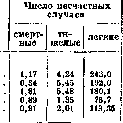
Accidents in the mining industry are classified by the technical causes that trigger them into the following groups: 1) cave-ins and collapses, 2) collapse of supports, 3) falls of persons, 4) injuries during haulage and transport, 5) injuries from fragments and falling objects, 6) injuries from tools, machines, and engines, 7) injuries from explosives, 8) gas and dust explosions, 9) suffocation by gases, 10) injuries from electric current, 11) injuries from steam boilers and steam pipes, 12) others (inrush of groundwater, etc.). Different branches of the mining industry are characterized by different work hazards. The distribution of fatal and serious accidents by the indicated groups of technical causes in various branches of the mining industry in percentages is given in the following table: there were 800 fatal accidents among workers, in the U.S.A. - 616 (in the Donets Basin in 1925 - 0 cases). On the other hand, accidents from electric current injuries in the Donbas are 10 times more frequent than in England, 2 times more frequent than in Germany, and 2 times less frequent than in the U.S.A. (electrification of the Donbas is significantly lower than in Germany, England, and the U.S.A.). In the oil industry, the greatest number of fatal accidents is attributed to gas explosions and injuries from fragments and falling objects. Among underground workers, the number of accidents is higher than among those working on the surface (on average three times higher). Safety engineering in mining operations. The procedure for conducting mining operations for safety purposes is provided for by special rules issued by the People's Commissariat of Labor of the USSR in 1925. The rules provide exclusively for work in the coal, ore, gold-platinum, and salt industries (special rules have been issued for the oil industry). These rules provide for general conditions concerning the hiring of workers and their work in mines and on the surface, and basic provisions for the conduct of work, concerning the fencing of excavations on the surface and ensuring reliable and completely free access to exits to the surface. Also provided for are obligations to have two exits to the haulage and ventilation drifts from each underground extraction site, as well as the administration's obligation to post separate copies of detailed safety rules for work in visible places and in barracks. Technical instructions concern the following basic elements of mining and the following basic operations: 1) construction of entrances to mine workings; 2) support of workings; 3) movement of workers along workings: a) along horizontal and inclined workings with a slope of up to 45°, b) along vertical and inclined workings with a slope of over 45°, and c) descent and ascent of workers in shafts, shallow mines, and prospect pits; 4) ropes used for the descent and ascent of people; 5) safety rules for the transport of loads; a) in vertical and inclined shafts, b) in horizontal and inclined drifts, and c) in brake inclines; 6) exploration and development of deposits by means of open cuts, shafts, prospect pits, and small mines; 7) development of deposits by open-pit mining; 8) development of stone quarries by underground mining; 9) development of mineral deposits by open-pit mining using excavators; 10) general ventilation rules for all mines and pits, as well as special rules for the ventilation of mines with firedamp and coal dust; 11) general rules for mine lighting; 12) safety engineering rules for the processing of minerals; 13) rules for preventing cases of people falling into workings; 14) rules for preventing danger from water and gases; 15) rules for preventing and extinguishing mine fires; 16) rules for the use of explosive materials in mining operations (acceptance, storage, carrying and transport, issuance, expenditure, monitoring of expenditure, conduct of blasting operations in coal mines containing firedamp and dangerous due to dust, protection of warehouses, installation of lightning rods, and destruction of explosive substances); 17) additional rules for conducting mining operations in gold and platinum fields; 18) sanitary rules for mining enterprises; 19) rules for electrical engineering installations.
V. Bilepko. Mine rescue work. Explosions of firedamp, coal dust, and underground fires are frequent phenomena in mines, sometimes taking on the character of catastrophes with hundreds of victims. Cases are known of the simultaneous death of almost all workers caught by such a catastrophe in a mine. Thus, in 1906, in the Courrières mine (France), 1,240 people died in a coal dust explosion; in Russia, in 1908, 270 people died in an explosion at one of the mines (now the Rykov mine) in the Donets Basin. Such a large number of victims is explained by the fact that the gases formed during this, primarily CO, quickly fill the underground workings and poison the workers before they manage to reach the surface. The effect of these gases, some of which, while not being poisonous in small concentrations, cause strong irritation of exposed mucous membranes (SO2, H2S, formaldehyde gases), for the most part completely excludes the possibility of performing work and sometimes causes loss of consciousness not only in the victims of the catastrophe but also in the persons rescuing the injured. At the present time, in all countries with a coal industry, there are special mine rescue stations, at which there are teams trained for work on the liquidation of catastrophes in mines, equipped with special devices for work in a suffocating atmosphere—mainly mask-respirators (see also Gas masks). Figure 1 depicts a filtering respirator-mask (gas mask) of the American type, representing the simplest, low-weight (3.5 kg) device, in which it is possible to perform work in a suffocating atmosphere, provided, however, that there is a sufficient content of O2 in the air and a relatively low (not exceeding 2%) concentration of suffocating gases.

-CHHHHHMM11
Figure 1. Respirator: a - mask; b - breathing hose; c - valve; d - absorption cartridge, in which activated charcoal, caustic soda, fused calcium chloride, hopcalite, silica gel, and a cotton filter are placed.

gases, by virtue of which it has limited application. Usually, however, mine rescue teams use primarily an insulating respirator (the simplest type of such a respirator is a helmet-mask worn on the head of the worker and connected by a rubber hose to an air pump-bellows), by means of which the fresh air necessary for a person is supplied and which is placed outside the suffocating atmosphere. The main type of respirator used by mine rescue teams is the so-called regenerative respirator.
In addition to respirators for work in mines, rescue teams use a whole range of other devices and accessories specially adapted for this purpose. These include oxygen pumps, which serve to fill cylinders for respirators with oxygen. The latter is usually delivered from factories in large steel cylinders and then pumped over with the help of pumps.
Fig. 2. into small cylinders for respirators at a pressure of up to 150 atmospheres. Such pumps are either stationary with an electric drive or manual, with the latter type being made foldable for convenience in transporting them to the site of rescue team operations. To provide assistance to those poisoned by gases, rescue teams use special resuscitation apparatuses and oxygen inhalers. Of the modern resuscitation apparatuses used in mine rescue work, the most widely used is the apparatus from the Inhabad company (Germany), which is a device used for the mechanical production of artificial respiration (see) according to the Silvester method (see Figure 2). The apparatus consists of a wooden board on which the patient is placed, a rotating metal frame to which the victim's arms are attached, an abdominal press, and an oxygen-filled cylinder from which oxygen enters the victim's mouth during inhalation. The Dräger pulmotor is also used for artificial respiration, although it has very limited application because it possesses significant drawbacks. To provide first aid in the mine, rescue teams are equipped with a set of medicines, stretchers, etc. Rescue teams usually carry portable telephones, signaling devices, ventilators with collapsible canvas pipes, portable battery lamps for lighting, and tools and devices for erecting fire-prevention bulkheads, etc. The formation of mine rescue teams and their training are carried out at special stations, where equipment is also stored. The stations are set up directly at the mines and are equipped with transport vehicles. Rescue teams undergo an established course of training in mine rescue work and first aid. Periodically, at least once a month, they perform practical work in respirators in an environment similar to that which occurs during catastrophes in mines. It is necessary to carry out a careful selection of persons enrolled in the rescue teams. All members of the rescue teams are subjected to a medical examination according to a special program, as well as to physiological and psychotechnical testing. Special attention is paid to the activity of the respiratory and circulatory systems and to the absence of an acute form of idiosyncrasy in relation to a reduced content of O2 and an excess of CO2 in the inhaled air. For monitoring the health status of the rescue teams, their training, and also for providing assistance to victims during catastrophes, there is usually special medical personnel.
Related articles
Cite this page
“Horner's Syndrome.” Soviet Medical Encyclopedia. English translation of Bolshaya Meditsinskaya Entsiklopediya, 1st ed. (Moscow, 1928–1936), ed. N. A. Semashko. https://sovietmedicalencyclopedia.pages.dev/article/horner-s-syndrome/