Abel Apparatus
Historical document, translated for reference. It reflects medical knowledge of the 1920s–30s and is not medical advice.
Summary
The Abel apparatus (Abel-Pensky) is a laboratory device used to determine the flash point of kerosene and gasoline vapors for sanitary and technical safety evaluations. The device heats the fuel sample in a water bath under strictly regulated conditions and introduces a small flame to detect the temperature at which the vapors ignite with a blue flash.
Encyclopedia article (1928–1936)
ABEL APPARATUS (Abel), for determining the flash point of kerosene vapors, invented by the English chemist Abel and improved by the mechanic Pensky, is used in sanitary and technical investigations of kerosene (as well as gasoline) to determine the degree of its fire hazard. The operating principle of the apparatus is based on the fact that, under strictly defined conditions, a small ignited wick is brought to the vapors of uniformly heated kerosene, and the temperature of the kerosene is noted at which a blue flame of ignited kerosene vapors appears in the vessel from the burning wick. The apparatus consists of the following main component parts (see figure): 1) the kerosene vessel G,
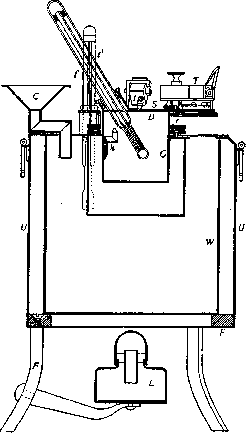
2) the vessel lid B with a rotating shutter iSh and an ignition device I, 3) a mechanism T attached to the lid, by means of which the ignition device I is actuated, 4) a water bath W in which the kerosene vessel is suspended, 5) a tripod F with an outer shield (casing) U and a spirit lamp L for heating the water bath, 6) the kerosene vessel thermometer t1, 7) the water bath thermometer t2. The test is carried out as follows: the water bath W is filled through the funnel C with water preheated to 50–52°; then the water bath is heated with the spirit lamp L to 55°, and this temperature must be maintained throughout the experiment. Vessel G is filled using a pipette with the test kerosene up to the upper end of the pin h. Then cover D is closed and the kerosene is allowed to heat. The first opening of the lid aperture D is performed, depending on the barometric pressure, at the following temperatures: 685–695 mm: 14.0°; 695–705: 14.5; 705–715: 15.0; 715–725: 15.5; 725–735: 16.0; 735–745: 16.0; 745–755: 16.5; 755–775: 17.0; 775–785: 17.5. As soon as the kerosene warms up to the corresponding temperature, the lamp I is lit, its flame is adjusted to a size equal to the white bone bead on the lid, and the mechanism T is set in motion. Upon actuation of the mechanism, the shutter S opens for two seconds, and the flame of device I is lowered into the vessel. If no flash occurs, a new test is performed after the kerosene temperature rises by 0.5°. This is repeated until the kerosene vapors ignite, which is recognized by the appearance of a blue flame. If the difference between two repeated determinations exceeds 0.5°, the average of three determinations is taken. Since barometric pressure affects the flash point of kerosene, in order to obtain comparable data it is necessary to reduce the found temperature to a pressure of 760 mm. To do this, immediately before the determination, the reading of the barometer located in the working room is noted, and then, according to the obtained flash point, the desired flash point at a pressure of 760 mm is found using a special table. Among the many apparatuses (naphthometers) proposed for determining the flash point of kerosene, the Abel apparatus deserves special attention for its comparative accuracy and constancy of readings. Details of the methods for determining the flash point in the Abel apparatus can be found in the manual attached to the device, as well as in guidebooks. The cost of the apparatus is approximately 230 rubles (1927).
Related articles
Cite this page
“Abel Apparatus.” Soviet Medical Encyclopedia. English translation of Bolshaya Meditsinskaya Entsiklopediya, 1st ed. (Moscow, 1928–1936), ed. N. A. Semashko. https://sovietmedicalencyclopedia.pages.dev/article/abel-apparatus/