Disinfection Chambers
Historical document, translated for reference. It reflects medical knowledge of the 1920s–30s and is not medical advice.
Summary
This article from the 1928–1936 Great Medical Encyclopedia discusses disinfection chambers, which are enclosed spaces with specialized equipment designed for sterilizing various infected objects. It covers the classification of chambers into steam, thermal, gas, and mixed types, detailing their construction, operation, and historical models such as the Kapustin and Jung-Buyvid chambers.
Encyclopedia article (1928–1936)
DISINFECTION CHAMBERS. Disinfection chambers are enclosed spaces equipped with specialized devices intended for the disinfection of various infected objects (linen, clothing, household items, raw materials, semifinished goods, finished products, and merchandise). Depending on the physical and chemical agents used in disinfection, disinfection chambers are divided into three main groups: steam, thermal, and gas chambers. A fourth group can also be distinguished—chambers of a mixed type, where high temperature and some chemical substance are applied simultaneously. The principal requirements for all groups of disinfection chambers are: a) the fullest possible guarantee of the reliability of the disinfection and disinfestation effect throughout the entire mass of the objects being disinfected;
b) the preservation of items (absence of damage) and c) universality both in the sense of the variety of objects permitted for processing in the chamber and in relation to the disinfection agents applied. I. Steam chambers. Saturated, flowing water vapor at a temperature of 100° and above possesses the most reliable bactericidal action, and therefore disinfection with such vapor deserves preference over other methods of disinfection in all cases when the use of steam disinfection is not associated with damage to the objects being disinfected. Steam that is saturated and flowing, but with a temperature below 100°, obtained under reduced pressure in vacuum apparatuses, does not by itself provide the proper disinfection effect and therefore is used in combination with various chemical disinfectants, which make up for the insufficiency of its disinfecting properties. In disinfection chambers, water vapor can be used in various states, namely: a) in the form of saturated vapor, i.e., vapor whose relative humidity is 100% (the pressure of such vapor is the highest possible at a given temperature); b) superheated vapor with a relative humidity below 100% at a given temperature; c) flowing vapor in continuous motion; d) stationary vapor whose outflow from the apparatus has been stopped; e) vapor without excess pressure, i.e., vapor at normal barometric pressure with a temperature of 100°, and f) vapor under pressure with a temperature above 100°. Between the temperature and the pressure of saturated water vapor, there is a strictly defined ratio (see table), which is of great practical importance as it serves as one of the methods for monitoring the operation of steam disinfection chambers. Steam pressure is generally calculated in atmospheres or pounds, with a pressure of one atmosphere considered equal to 15 pounds per 1 square inch, or 1 kg per 1 cm2. With an increase in pressure above normal, the temperature of the vapor also increases, and vice versa. Most modern steam disinfection chambers are designed to operate with saturated, flowing vapor under pressure. The shape and dimensions of steam disinfection chambers are very diverse, with the best shape in terms of utilizing internal space and the convenience of placing items being quadrilateral, while regarding the strength of the apparatus at the same wall thickness, the advantage lies with the cylindrical shape. The internal dimensions of disinfection chambers range from 0.5 m3 to 10 m3 depending on their purpose. There are stationary steam disinfection chambers of a fixed type and mobile ones. According to the degree of perfection of design and completeness of equipment, steam disinfection chambers are divided into two groups: simple, primitive disinfection chambers that can be manufactured by handicraft methods from local materials, and improved ones with complex assembly, manufactured industrially. A. The group of simplest steam disinfection chambers is characterized by simplicity of design and insignificance of dimensions. They can be made of sheet iron, wood, tarpaulin, canvas, etc. Disinfection in this group of chambers is usually carried out by flowing vapor without excess pressure. Steam generators for them can either be connected to the chamber itself, forming a single unit with it, or be independent (various types of samovars, coils built into a firebox, open steam boilers, etc.). The main requirements for simple steam disinfection chambers are: 1) sufficient dimensions of the chamber, ensuring the possibility of free placement of the items being disinfected on hooks, hangers, crossbars, etc., with which these chambers are provided; 2) the body of the chamber and its doors (or lid) must ensure proper tightness of the internal space; 3) the chamber must be equipped with thermometers to monitor the temperature movement during the disinfection process; 4) if there is a separate steam generator, steam must be introduced into the chamber from above, and the outflow for it arranged at the bottom of the apparatus; 5) the steam generator attached to the chamber must ensure the rapid and continuous production of water vapor of at least 100° throughout the entire disinfection process; 6) the correction and repair of such chambers and steam generators should desirably be possible everywhere by local means. From the great variety of existing types of simple steam disinfection chambers in the USSR, practical application is held by: 1) the Kapustin chamber; 2) the Jung-Buyvid barrel-chamber, and 3) the Rostovtsev chamber. 1. The Kapustin chamber consists of a) a laundry boiler made of galvanized iron;
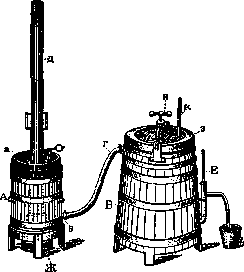
Figure I. Jung-Buyvid barrel-chamber: A - samovar steam generator; a - water dish; B - steam outlet opening; D - pipe; Ж - ash pit; B - barrel-chamber; Г - flexible hose; з - removable lid; и - screw for pressing down the lid; E and к - thermometers.
b) a cylindrical canvas or tarpaulin cover for this boiler, c) a canvas cover for the upper part of the cover with a hole in the middle for placing a thermometer, and d) an iron hoop covered with canvas, which attaches the cover to the edges of the boiler. After the water boils, the cover with items is placed over the boiler and secured with the iron hoop, and a thermometer is inserted into the cover. Upon reaching a temperature of 98-99°, the items remain in the chamber for about 1/2-1 hour, after which the cover with items is removed, and the items are aired. The positive qualities of the Kapustin chamber are its simple design, ease of manufacture, and low cost. The disadvantages include the difficulty of working in the open air in windy conditions, the flow of steam upward inside the chamber, significant wetting of items during disinfection, the presence of only one opening for loading and unloading, and relatively high fuel consumption. 2. The Jung-Buyvid chamber (see Figure 1) consists of a wooden barrel with an expanded base, serving as a receiver for items to be disinfected, and a steam generator in the form of a large tin samovar, covered with wood with a sealed top lid. The chamber usually operates without excess pressure; the latter can be increased by narrowing the steam outlet tube, and in this case, the temperature inside the apparatus can easily be brought to 102-103°. In terms of quality, the Jung-Buyvid chamber is significantly superior to the Kapustin chamber, but it also has the main disadvantage of having only one opening for loading and unloading items to be disinfected. 3. The Rostovtsev chamber is a rectangular elongated box made of galvanized iron sheets and covered with wood on the outside. The capacity of the chamber is 1-1.5 m³. The chamber is equipped with two doors, allowing it to be installed in a partitioned room—infectious and clean—and to load and unload items from different sides. The chamber operates with saturated, flowing steam, which is introduced into the apparatus from the top, with outflow at the bottom. The samovar-boiler also serves as the steam generator. Among the described types of D. k. (disinfection chambers), the Rostovtsev chamber is the most satisfactory, and its simple design makes it possible to manufacture it locally in rural settings. To this same group of simplest D. k. belong the barrel chamber of the Norwegian type, the Kryupin barrel chamber, the Rapchevsky chamber, the Prokhorov chamber (its initial model), the 'Meteor' chamber, and others. B. Group of improved type steam D. k. This includes 1) steam D. k. of various systems with increased pressure, 2) vacuum-form chambers with reduced pressure. 1. Steam D. k. with increased pressure must meet the following main requirements: 1) the steam generator must be of appropriate power, developing a pressure of 3-4 atmospheres and ensuring a sufficient amount of steam throughout the disinfection process; 2) the chamber is installed in a room divided by a solid wall into two halves ('dirty' and 'clean'); 3) the chamber must have two doors opening into the infectious and clean halves of the room; 4) to avoid excessive heat loss, the chamber can be covered with wood with appropriate insulation; 5) for preheating the chamber and reducing the formation of condensation water inside the apparatus, heating devices in the form of coils or radiators should be provided; sometimes for this purpose double walls ('jackets') are arranged, between which steam is introduced to heat the chamber body; 6) steam should be introduced into the chamber from the top; the outflow for it is at the bottom; 7) parallel to the upper part of the chamber inside it, a protective metal canopy is attached to protect the items from direct impact of the steam jet and to protect them from condensation water droplets; 8) to control the operation of the D. k., it is equipped with two permanent thermometers, one of which is installed in the chamber doors, and the other on the steam outlet pipe; in addition, contact thermometers and a maximum thermometer are placed inside the items to be disinfected (a manometer and a safety valve should be available for observing pressure); 9) the chamber must have two ventilation openings: intake and exhaust with a steam inducer, with the intake opening facing the clean half of the room; 10) for ease of loading and unloading, the chamber is equipped with a retractable cart with removable shelves, hooks, and hangers; 11) control of the chamber should be concentrated on the clean half of the room; 12) the usual material for manufacturing D. k. of this type is boiler and sheet iron; 13) all internal space of the chamber except the canopy and cart should be painted with special paint for the preservation of the apparatus; 14) the chamber doors should have hermetic seals. The disinfection process in D. chambers is usually divided into separate stages: a) loading, b) heating, c) disinfection, d) ventilation, and e) unloading. 3 a loading is done from the infectious half of the room with the opposite door closed. 1) Items are placed in the apparatus freely for steam penetration; 2) clothing is hung on hangers and hooks; 3) colored items should be placed separately from 'colorless' ones; 4) blankets, carpets, etc. are neatly folded or hung on stretched ropes; 5) pillows with colored pillowcases are hung by one corner; 6) linen stained with blood, pus, excretions, etc. should be pre-soaked in a 1% soda solution to prevent the formation of non-washable stains; 7) items should not come into contact with metal parts of the apparatus. After loading the apparatus with items, heating begins with the coil or by introducing steam into the 'jacket' to 45-50°; after this, the steam supply to the heating devices is stopped, and steam is introduced directly into the apparatus through the upper opening; the lower opening should be open for the outflow of air, condensation water, and spent steam. Upon receiving a signal bell at 100°, the items remain in the apparatus for 20 minutes to 1 hour with continuous steam flow, depending on their quantity, packaging nature, and resistance of the pathogen. At this time, the temperature in the apparatus is brought to 105-108°. After the specified time, further steam supply to the apparatus is stopped, and ventilation is begun, for which first the exhaust (upper) opening is opened, then the intake (lower) opening, and to increase draft, the steam inducer is activated. The ventilation period lasts from 5 to 20 minutes, after which the apparatus is opened from the clean half of the room, the cart with items is pulled out, and items folded several times (blankets, carpets, etc.) are unfolded and shaken to remove residual steam. In D. k. at a temperature of 100° and above, the following can be disinfected: 1) bedding—blankets, pillows, mattresses, feather beds, etc.; 2) wearing apparel and outerwear without fur and leather parts; 3) hair, bristles, wool, down, feathers; 4) carpets, draperies, curtains, etc.; 5) rags, waste, bags, ropes, burlap, etc.; 6) wearing, bed, and table linen, pre-soaked in a 1% soda or alkaline solution; 7) soft furniture, not laminated and without veneered and polished parts. As an example of flowing-steam disinfection chambers with increased pressure, which have become widespread in the USSR, can serve the chambers of the Dr. Kryupin system, formerly manufactured by the San-Galli factory in Leningrad (see Figure 2).
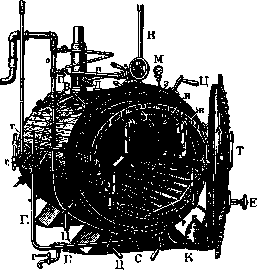
Figure 2. Kryupin steam disinfection chamber: A-door; B-steam pipe for coil; C and D-exhaust and intake ventilation openings; E-condensation pot for coil; F-manometer; G-safety valve; H-steam main; I-valve for steam inlet; J-coils; K-thermometer of the apparatus; L-hinge bolts for closing; M-valve for draining condensation water; N-valve of steam outlet pipe; O-retractable cart with removable shelves; P-hooks for items; Q-protective canopy; R-steam-driven pipe; S-removable wooden gratings; T-thermometer of steam outlet pipe; U-exhaust pipe.
Krupin chambers were manufactured in three sizes: 9.1 m3, 4.5 m3, and 2.76 m3; the first had a cabinet-like shape, while the others were cylindrical. This type of D. k. is supplied to disinfection institutions and hospitals of many large cities of the USSR: Leningrad, Kiev, Odessa, Saratov, etc., and, as experience has shown, their service life is determined by decades. To this same group of disinfection chambers belongs the chamber of Dr. Mandelstam, the characteristic feature of which is the presence of double walls ('jacket' or 'sheath') and the possibility of obtaining negative pressure in it, i.e. some approximation to vacuum-form chambers. - In addition to stationary D. k. with increased pressure, there are also a number of mobile ones: of the Red Cross type, Schwabe, Rapchevsky, 'Maruko' and others. In the Rapchevsky and 'Maruko' chambers, the vaporizer is directly connected to the chamber itself and is placed under it, while in the Red Cross and Schwabe chambers there is a separate steam boiler installed next to the chamber. The main disadvantage of these types of disinfection chambers is the existence of one opening (door) for loading and unloading the apparatus. Each new and majorly repaired D. k. before beginning practical work must be subjected to sanitary-technical testing. The purpose of the test is to determine: a) the technical condition of the component parts of the apparatus; b) the distribution of temperature inside the D. k.; c) the speed of air removal from the D. k. and heating of the entire mass of objects to be disinfected; d) the maximum load of the D. k. with different items; e) the degree of dampening of items during disinfection; and f) the correctness of the readings of control instruments (manometer, thermometer, safety valve, etc.). Based on the results of the test, instructions for operating this particular D. k. are compiled. When testing and monitoring the operation of D. k., two methods are usually used: biological (and in particular bacteriological) and physico-chemical. The biological method consists in the use of test objects infected with microbes of varying resistance (including spore-forming ones) and in experiments with insects. Physico-chemical control of D. k. is carried out with the help of various physical instruments - external and internal, with which the D. k. are equipped, and chemical substances placed inside the apparatus. Control instruments include: manovacuometers, apparatus thermometers and on the steam outlet pipe, self-recording thermographs, maximum thermometers, contact thermometers, contactor with alloy, etc. Chemical substances for controlling D. k. are used either in Sticher's control tubes, or in the form of thermal indicators proposed by Artemyev, or in the form of control papers by Mikulich, Torgler, and Lautenschläger. Sticher's tubes are double sealed glass tubes with chemically pure substance with a specific melting point placed in the inner one, for example: phenanthrene (melting point 98°), brenzcatechin (melting point 104°), resorcinol (melting point 110°). Based on which of the listed substances in the tubes have melted, a judgment is made about the achieved temperature and, within certain limits, about the duration of its action. Some of the indicators change their original color in the process. The significance of Mikulich's and other papers lies in the fact that they are decolorized by the action of steam of a certain temperature, and not by another factor, for example hot air. 2. Vacuum-form chambers. The essence of the operation of vacuum-form chambers lies in the use of low-temperature steam (49-60°), obtained with appropriate rarefaction of the intrachamber space. But since the bactericidal force of steam decreases proportionally to the decrease in its temperature, formaldehyde is added to low-temperature steam to restore it. In vacuum-form chambers, disinfection can be carried out either with continuous circulation of water and formaldehyde vapors or with their stationary state. Flowing steam with formalin has greater bactericidal properties than their stationary mixture. Existing types of vacuum-form chambers are thus divided into two groups: systems of Rubner, Henneberg, and so-called Hamburg ones, in which disinfection occurs at constant vacuum with a flowing steam-formaldehyde mixture, and apparatus built according to the Halm system - Weimar type, working with the same mixture but in a stationary state.-Disinfection chambers of the Rubner system consist of five component parts (see Fig. 3):
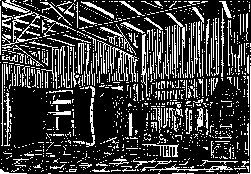
Figure 3. General view of the component parts of a stationary Rubner vacuum-form chamber.
steam boiler, a pot for evaporating an 8% solution of formalin, a chamber for items, a vessel for collecting the spent steam-formaldehyde mixture, and an air pump driven by steam or electricity. Rubner D. k. and their component parts are made of forged iron. The shape can be cylindrical or quadrangular with concave walls; average capacity 5-6 m3. There are stationary (see Figure 7) and mobile types. The sequence of operation is as follows: after loading the apparatus and filling the evaporator with an 8% formalin solution, the air pump is started, which pumps air out of the chamber and from the evaporator, which is in connection with it. As soon as the vacuum reaches the desired degree, heating of the formalin to the boiling temperature corresponding to the existing vacuum begins with the help of a coil. Water and formalin vapors enter the chamber from above, pass through the loaded items and enter the condenser, where they condense into a liquid, which can be reused. By regulating the steam supply to the evaporator and the operation of the air pump, a constant vacuum (up to 710 mm) is maintained in the entire closed system of apparatus (chamber, evaporator pot and condenser) and the corresponding steam temperature. This makes it possible to disinfect items that cannot withstand high temperatures (fur, leather, etc.). For most such items, a vacuum of 600-620 mm is sufficient, as these materials do not deteriorate at 58-60°. Of all vacuum-form chamber systems, Rubner disinfection chambers are the most advanced and 'universal'. In the USSR, typical Rubner D. k. have not been manufactured to this day, and the existing chambers were installed by the Berlin firm of Lautenschläger (for example, in the Botkin Hospital in Moscow).-In vacuum-form chambers with stationary steam-formaldehyde mixture. Vacuum in them is usually achieved with the help of a steam ejector, not an air pump. To this group of D. k. belong most of the vacuum-form chambers manufactured in pre-war Russia by various factories: Leningrad Metal Plant (Taranukhin system), former San-Galli plant, Schwabe, Saxé, and currently produced by Prokhorov's workshops under the name 'Universal' (Leningrad).-D. k. of the Taranukhin system is a horizontal cylinder 2.5 m in length and 2 m in diameter, sheathed with cork and wood. With a steam ejector, a vacuum of up to 2/3 of an atmosphere is obtained. Formaldehyde vapors are introduced into the chamber with the help of a nozzle that sucks in heated formalin from a pot located under the ejector. Disinfection under vacuum is carried out at a temperature
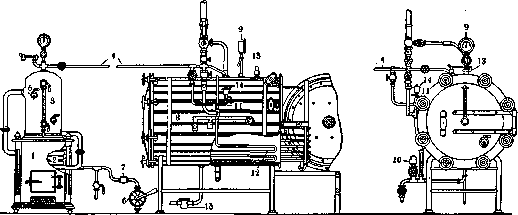
Figure 4. Diagram of the installation of the 'Universal' disinfection chamber with a Prokhorov system vaporizer, model 1928: 1-vaporizer; 2-vaporizer coil; 3-steam-water reservoir; 4-steam supply tube; 5-test cocks; 6-pump; 7-feed valve; 8-chamber; 9-manovacuometer; 10-air filter; 11-nozzle; 12-chamber coil; 13-safety valve; 14-funnel for formalin and ammonia; 15-condensation pot. 65-70°. The duration of the entire disinfection act, not including loading and unloading, is 1 hour-1 hr. 15 min. The actual disinfection takes 25-40 min. depending on the amount of items. The difficulty of obtaining high degrees of vacuum (over 550 mm) and the relatively high temperature at which disinfection is carried out do not allow this type of D. k. to be used for all types of fur and leather goods, but they are quite suitable for most coarse types of these materials. In 1927, Leningrad Prokhorov workshops produced disinfection chambers under the name 'Universal', equipped with a separate vaporizer (see Figure 4). The chamber is of small size, with a capacity from 71/2 m3 to 11/2 m3, cylindrical in shape, equipped with a steam-jet ejector allowing rarefaction of 400-450 mm; these chambers require testing. II. Thermal dry-air (hot-air) D. k. Thermal D. k. are apparatus or entire premises intended for disinfection with hot air. The disinfecting properties of hot air are significantly lower than those of water vapor at the same temperature, and therefore air is used heated to 150-180°. Adding water vapor to the heated air and setting it in motion enhances the disinfecting effect, promoting uniform distribution of temperature in the chamber space and facilitating the penetration of air deep into the objects to be disinfected. Thermal D. k. are used in practice mainly for disinsection purposes, as ectoparasites and their 'embryos' are especially sensitive to dry

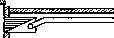
Figure 5. Pit chamber: 1-hangers; 2-entrances to the loading compartment; 3-chamber; 4-exit and unloading compartment; 5-furnace. (According to Syusin.) Heat. For combating spore-bearing forms of microbes, heat disinfection chambers are poorly suited, as they require very high temperatures (180° and above) and prolonged exposure, and under these conditions, items begin to deteriorate due to charring. Each heat disinfection chamber consists of a container for items and a heater (furnace, stove, calorifier, etc.). There are three types of heat disinfection chambers: 1) type of pit chambers (see figure 5), chamber
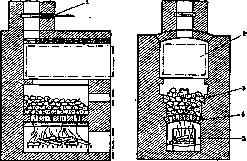
Figure 6. Steam bath chamber: 1-damper pipe; 2-sliding curtain; 3-cobblestone; 4-brick; 5-furnace. (According to Syusin.)
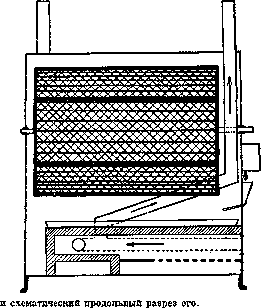
s (see figure 6), boxes, etc.; 2) type "Helios" and 3) chambers with blowing in of hot air. 1. The first type is the most primitive. In chambers of this type, hot air is obtained either by heating stones and bricks located above a perforated vault of the furnace, or by heating the chamber with iron stoves and their chimneys running inside the chamber. To humidify the air, water is poured onto the heated surface, which turns into steam. The temperature in the chambers is brought to 100-150°. In some of the D. k. of this group, air circulation is also provided by the installation of an inlet opening in the chamber and an exhaust, sometimes connected to the chimney. To this group of D. k. belong the Khizina, Lebedev, Gashinsky, Emelyanov chambers and the German Hamburg and Dorfzaun (Gamburger, Dorfzaun) chambers, etc. 2. The "Helios" apparatus (see figure 7) is a box made of corrugated iron. The box is divided by an iron plate into two parts: the lower part is occupied by the furnace, which heats the air of the chamber through the plate, and in the upper part a hexagonal mesh drum is placed, in which the items to be disinfected are placed. To humidify the hot air, a metal vessel is attached to the outside of the apparatus, from which water is supplied through a tube into the chamber and falls onto the heated plate. The drum rotates with a handle at a speed of 12-15 revolutions per minute. The heating of the air in the "Helios" should not be below 120°. Duration of disinsection 25-30 min. Average loading capacity-8 sets. "Helios" apparatuses are made stationary and mobile. With proper use, the apparatus ensures a reliable disinsection effect. They are convenient for flophouses. 3. The most perfect heat (hot) D. k. are installations in which very hot air is blown into the chamber space and is in continuous circular motion. The purpose of this type of installation is mass disinsection. The idea of using rapidly flowing hot air for disinsection purposes belongs to Vondran. The Vondran installation consists of a chamber, grate batteries or a calorifier, a system of air ducts and a fan with an electric motor (see figure 8). The fan blows hot air through the duct into the lower part of the chamber, where it passes through metal grates, washes the items from bottom to top and is again
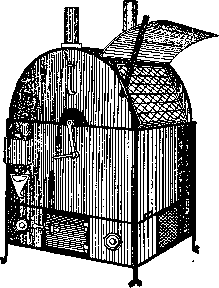
Figure 7. Stationary "Helios" apparatus
directed to the calorifier. The speed of air movement on average is 1.3 m per second. Duration of the entire session 40-45 min. Installations built on the principle of Vondran exist in Moscow at some railway stations, and in Leningrad at one of the tram depots and at flophouses.
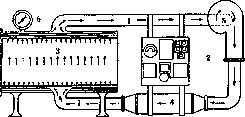
Figure 8. Vondran's disinfection chamber for rapidly flowing hot air (diagram): 1-channels supplying hot air; 2-distribution board; 3-chamber for placing objects of disinsection; 4-system of grate batteries; 5-fan with electric motor; f-spring thermometer.
III. Gas D. k. The active agent in these chambers are chemical substances used in gaseous state. Of such substances, formaldehyde and sulfur gas are most widely used, and in recent years carbon disulfide, hydrogen cyanide, chloropicrin, etc. have also begun to be used. Gas D. k. are used mainly for disinsection purposes, as their bactericidal properties are unreliable, and only formalin chambers are intended for disinfection. Formalin chambers serve for disinfection of items that cannot withstand high temperatures (leather, fur, paintings, etc.). Disinfection is carried out at a temperature of 20-30°. Duration of disinfection 10-24 hours. Dose: 20-40 g of formaldehyde per 1 m3. Chambers of various sizes are built from a double row of boards, brick, concrete, etc. In
the chambers there must be devices for spacious placement of items (shelves, hangers, hooks, etc.). The apparatus for developing and supplying formaldehyde vapors to the chamber is located outside. It is necessary to provide inlet and exhaust ventilation openings, as well as an air mixer. -Sulfur chambers are intended for disinsection by means of sulfur gas, obtained by burning sulfur in a special furnace installed next to the chamber and supplying the gas through a pipe, or by burning in the chamber itself sheets of paper impregnated with molten sulfur ("sernichki"). Dose: 80-100 g of sulfur per 1 m3. Duration of disinsection 10-12 hours. Moistening of the air during processing of soft items is not allowed. Practical application is very limited due to the harmful effect on the coloring of colored fabrics and on their strength. The walls of the chambers can be wooden, stone, etc. -Cyanide, carbon disulfide and chloropicrin chambers must be arranged in separate premises, ensuring at the same time the complete tightness of the chamber space. The high toxicity of hydrogen cyanide vapor, the sharp, irritating properties of chloropicrin on mucous membranes, and the easy flammability of carbon disulfide do not allow their wide use in ordinary disinfection practice. A valuable property of these gases is the absence of their harmful effect on the strength of fabrics and on their coloring. IV. Steam - formalin D. k. were introduced into disinfection practice during the war of 1904-05 by Japanese doctors and are therefore called "Japanese" disinfection chambers. The disinfecting action in these chambers is determined by the simultaneous influence of five factors: temperature, humidity, formalin, time of exposure of these agents, and finally the vortex movements formed when high-pressure steam (4-6 atmospheres) is admitted into the chamber. Vortex movements contribute not only to the uniform distribution of heat, humidity and formalin among the objects, but also to better penetration of heat and chemical agents into the depth. The purpose of Japanese D. k. is rapid and mass disinfection and disinsection of the most diverse items, including those that cannot withstand high temperatures. A chamber of 30 m3 allows processing 400-500 sets in a working day. Japanese D. k. are built of wood, brick and concrete (see figure 9), and inside are lined with linoleum or covered with oil paint. The shape of D. k. is quadrangular. Dimensions - depending on the need; average capacity of a stationary D. k. -30 m3, of a mobile D. k. -4-5 m3. The equipment of Japanese D. k. consists of: 1) coils or batteries on the floor for preliminary heating of the chamber; 2) a metal (copper or galvanized iron) canopy at the ceiling to protect items from condensation water (from the ceiling); 3) lower and upper inlet and exhaust ventilation openings; 4) a drain trap for water; 5) thermometers at different levels; 6) removable wooden grates covering the coils; 7) shelves, crossbars and hangers for placing items; 8) nozzles and reservoirs for
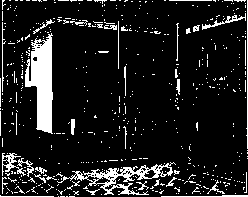
Figure 9. General view and external equipment of a concrete steam-formalin disinfection chamber of Japanese type: a-steam main; b-tube for admitting steam; c-nozzles; d-exhaust ventilation pipe; e-steam promoter; f-exhauster; g-vessels for formalin; h-door to the clean compartment of the room; i-inlet ventilation openings.
formalin; 9) two steam tubes for admitting steam into the chamber: one above the canopy, and the other at the bottom to equalize the temperature; 10) two doors opening to the infectious and clean halves of the room. -The scheme and sequence of work in Japanese disinfection chambers is as follows: 1) loading of items; 2) heating the chamber with coils to 35-40°; 3) direct admission of steam into the chamber with the lower exhaust opening open; 4) upon reaching a temperature of 58-62°, steam admission is stopped and the exhaust opening is closed; 5) introduction of formalin through the nozzle from
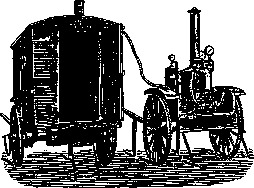
Figure 10. Mobile steam-formalin "Japanese" disinfection chamber of Baltvod type, model 1925, with a steam generator.
calculation of 20-25 g of formaldehyde per 1 m3 of space; 6) disinfection period of 20-30 minutes; 7) neutralization using NH3; 8) ventilation of the chamber for 10-20 minutes and draining of condensation water into the trap; 9) unloading. All these procedures take 45 minutes to 1 hour. In addition to stationary ones, there are also mobile Japanese disinfection chambers of several types: Baltvod model 1925 (see Figure 10); former Union of Cities; 'Gnome', Commission of the VSU RKKA model 1928. Most of these D. k. are served by a vapor generator of the Prokhorov-Sterling type. At present, the NKZdr. RSFSR has developed detailed types and designs of Japanese chambers, which can be constructed from local materials by local forces and thus are now most accessible for equipping our cities and other populated places with disinfection installations.
Related articles
Mentioned in
Cite this page
“Disinfection Chambers.” Soviet Medical Encyclopedia. English translation of Bolshaya Meditsinskaya Entsiklopediya, 1st ed. (Moscow, 1928–1936), ed. N. A. Semashko. https://sovietmedicalencyclopedia.pages.dev/article/disinfection-chambers/